Prologue
Junior hurries down the hill from the convent towards the railway yard. It is becoming cold and dew is forming on the ground. There will be a frost in the morning. It is dark already and not yet six o’clock. Mum will have something nice for tea although Junior is not all that fond of food. The fire in the stove though will be nice and after tea sitting around the stove in warm pyjamas with the oven open is best.
Junior decides to take the short cut across the railway marshalling yard at the bottom of the shallow valley and head straight up Atkinson Street to home. Mum and Dad had often warned of the danger in doing this – you might trip on the track; the shunters come all the way up there – but they hadn’t said not to. The air is thickening with coal smoke hanging on the moisture, not just from the shunting engines putting the coal trains together, but also from the stoves and fireplaces of the homes. For Collie is mostly a coal-mining town. The smoke has a delicious smell – warm and friendly, always part of Collie. Mum doesn’t like it – she says it is a dirty smell. Only chopped wood is used in Junior’s Forest Department home.
Negotiating across the dozen or so tracks is not difficult. Sleepers had been laid between the rails to form a walk way although the sign at both ends said entry is forbidden. Emerging in Throssell Street on the southern side of the yard, Junior peers through the darkness to see if any of the soldiers from the camp are assembled waiting to go into town. They sometimes carried a few spare buttons and colour patches to give to pestering kids, but it is too late in the afternoon and maybe the wrong day. It is wartime and a jungle training camp had been created in the heavy temperate rain forest a few miles out of Collie off the Bunbury road. He’d better hurry home. Mum gets cross if he is late home from music lessons. Anyhow, Pixie will be waiting for him at home. Mum won’t let Pixie follow him to the convent even when he rode his bike in the summer months. Once he called in to his cobber Geoff Fogarty’s home not far from the convent. It was summer then and the twilight was long, especially with daylight saving. Arriving home at seven o’clock after Mrs Fogarty pushed him out made Mum quite angry. Mum often gets angry but at other times is good fun.
War is exciting but it makes some people sad. There are a lot of fathers and older brothers away at the war. Sometimes at school a boy or girl would be away for a day or two because dad or older brother had been listed missing. Families hold together when these things happen. Junior has no brothers or sisters and Dad is home every night and the office where he works is only a few steps away from the back door. Junior sometimes wonders why Dad was at home and not at the War although there are quite a few dads at home. Robert Phillips’s dad is an engine driver and he didn’t go to war neither did Mr Withall, a guard on the trains. Mum says Dad is manpowered and Junior doesn’t quite know what that is.
Introduction
Junior came into his world on the 2nd day of July 1934. Born in Perth’s Mount Hospital to Mabel Madeline Skitch in her twenty seventh year he soon after went to live with his mother and Forestry father, Robert Mason Skitch at Collie in the south west of Western Australia. He was and remained an “only child”. He enjoyed ten and one half years in Collie, the latter five of which were the “war years” of 1939 to 1945, the Second World War. Tragic as they were for many, for a small boy they were great fun.
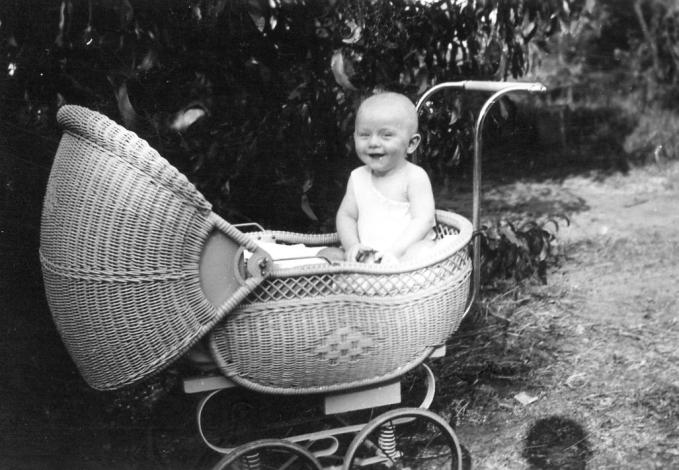
And why “Junior”? It was a popular notion during the 1930s to bestow “Junior” as a family name on a boy child bearing the same name as his father – very American and no doubt popularised through American “talkies” of that era. Hence Robert Francis Skitch, son of Robert Mason Skitch, became “Junior”. Junior accepted the name readily enough and so did his friends. Even at school he was “Junior Skitch” entered as such on the class roll books. It was only in later years as a young teen-ager that the name became an embarrassment. His friend Robert Phillips was known at home as “Chummy” and to Junior that sounded worse.
The family
Although an “only child” sometimes there was mention of a sister no longer there and even the name Elizabeth. Mum had told Junior he was born caesarean and Junior had even seen the long scar from belly button to pube on Mum’s tummy from whence he had entered the world. Junior had a faint scar on his right shoulder blade, apparently the result of that difficult birth. Junior once confided to Mum that it would be nice to have a big sister like Joyce Hough who lived across the road and Mum got upset and cross. Junior was perplexed and never raised that again. Mum was said to be frail, only five foot two in height and six stone in weight. Because Dad’s Forestry office was so close, Dad would pop over to light the stove about four in the afternoon while Mum was resting. Of course he set it going in the morning also before breakfast and kept a box of finely chopped “morning’s wood” next to the stove.
Junior’s Mum was a competent dressmaker and her pride and joy was a cabinet model treadle action Singer sewing machine, known simply as “the machine”. Junior’s pants were mostly made from the leg material of his Dad’s worn trousers and his Mum made all her own clothes. On one occasion, having completed a new costume comprising skirt and close fitting waist length jacket in a soft blue woollen material, Mum asked Junior what he thought. Junior, then at the age of seven or eight, replied “it makes your tits look big” – not the reply she sought and her reaction was one of horror, little short of requiring the hapless Junior to wash his mouth out with soap.
The home
Junior’s home on the Forestry land at the western end of Wittenoon Street was modest but comfortable and very clean, Junior’s Mum being responsible for ensuring that second quality. While his Dad contributed to home life – he provided the wood supply, did the weekly wash, lit the stove daily and many other chores, it was house-proud Mum who maintained a spotless house that was tastefully furnished and that Junior was well dressed and shod.
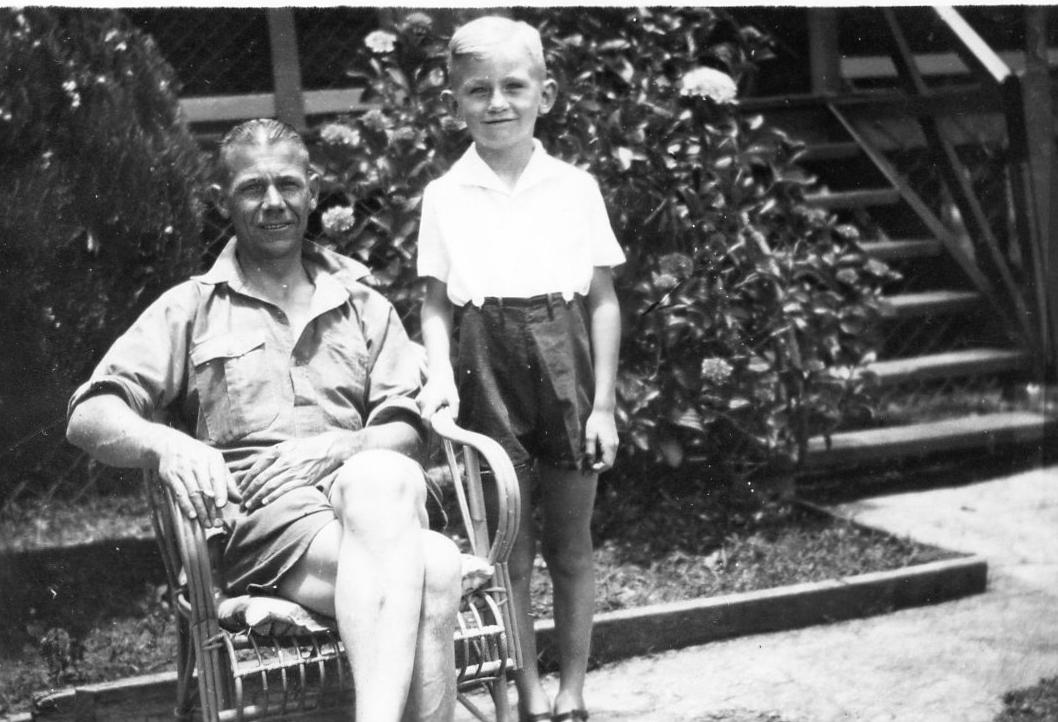
The house itself was of simple design. It faced north across the east-west running Wittenoon Street. The wide front veranda with waist-high wooden rail ran the full width of the house. Entering the front door into a short passage, the main bedroom was to the left and the lounge room to the right. The passage opened through a bead curtain into the dining room and to the immediate left was the second bedroom, Junior’s bedroom, also used for storage. A door from the dining room entered the kitchen, which was the centre section of an enclosed back veranda with the bathroom at the left end and the laundry (washhouse) at the right. The back door led from the washhouse into an open trellised area covered with grape vines, the full width of the house. The house sat at ground level at the back and was five or six feet above the ground at the front with a broad flight of wooden steps central to the veranda. Like all Forestry houses, the rough sawn weatherboards were unpainted, not even oiled. The corrugated iron roof was, however, painted red. A 1000 gallon rainwater tank on a tank stand stood at the rear left corner of the house with a single tap into the bathroom. Junior knew every inch of that house. It seemed so permanent and everything in it – all the furniture whether bought or makeshift – was meant to be there and would always be there.
The main bedroom was furnished with a good quality suite of a grey-green stain, popular at the time with a full length oval mirror. The suite was more expensive than one might have expected. The lounge room was carpeted with a carpet square and contained a lounge suite comprising a three-seater lounge and two chairs upholstered in an autumn toned velvet. The piano, purchased for Junior’s piano lessons, was in the lounge room. Also there was an open fireplace that backed onto the fireplace in the dining room, both emitting to a common chimney. The lounge room fire was never lit but the fireplace in the dining room, more a sitting room, was used frequently throughout the cold winter months. The dining table and six upholstered chairs were rarely used but an older and somewhat sagging lounge against the western wall under the window was frequently used since it was next to the console wireless. The old lounge was the only piece of furniture in the house that Junior could pull his feet up on without being in trouble. Even Pixie the Kelpie dog sometimes curled up on it. The end of the lounge next to the wireless was Dad’s place and the springs at that end had just about given up and sagged lower than the rest of the lounge. In wartime listening to the news was very important.
It was the kitchen that was the centre of all domestic activity – cooking, ironing, meals off the lino- covered kitchen table, for Junior in his younger years, bathing in the tub and sitting around the stove during winter with the oven open in the evening. Since the kitchen was an enclosed back veranda, it was quite narrow. Also in the kitchen was the “box”. The “box” seemed to have no particular purpose. It sat open end down and the top was also lino- covered. Perhaps it was to stand upon to reach the canister shelf on the wall above it. On that shelf sat the kitchen clock, maintained always five minutes fast. The clock was religiously wound every night before being taken to the bedroom with alarm set for six o’clock.
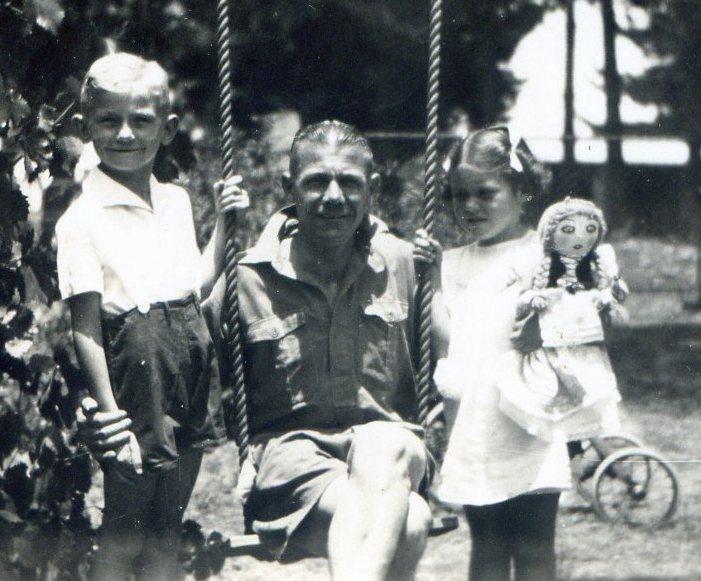
The bathroom had a grey concrete bath the bottom of which was stony rough. Junior soon learnt that sliding on his bottom in the bath could be very uncomfortable. Hot baths required the boiling of the copper in the washhouse and transporting the hot water in a bucket through the kitchen to the bathroom. Hence baths of that nature were a once a week effort with the same bathwater serving all three members of the family – Junior, Mum, Dad, in that order.
Although the summers were hot there was no refrigerator. The means of keeping food cool was the Coolgardie safe located in the washhouse. This consisted of a hessian covered safe on top of which was a galvanised tray of water. Pieces of flannel draped over the edge of the water tray onto the top of each hessian covered side allowed water from the tray to soak down onto the hessian keeping the sides of the safe constantly wet. Evaporation kept the contents of the safe cool. A further galvanised metal tray under the safe caught any excess water. Junior’s Dad had had made the Coolgardie safe and it probably replaced an earlier model. Summers in Collie could be as hot as the winters were cold. Cool drinking water was provided from a water bag hanging just outside the back door.
In the far corner of the back yard was the lavatory. The pan was removed weekly by the “lavatory-man” who took it away to the council sanitary depot on his horse drawn cart.
The front gate was on the eastern side of the front fence and just inside was a large flourishing peppermint tree under which Dad parked his departmental heavy red bike. A row of dusty pencil pines grew along the front fence – dusty because Wittenoon Street at that end was not sealed. Other notable features (notable to Junior at least) in the yard were a large tree stump that served as a sort of workbench in the back yard, the woodheap next to the stump and behind that, a fig tree that produced bright green figs with very red pulp. They peeled easily and were nice to eat. Mum often made fig jam from these. At the back gate was a tree Mum called a lilac tree. It certainly had lilac coloured flowers on it in the spring. On a bough of that tree hung Junior’s first swing to be replaced later by a big swing hanging from a constructed wooden frame consisting of two upright poles and a sturdy wooden crossbar, built for the purpose sometime in the past. Dad would push Junior on the swing until he learnt to swing himself, which he frequently did.
A garden
Junior’s Dad was no gardener. The ground was rocky and gravely, the bed-rock called “ironstone” being only a few inches below the surface. At one time a vegetable garden was created in the back yard, it taking days for Dad to hack out the plot and scrape into it enough soil. It was moderately successful and yielded a few vegetables every year. On another occasion on returning home with his Mum from the annual trip to Perth, Junior was surprised to find a patch of lawn planted in front of the house. Generally the yard was tidy but the grass was allowed to grow long and was brown in the hot summer. A row of fruit trees – two varieties of peaches and two of nectarines grew along the eastern side boundary. Surprisingly these were strong growers and bore luscious fruit. If Junior was not addicted to food in general, he certainly enjoyed the fruit.
The daily routine
The daily routine in Junior’s household started with Dad getting up to the alarm in the morning about six o’clock or a little later and lighting the fire in the stove. He would then come into Junior’s bedroom to change into his working clothes for the day; in summer, khaki shorts and shirt and cross-strapped sandals for footwear; in winter, brown gabardine trousers, business shirt, usually without tie, pullover and sports jacket, favouring a donegal tweed belted at the back. Junior often watched this operation through one opened eye. Dad had an athletic body, well muscled and tanned.
Junior’s power of observation was sometimes at fault. Having glimpses of his Dad’s penis from time to time he became convinced Dad had two, one shorter than the other and when discussing such matters with cousin Ken at Fremantle during a visit, tried to convince him of that fact. Dad, on his journey from the bedroom to the kitchen, tended to somewhat explosively pass the wind he had accumulated overnight. Junior found that quite impressive and apprised cousin Ken of that also. Both of these pieces of information were given in the context of “my Dad’s better than your Dad”. Junior may have won that argument.
The object was to not disturb Mum who slept on for another hour. Soon after Junior would emerge, clutching one of the cuddle toys, teddy or the red and blue felt dog made by Mum in numbers. Doll Polly, not one of the extravagantly dressed dolls made by Mum but another acquired from goodness knows where, was another favourite. At seven o’clock the wireless was turned on for the ABC news – overnight news of the War – followed by Don Juan’s exercise programme. Sometimes Junior tried to follow these but exercise was not a great interest. Mum came out at breakfast. Dad often had a cooked breakfast but Junior was strictly Weeties or when purchased, Corn Flakes and milk. Milk was always boiled, not surprisingly since it was delivered in the afternoon into the milk billy can, hanging on a fence post at the front. The TB scare in cows had emerged at that time and “pasteurising” was still a long way off. Boiled milk produced cream that supplemented the meagre wartime butter ration.
Mum would come out to the kitchen about this time and Dad would leave for the short walk to work at eight o’clock. Mum supervised Junior’s despatch for the long walk to school, which started at 9 o’clock. Working so close to home, Dad would have lunch with Mum on most days other than when he was in the bush. Mum was always home to greet Junior on his return from school at about half past three. Then on some days from about the age of eight there were music lessons at the Convent and on most other days, visits to cobber’s homes. Mum rested in the afternoon and prepared the evening meal. After tea at night Junior would do any set homework from school that for a long while included practising writing with his right hand since Junior was naturally left handed. Listening to the news was important, as was reading the “West Australian” newspaper that was delivered in the late afternoon, the Collie Mail once a week and the “Broadcaster” containing the wireless programmes.
The ‘Wireless’
Within the home the main outside source of entertainment came from the “wireless”. Junior’s family had a good quality console wireless with a complicated dial showing all the Perth wireless stations backlit by a fascinating green light. Collie had no wireless station of its own and reception from the Perth stations was often a bit staticy. A long wire aerial looped from a tall spindly mast in the back yard fed through a corner of the window and into the wireless. Perth wireless stations were all prefixed with the figure “6”. There was 6IX, 6PR, 6WF and 6WN. 6WA was the ABC station and it as very important because only on that station could you get the BBC war news re-transmitted shortwave from London. The often thready reception had an unforgettable solemn ring to it – “This is London calling” and often “London was bombed last night….” Of course there were many lighter programmes that were always listened to such as “The Australian Amateur Hour” compared by Dick Fair and later by Terry Dear and the “Lux Radio Play”, an hour long drama. Mum was allowed to have Dad’s end of the couch for the Lux Radio Play with its commercial “Nine out of ten Hollywood film stars use Lux beauty soap”. Junior would wonder “how do they know that?” The wireless was an important component in most households and if in Collie the reception was often a little scratchy it was nevertheless listened to very carefully, especially the war news. The war was all consuming.
The environs
It was Forestry land and just outside the side boundaries, both eastern and western, were two rows of very mature pine trees. On the western side a gravel track ran up to the Forestry works yard, the horse stables, blacksmith shop and sundry other buildings and garages for Forestry trucks. Over the fence on the eastern side was a small single bedroom cottage that Mum and Dad had lived in for a short time before Junior was born and beyond that the Forest Department office on the corner of Wittenoon and Atkinson streets. Behind the cottage was “The Shed”, a somewhat dilapidated structure of vertical wooden slats, unpainted, and with a curved galvanised iron roof. “The Shed” had a locked door to which Dad had a key. From time to time Dad and Mum would access “The Shed” which seemed to be full of collectables, boxes of important papers (in which Dad had to locate a particular sheet) and also newspapers going back to the thirties that Mum liked to peruse. “The Shed” had a smell of its own, not unpleasant, that lingered in the nostrils for some time after.
Forestry
Junior always felt part of the local forestry scene. After all, the western end of Wittenoon Street, on the southern side, was very much a Forestry enclave. It was Forestry land with Forestry houses. The Moores, the Loxtons, the Smiths and others all worked for the Department. The vehicular track on the western side of his home led into the Forestry works yard where vehicles were stored and serviced, where the draught horses were stabled, where the big old spring carts were housed and where the blacksmith’s shop was located.
The blacksmith’s shop was a special fascination for Junior. Mr Prosser was the Forestry blacksmith. He wore a heavy leather apron, black with use contrasting with his thick white hair. To Junior Mr Prosser seemed quite old, much older than his Dad – and he probably was. He had a kindly nature and made Junior welcome. In winter the old earth-floored corrugated iron blacksmith’s shop was warm and had the cosy smell of burning charcoal and steam from the cooling tub. Perhaps it was primitive but that didn’t concern Junior. Central at the back of the shop was the forge with its hand-operated blower. A few turns of the handle would have the coals in the forge glowing white-hot. Next to the forge was the all-important anvil fastened to a heavy jarrah stump sitting firmly on the blackened earth floor. On this anvil Mr Prosser with a heavy hammer beat the white hot pieces of steel from the forge into rare and wonderful shapes, at critical moments plunging the still glowing object into a half 44 gallon drum of water, not only to cool the metal but also to achieve the right temper. Racks against the walls held lengths of steel bars of all shapes and sizes. Other racks contained rows of horseshoes and other shaped pieces of steel – angles, spirals – bent and hammered into shapes for some purpose or other beyond Junior’s understanding. Some days Mr Prosser actually fitted horseshoes to the hooves of the draught horses from the stable opposite.
Junior looks in dismay at the twisted shape of his scooter. It is his means of transport and he had well mastered it since his birthday some months before. It is orange and green and had a brake on the back wheel. Mum had insisted that the more expensive model with the brake be bought. Now it lay there with a squashed back wheel and brake and a split platform. “Well sonny – you must be more careful where you leave your things. The bottom of this-ere car ramp is not such a good place” were the less than sympathetic words being directed at him from above. Junior sobbed “but I didn’t mean to Mister”. He drags the scooter through the back gate and home, not at all confident of the reception he would receive from Mum, or worse, Dad. Even Pixie seems subdued. However, loss of the scooter is seen as punishment enough for an act of carelessness. The busted scooter disappeared both materially and in Junior’s mind – it was gone and any lingering regret soon dissipated. Visiting Mr Prosser’s blacksmith shop a week or two later Mr Prosser said by way of greeting – “where’s that scooter I used to see you on Junior?” “It got busted Mr Prosser!” “Did it now – well look over there in the corner – is that your scooter?” There it was – all straightened up with a new wooden platform, bearing a few scars but a goer! “Gee, thanks Mr Prosser”.
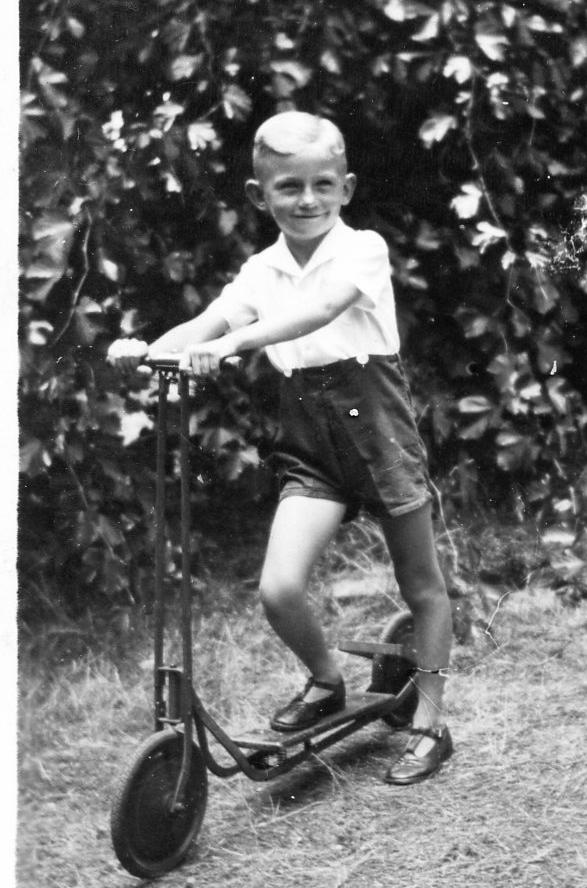
Sometimes in the evening before tea Dad would go over to the stable to feed the horses. Junior was unaware of what occasioned that event, it only happened sometimes. Junior enjoyed being part of that – pulling the chaff from the big hoppers at the end of the stable into a bin and mixing it with a lashing of bran and then tipping the mix into the feeding troughs. By this time the draught horses would have nosed their way into the stable from the paddock behind and be gently snorting and neighing in anticipation. They were gentle creatures – gentle giants to Junior. He was not afraid of them but was cautious in case they might step on him.
The horse paddock behind the stables and across the pine tree lined track on the western side of Junior’s home had a concrete horse trough against the near fence. A large tap at one end of the trough kept it full of water.
Then at an early age……Junior starts to panic. The tap is gushing water at a furious rate into the trough and already it was overfull, with water tumbling over the sides and onto the ground. The tap won’t turn off – it seems to be stuck and he had only turned it on a bit and then tried to turn it off. It is running faster than any tap at home. Should he call for Mum – she would be resting and in any case she had always said Junior was not to turn taps on! She would be cross. Then maybe he should get one of the Forestry workers to come to his aid – he wouldn’t have to admit to turning it on. He could just say he found it turned on. Junior’s dilemma is resolved by Mrs Moore approaching down the track intent on visiting Mum. Frail though the lady seems to be she comes to his aid with a slight reproach and turns the tap off. The incident is raised at tea that night and Junior wonders at the powers of his parents to know what he had done when they were not present. He is warned not to go to the trough again – but it is the best place for sailing toy boats.
Junior has a toy boat but it isn’t all that good. Mrs Smith’s boy has a toy boat too and it is better. Junior looks enviously the other boat sailing effortlessly around the surface of the horse trough with only the slightest push and making its own little bow wave. He knows he wants that boat and decides to offer a swap for a shiny clockwork aeroplane. The aeroplane didn’t fly but the propeller would turn and the key had not been lost. Mrs Smith’s boy readily agrees to the swap and the deal is done. But later that day Junior realises what a poor deal he has done. The aeroplane was much better than the boat, which is little more than a tin shell; rusty at that! He wants to swap back but Mrs Smith’s boy is more than happy with his side of the deal. Parental intervention finally occurs – perhaps the story was put that it was only meant to be a “loan swap”. The outcome is both articles are returned to their original owners. “Swappers are keepers”, Mrs Smith says to Junior the next time she saw him and Junior feels appropriately abashed. There isn’t much fun in sailing boats in the horse trough after that and Junior finds he had lost a friend as well.
The horse paddock had its attractions. It was well covered with dandelions in the early spring and Mum in taking him for little walks in the paddock showed a much younger pre-school Junior how to make daisy-chains from the dandelion flowers. Junior in later years was fascinated to find lots of shells, like sea-shells in the paddock and wondered how they got there. On asking one of the old forestry workers one day he was told “well a long long time ago all the land was under the sea”. Food for thought but it must have been a long time ago. Junior was suitably impressed and passed this bit of fiction onto his cobbers.
Communications
In Junior’s experience telephones in a home were a rarity, certainly during the war years. The Houghs across the road may have had one, perhaps in Mr Hough’s office, but that was all. However, the Skitch family had a telephone mounted on the wall just inside and opposite the back door. It was a Forestry Department telephone on a “party line connected to all the Forestry staff within the area. The telephone was large, in a cabinet, about two feet in length with two large bells at the top and two large single cell batteries in an enclosed compartment at the bottom. Between the bells and the battery compartment was a small sloping platform on which to write. The platform usually had a few sheets of paper clipped to it and a pencil on a string. On the right hand side was the ringing handle. Each telephone on the party line had a code and the Skitch’s code was two long rings and one short ring. Hence if the telephone rang two longs and a short a Skitch would pick up the receiver and say “Hello” into the mouth piece sticking out from the front of the cabinet above the writing platform. Of course all the Skitches, even Junior quickly learned the code of all the users connected to the party line and one could easily listen in to someone else’s conversation. Did that happen? Of course it did and lots of gossip emanated from the party line telephone including an illicit romance that became the talk of the town. Junior’s Dad spent considerable time on the telephone apparently organising things, particularly during the bush fire season. This could be at any hour of the day or night. He filled the role of coordinator in the Forestry complex.
Wood gathering
Maintaining a supply of wood for the kitchen stove and in the winter the fireplace gave rise to a twice a year event. That entailed Dad harnessing a horse into one of the big spring carts and with axes, wedges, sledgehammer and crosscut saw, head out into the bush for a day. Since Saturday morning was a work morning, wood cutting day was a Sunday. Mum cut sandwiches and prepared bottles of cordial and most times rode with Junior in the back of the cart. While Dad toiled, sawing a selected fallen log into convenient lengths and splitting it into a number of pieces and loading these onto the spring cart, Mum would pick bunches of wild flowers – boronia, blue leschenaultia, kangaroo paws and sometimes Junior would find a few spider orchids. At the age of about four this had led to Junior’s second broken arm. Climbing the butt end of an old fallen tree he slipped and fell. This curtailed the wood- gathering activity and a rapid return home ensued. Dr Smith was called and Junior taken to his surgery by Mr Moore in his car to undergo his first recalled experience with chloroform. On awakening he found his arm encased in a white and somewhat heavy plaster. Mum said it was Junior’s second broken arm but Junior could not remember the first. Some weeks later Dr Smith removed the rather less-white plaster.
Photography
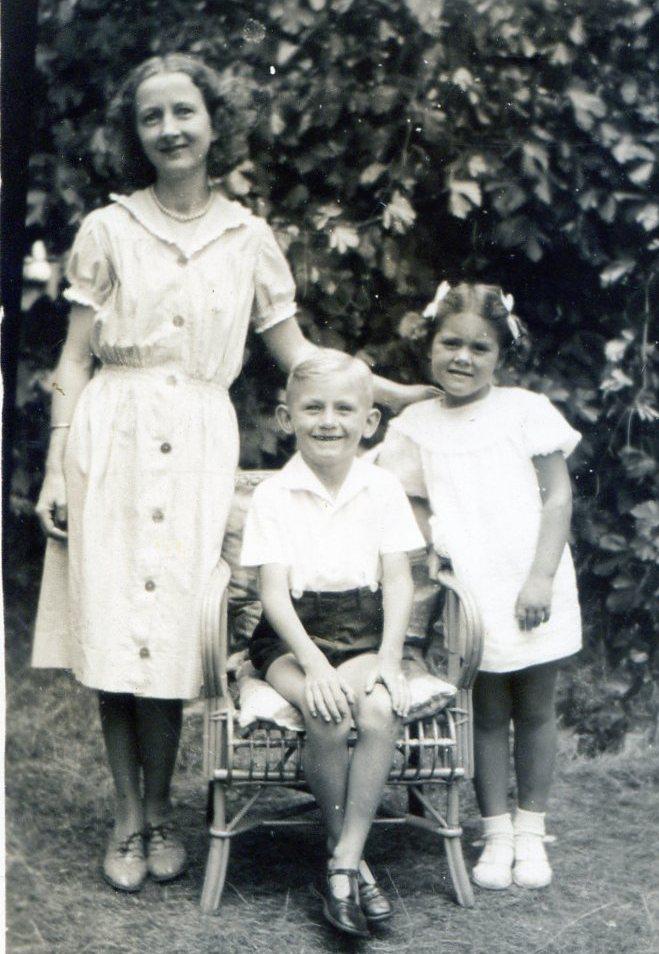
Junior’s family did not own a camera but occasionally Junior’s dad borrowed a camera from the Forestry office and having purchased a roll of film from Mr Avenell the chemist the eight shots on the film roll would be taken over a weekend. There was only one subject and that was Junior. Such occasions were infrequent, perhaps once a year. Film was expensive both to purchase and then to process and have prints taken off. Photos were never taken of Pix, the dog nor of Junior’s cobbers other than Elizabeth Withell. The Forestry camera was large with bellows that sprang out when the opening mechanism was pressed. To Junior it seemed very complicated with little bit sticking out all over it. After the war started film became very hard to get and even more expensive and these occasional photo shoots came to an end, probably in about 1941. The few photos in this account depict Junior only up to the age of about seven. In the background can be seen some of Junior’s home, the tank stand, the swing, the grape vines, the front veranda.
Cobbers
At age eight years, Collie was very much Junior’s place. Mum had long given up being overly protective and there weren’t many places he hadn’t played in or gone to with various cobbers. Socially Junior revolved around three groups of cobbers. One enduring friend was Robert Phillips who lived on the corner of Wittenoon Street and Marsh Road. Robert was a year younger than Junior and usually fell into line with Junior’s bidding. The Phillip’s had a large wood-heap of sawn wooden blocks that were capable of being moulded into all sorts of things, aeroplanes, ships, tanks. However, aeroplanes were the favourite and the best was the Lincoln Bomber that flew daily missions over Germany. Junior was the pilot mostly and Robert the bomb aimer and gunner and was usually killed leaving Junior to heroically bring the limping aircraft back to base. Sometimes Robert was allowed to have a go at being the pilot. Robert’s wood-heap was better than Junior’s. Junior’s was of split logs from the bush that were charcoally and full of splinters. Robert may have been the oldest of the Phillips family. He had a younger brother and two or three quite young sisters. Robert’s father was a railway engine driver and for that reason did not get called up for war service. He and maybe Mrs Phillips may have been English. Robert was always called by them “Chum” or even “Chummy” although to Junior Robert was “Robert”. Junior’s mum and Mrs Phillips were only on “nodding” terms for no particular reason.
If not Junior’s favourite friend and in no way adventurous, Robert Phillips was at least compliant and fell into Junior’s wishes. Junior became fascinated with Morse code and taught himself the full alphabetical code. Robert Phillips at Junior’s urging also learnt the code and they tested each other. It was Junior’s Dad, who seemed to be familiar with the code, probably it had some application in Forestry, who said the verbal version of the code’s dots and dashes was “dit” for a dot and “dah” for a dash. Junior conveyed that important piece of intelligence to Robert and they ditted and dahed each other messages of a military significance. Junior rapidly became dissatisfied with that means of communication and made a pair of rudimentary Morse code devices out of string, nails and elastic bands mounted on a flat piece of wood. Clicking two nails together against the wooden base made a different clack than clicking only one nail against the base. Somehow it worked and messages were flashed from one spot to another. Of course the sender and the receiver had to be no further apart than about twenty metres or the clicking and clacking couldn’t be heard.
Junior was allowed one comic book a week and he chose “Radio Fun” that had comic strips of all the favourite funny men of wireless broadcasting – mostly British. Robert Philips got “Film Fun” and after a week they swapped. The Sunday Times newspaper had the Bluey and Curley comic strip; the two Aussie soldiers undergoing the vicissitudes of war with good humour. Bluey and Curley were national icons and were read by all. For Junior and his cobbers it was Bluey and Curley who kept the abreast with the war.
At about the age of eight or nine Junior developed another circle of cobbers. Just how that happened Junior was never quite sure. The two principal friends were Geoff Fogarty and Billie Cook, especially Geoff Fogarty. That was a more exciting arrangement and led to long bike-rides to exciting spots. Geoff lived in Atkinson Street – North and was a few months older than Junior but in the same class at school. Geoff’s father was a miner and seemed to work mostly at night so noise at Geoff’s home, a “miner’s cottage” during the day was forbidden. Geoff’s mum was always good fun and seemed to like Junior. Geoff was a fair- headed boy and he and Junior could be mistaken for brothers. Billie Cook was a short stocky boy with red hair and always wore blue serge pants. He was often kept at home at the whim of his parents who were English. He lived not far from Geoff in a corner house that was big and overgrown with trees and shrubbery. The cobbers never played there but on one occasion Junior was invited inside. The house seemed dark and full of large furniture. Billie’s dad was listening to the BBC news heard short-wave on a rather spluttery wireless. The war was not good news and London was being bombed nightly.
Billie only occasionally was allowed to accompany Geoff and Junior on adventures and often after school the threesome would catch gilgies in the creek flowing from the Collie powerhouse next to the Co-op coal mine. It was full of gilgies and it wasn’t hard to get a pailful to take home. Junior’s Mum was pretty good about cooking them so long as they were fresh and still kicking. Into a pot of boiling water and instantly they stopped kicking and turned red and were cooked.
Adventures with Geoff Fogarty involved much more; usually a bike-ride to some predetermined destination. Geoff seemed to know the destinations. There was “Switzerland”, an old caved in mine somewhere north of Collie – a longish bike-ride along a gravelly track (all tracks and most roads around Collie were gravelly) – to a location hidden behind secondary growth gum trees. The sides of the slope falling abruptly to the old shaft still visible at either end of the cavernous pit were of whitish grey clay. At the bottom of the caved-in pit was an elongated pool of inky black water. Sheets of flattened corrugated iron lay around the top of the slopes, rusting and part covered in fallen leaves. Some sheets had been bent up at one end to form a rudimentary toboggan with wire or old rope reins attached to the upright leading corners. The dare was to ride a toboggan down the slope – quite slippery after rain – and come to a skidded halt at the edge of the inky water. On any afternoon there were a few game ones testing their skill on the slopes of Switzerland. Geoff took it on coming perilously close to launching into the water. Junior watched, not really wanting to risk it but finally responding to the taunts of the kids he barely knew. He was pleased enough to fall off a short distance from the start. The experience gave him nightmares for a while after.
Sometimes Geoff and Junior would ride out to a secluded creek and arriving hot and dusty skinny-dip in the chilly clear pools of the creek, cavorting around the bush in their altogether like naked Indians. Too close to a road on one occasion Junior erroneously identified a passing car, as that of the Mr Moore, the District Forest Officer and Dad’s boss, and quickly became convinced they had been seen. For days after Junior lived in fear of Mr Moore informing on him to Dad, or worse, the police.
Down one side of Geoffrey’s house the soil was soft and friable – excellent for building things. It had a slightly clayey content and if a little moist it could be moulded like plasticine. Geoff and Junior set out to develop a miniature coal mine with gantries made from sticks of wood and tunnels driven to the length of their arms, railway tracks and roads. Geoff for whatever reason (perhaps he wanted his mum to be involved in the project) asked his mum to draw up some notices like “keep out”, “danger”, “no entry” and the like. She did so. Junior thought they were a little large and flimsy but they were duly put in place and saw out the duration of the project, maybe two or three weeks.
Picking armfuls of sweet-smelling Boronia in the clear-water swamps in the winter and selling handfuls for a penny or threepence at the Collie railway station to arriving or departing travellers was a more remunerative activity although rarely making more than a shilling.
Junior’s third circle of cobbers was a little older and tolerated Junior tagging along so long as he did not get in the way. They were Bob Hough and Bob Loxton, the latter being considerably older. Bob Hough lived opposite Junior in Wittenoon Street. His dad was Dick Hough, secretary of the Colliefields Roads Board and a man of some influence in the running of Collie. Bob’s mother Margery was Junior’s Mum’s best friend. Junior thought Bob’s older sister Joyce was a good sport also. Bob Loxton lived across a small paddock at the back of Junior’s home also in a Forestry house fronting Atkinson Street. His dad was a forester. Bob Loxton was close to school leaving age of fourteen years and wanted to be a miner and more than that a mine blacksmith. He was innovative and built a blacksmith forge in an old cow- bale at the top end of the small paddock at the back of Junior’s home. Junior would watch with interest at the goings on. Bob Loxton started to develop older friends once he started work and Bob Hough was dropped from the circle. Junior who still had access saw in this a conspiracy and conveyed to Bob Hough highly untruthful accounts of talk from the Loxton camp.
In a paddock next to the Griffin coal mine railway line the soil was soft and sandy, clean white sand only a few inches below the surface. Here Junior and cobbers, mostly Robert Phillips and some of the local kids built tunnels or at least that was the way they described them. Perhaps Geoff Fogarty took part in this activity also. A tunnel consisted of a trench dug to a depth of about four feet and three or four yards in length entering a circular “room” two or three yards in diameter. The trench would then be covered with pieces of old corrugated iron dragged from a rubbish dump some distance away, sometimes with supporting branches cut from nearby saplings, especially over the “room” and the lot covered with a few inches of sand leaving an entrance at the end of the trench. Once constructed, what to do with it? Mostly interest in the “tunnel” diminished once it was completed. It wasn’t much fun sitting or crouching in the damp and dark room. Once or twice an attempt was made to provide lighting with a candle or kerosene filled jar with a rope wick protruding through the lid but the interest in that soon petered out. The whole venture came to an end when someone’s horse walked on the roof of an abandoned tunnel causing it to collapse and somehow word got around that the police had been called in. Nothing more was heard but it was enough to discourage Junior and others from further tunnel building. Anyhow, it wasn’t all that much fun!
Junior and a few cobbers, one was Bob Hough and maybe a couple of his friends, were wandering out to the Collie rifle range through the sand-pits on the western side of the Griffen Mine railway line. Junior sees no particular purpose to their meanderings but it is fun being with the older boys. The rifle range seems deserted; it is little used, even by the Home Guard, despite the war. Sometimes a few old tramps might be shacked up in the dilapidated corrugated iron shelters at the back of the range, but not on this occasion. The cobbers poke around the stop-butts behind the target pits looking for bullets. There were always a few to be found and it was fun to heat these up in a tin can over a fire and extract the lead and pour it into shapes. The cobbers leave the range and walk on through the bush to the back of the Collie cemetery. A few war-graves are starting to appear, marked by a simple wooden cross carrying the details of the interred on an attached small brass plate. Interest soon lost they cross the Bunbury main road to the railway line. Even to Junior this is clearly a much more important railway line than the light track to the Griffen Mine. It is heavily ballasted in blue metal and the sleepers seem more substantial. The rails are shiny with heavy use. Walking along the sleepers is fun and for Junior big steps need to be taken. Interest in walking is sustained by choruses of “The Quartermaster’s Store”, the content of the “QM Store” are improvised in turn by the cobbers. Junior thinks of one or two but leaves it to the older boys. He is just happy to be there and part of it.
A friend beyond parallel for Junior was the blue clad Kelpie with the unlikely name of “Pixie”, or more often just “Pix”. There always was a dog in Junior’s home and in Junior’s recollection it always was a blue clad Kelpie, although he had seen pictures of his Mum nursing a small black Pomeranian. Before Pixie was Dookie and Dookie had to be put down for some reason. Pixie was a very attractive dog, blue/black shiny coat, a pure white breast from front legs to throat and a brown spot above each eye. Pixie went everywhere Junior went, galloping along after his bike, sometimes getting in the way with unfortunate consequences. Pixie would wait patiently outside the gate while Junior was visiting friends. Pixie, allowed in at night, joined the family in front of the open stove in the kitchen and had been known to sneak into Junior’s bed, or even be allowed in when Junior was confined to bed sick. Sometimes late at night Pixie was not a good dog. After being put out he would bark at the moon (so it was said) and eventually Dad would have to get up and bring him into the wash house where he would spend the night.
And a girl friend
Junior was not too impressed by girls but diagonally across Wittenoon Street lived Elizabeth Withall who was an approved playmate during the pre-school years. Together Junior and Elizabeth would walk to Mr McKeller’s kindergarten at the Methodist Church hall to be taught things by Miss McKeller. Then they walked home together. Junior would hear Mum refer to Mrs Withall as May although the mums always called each other to their faces as Mrs so and so and of course the husbands were always “Mister” to the wives. Junior stayed at Elizabeth’s house for a few days once when Mum had to go to Perth for medical reasons. On return and having crossed the street to collect Junior, she inquired of Junior’s wellbeing and Mrs Withall responded that he may have been a “little homesick. Junior wondered at that! What was “homesick”? He didn’t feel the least bit “sick”.
Mrs Withall aspired to a higher level of society and made it clear that being married to a railway guard was something of a handicap. Like Junior, Elizabeth was an only child. Mrs Withall was determined that Elizabeth should have curly hair and applied bottles of “Curlypet” to her head but to no avail. Poor Elizabeth had to have her head shaven in the belief that a new growth would turn out curly. But it didn’t. The Withall’s dog was called Whiskers. He seemed to be an old dog and no doubt he was because one day he died and was buried in the front garden. Junior knew this because he saw the gravesite with the name “Whiskers” routed into the crossbar of a cross. Elizabeth informed that Whiskers had gone to doggie heaven. The Withalls had a “vestibule”, as Mrs Withall called it, at the back of the house that was really a back veranda enclosed with fly-wire. That was where Elizabeth and Junior played. On one revealing occasion in Elizabeth’s cubby under the vestibule the game led to the exposing of their respective private parts to each other “you show me yours and I’ll show you mine” probably initiated by Junior. Junior’s Mum had told Junior that playing with his private parts would cause it to fall off. Junior was shocked to discover that poor Elizabeth had already lost hers!
Elizabeth as a friend persisted in a formal sense but not as a playmate. Geoff Fogarty had a slightly younger sister called Lorraine whom Junior secretly fell in love with. Occasionally Lorraine joined in an adventure but the relationship was always circumspect except perhaps in Junior’s imagination.
Pastimes
Apart from playing with cobbers Junior was never short of things to do on his own. The particular type of pine tree that surrounded the home had a very thick and lumpy bark that could be chipped off in quite large chunks. These were ideal for carving and since the shape of a boat was relatively easy to carve Junior carved many such boats. They were not large, no more than two to three inches in length. They didn’t float all that well – well, they floated but always turned over.
Morning cereal in the Skitch family mostly Weetbix or Weeties both of which always contained swap cards. Juniors favourites were aviators including of course aviatrix – Bert Hinkler, Amy Johnson, Charles Kingsford Smith and others. As war progressed war planes appeared in the series and aeroplane identification cards, especially enemy ones – German and Japanese. One could purchase albums for a few pence from the grocers in which to stick the cards and where you had more than one of a particular card the spare could be swapped with friends. Junior never managed to complete an album before the series changed to a different topic; clearly the Skitch family didn’t eat enough cereal and sometimes, especially in the winter, Dad made porridge with John Bull rolled oats. Mum would only have toast and marmalade the latter being made by Mum.
Making things from match boxes was an activity that could soak up a few hours. He set up a sort of work space under the high side of the house since Mum would not permit such untidy activities in his bedroom. Junior embarked on a major project to construct a battle ship from matches and Clag glue but the supply of match boxes was slow, no more than two or three a week, mainly as a result of his dad’s smoking habit and the project lapsed after a few months.
Through successive birthdays Junior acquired a fair collection of Meccano. It wasn’t true Meccano but Ezi-Bilt that was much the same. That filled in many winter hours and Junior wished he could have the real steam donkey engine to drive his many Meccano contraptions but that acquisition was not to occur until many years later, long after Collie had been left behind. Junior was a good reader and gravitated to books prescribed for ages several years above his own. R.M. Ballantine was a favourite author with books such as Masterman Ready. Then there was Captain W.E. Johns and the Biggles and Gimlet series, the latter being realistically set in the prevailing world war. Junior tried writing his own war stories but these rarely if ever saw completion.
Probably at about the age of ten he discovered maps and make-believe maps. He often saw his dad working on Forestry maps in the office with red and green inks but they didn’t seem to make much sense. Nevertheless they were fascinating and he wondered what all the colours meant.
Gings and trouble
Within the company of cobbers to not have a “ging” hanging out of one’s back pocket was evidence of being something of a sis. What is a ging? Perhaps in other societies a ging would have been called a “shanghai” or maybe a “sling shot”. It consisted of a “Y” cut from a strong sapling trimmed to an overall dimension of three to four inches in length and about two inches across the top of the Y. Attached to each arm of the Y by a thin leather lead is a 12 inch length of stretchy rubber, usually cut from an old bicycle tube, the two pieces joined at the opposite end with a leather thong. The weapon so made was used for firing small stones considerable distances with considerable force. Put the stone in the leather thong, stretch back on the rubbers six or eight inches, take aim through the open Y and let go and the stone would go hurtling through to a distance of up to 100 yards. And where did the materials to make a ging come from? The Y could be cut from a stout sapling, a eucalypt sapling was best and there were plenty of those around. Everyone who had a bike had discarded tubes, And the leather thong? It needed to be good soft leather so that you could grip and feel the stone held within. Junior found a solution to that need – the tongue from his Dad’s best shoes; after all, Dad didn’t wear them all that often. A quick cut with Mum’s carving knife and he had it. Some days later when Dad went to use those shoes; well, Junior couldn’t remember seeing his Dad ever quite so furious. How he avoided a strapping he could never understand. The slight smile on Mum’s face may have had something to do with it.
Gings could get you into trouble in more ways than one. A misfire could cause the stone to hit either prong of the Y along which the firer would have a finger extended, with considerable force causing great pain with loss of skin, bruising and blood. Junior, who as with most things wasn’t all that good at it, experienced that discomfort more than once. And what constituted an appropriate target? Birds, especially crows and black cockies although there is no record of one being hit. Other boys? Not such a good idea because return of fire could be damaging. But there was an incident that resulted in something of a victory for the cobbers, comprising surprisingly, Bob Hough and one or two others; a victory perhaps, but with dire consequences. The Smith kids who lived in the Forestry house facing Atkinson Street behind and to the left of Junior’s house were giving a lot of lip and out came the gings. From the protection of the Skitch air raid dugout the cobbers rained ging shots on their adversaries who retreated onto their semi-enclosed back veranda. Still the cobbers continued to send their ammunition over the fence and now onto the Smith back veranda until the appearance of Mr Smith who marched over to the fence behind which the gallant cobbers were huddled. In the sternest of tone he demanded that they hand over their gings and sheepishly the cobbers did so, retiring back to the Skitch home. Junior’s mum, perhaps being told only half the story seemed sympathetic to the fact that the cobbers had had their gings confiscated and promised that Junior’s dad would look into it. Bob Hough was quite distraught, being the oldest and now, realising the enormity of what he had been involved in, concerned that his father would find out. Mr Hough would be less than impressed and Bob felt he would cop it! Mum assured him that she would not pass on a single word about the incident – mum’s the word. Junior’s dad after work somewhat reluctantly walked over to the Smith’s back door – to get the gings? Maybe. More likely he apologised for the incident. He returned without the gings. A week or two later Mr Smith seeing Junior playing in the back yard called him over to the fence and with a few words returned the handful of gings. All forgiven. Mr Hough never heard a word about it all and Bob survived.
The Saturday afternoon matinee
Junior’s picture going was mostly confined to the Saturday afternoon matinee in Collie’s only picture theatre, the Royal in Forrest Street. The programme was designed for children and attempted to cater for all ages. Cartoons were a favourite item, Disney cartoons and others, Popeye the Sailorman and Olive, Tom and Jerry. A war newsreel often followed and a short war feature such as code breaking, often above the heads of the young audience. Then there was the serial, mostly Cowboys and Indians but others of a gangster crime nature such as “The Green Hornet”. If the current episode had failed to arrive the Royal management would re-run last weeks and if that created some initial uproar in the theatre, it soon quietened down. The feature film was usually a Western but as the war progressed and especially after the Americans entered the war, war films became frequent. These might also attract some adult audience and adults were allowed to sit upstairs in the “lounge”. Junior’s mum sometimes took advantage of that privilege and may have seen “Mrs Minerva” several times with Greer Garson and Walter Pidgen. If the feature film was not too much to the liking of the younger downstairs audience unruly behaviour would develop taking advantage of the darkness and the manager would stalk the aisles with a flashlight trying to identify the unruly ones with a view to ejecting them and in extreme cases stopping the movie and threatening to eject the whole downstairs audience. That would usually quieten things down sufficiently to hear the dialogue and the picture would continue to the end.
Junior’s picture excursions were mostly with Robert Phillips but in very early years one of the older boys would take him. Elizabeth Withell was never allowed to go.
The War
Junior’s Collie was Collie during the 1939 to 1945 World War. Junior’s consciousness of the War began at the very start. At the age of five years and a few months childhood memories become sustained – locked in – and after all, it was only four months later when Junior started school and the years became marked by the progression of classes and changing teachers. On that singular day in September 1939 Junior was well aware that something important, even momentous had happened. Mum called him in from whatever he had been doing and together they sat on the bench seat outside the back door under the trellis. She had been listening to the wireless during the day and that was not her usual practice. Dad came across from the office early in the afternoon and after they had talked for a while, Mum seemed to be a little teary, Dad returned to work. Mum sat with Junior for a short while and then said “Junior, do you know what a war is?” Junior had heard talk of the Great War and he had seen Dad in his Militia uniform so his response to the question was a guarded yes. She then went on to say that the Prime Minister had just announced that we were all at war again and that many people would be killed. Junior was then released to continue playing. His response to the news was not at that moment demonstrative. He went off – perhaps across the road to Elizabeth Withall’s and gave it no more thought.
The War soon became an overpowering influence on all social activity, both at an adult and a child level. Movies, or “talkies”, as they became known during the 1930s, were war-based, especially British movies initially, and American movies from 1942; Wake Island was notable. Even Sherlock Holmes (exquisitely played by Basil Rathbone) was hi-jacked into the War. It was entirely war propaganda and it worked. Junior learnt to hate the Hun and later the Jap. The public flocked to see them. They built public morale behind the “war effort”. With few exceptions they showed not the horror and tragedy of war but the heroics, even the glamour. The games children played reflected all this. Toys became war toys. Cowboys and Indians became Goodies and Baddies the Goodies “us” and the “baddies” the Germans and even worse, the Japanese. The latter were usually invisible because no one would play that part! Toy guns were given as Christmas presents and Junior had a heavy cardboard Vickers machine gun that made a loud “clack clack clack” noise as a cardboard ammo belt was drawn across a celluloid clacker in its mechanism. It was Junior’s pride and the envy of his cobbers until it got wet one day and fell apart. Another tin gun brought by Father Christmas that spat out sparks went bung on Christmas morning, even before breakfast – to Junior’s tearful dismay.
Junior’s Dad had been in the Militia before the War. His uniform hung behind the spare bedroom door (Junior’s bedroom). It was of The Great War (World War One) design in a lightish tan coloured material of finer weave than the World War Two equivalent. The slouch hat and boots were also of a light tan colour and the britches were tight over the lower leg and long puttees were wound from the boot-top over the calf to just below the knee. The uniform may have been of the Light Horse although Junior was never aware of his Dad being on horseback. The uniform had well polished lapel badges of a design not carried into World War Two. Once during the War when the soldiers from the jungle training camp west of Collie on the Wellington Dam were formed up waiting to go on leave at the bottom of Marsh Road where Throssell Street becomes the Coalfields Road from Bunbury, Junior took Dad’s badges to show the soldiers. He was very proud of them but the soldiers were amused. Only Militia they said. Junior was abashed but by way of consolation they gave Junior badges of their own.
Dad’s time with the Militia came to an end probably early in 1939 when he was “called up” and sent to Swanbourne for training. Mum seemed distressed and she and Junior went to Perth during this training period, maybe six weeks, staying with Aunty Thora and Uncle Don Coverley at their South Perth shop on the Canning Highway to Fremantle. Junior was often left with his Uncle and Aunt and younger cousin Robin while his Mum had business elsewhere that may have been medical or something to do with his Dad’s military service. The family returned to Collie, Junior’s Dad having been “manpowered” back to Forestry. Dad continued in reserve service in the “Home Guard” for a period then moving into a reserve Forestry Unit with the rank of sergeant, finally becoming a staff sergeant. Junior would see him go off at weekends on his red departmental bike in uniform. This form of military service continued with decreasing frequency and although Junior often asked his Dad what he did on these occasions, the reply seemed vague. In retrospect Junior’s Dad was probably disappointed that he had been denied real war service.
Junior’s Mum had her own involvement. She was not a knitter but crocheted and made other things on her machine for the “Australian Comfort Fund”. There were always raffles and Mum made peanut toffee for Junior to take to school to raffle by guessing the number of pieces in the jar at a penny a guess. The teachers allowed Junior to take the jar from classroom to classroom collecting guesses and pennies and if the exercise raised five shillings that was good and the money would be taken to the Australian Comfort Fund office in Collie.
At school, a network of air-raid trenches was dug on one of the grassy playgrounds by hard- working volunteers with pick and shovel at weekends and after work in the evening – sufficient for all 400 or so children to take cover. Each child was required to carry a cork on a string around their neck and practices were carried out with the children filing in an orderly manner into the trenches and crouching with hands cupped over their ears and corks in the mouth (to stop teeth from being chipped in the event of a bomb landing on the school – also to equalise pressure between nose, mouth and ears). Some practices were town wide with the town air-raid siren mounted on the large tree outside the Collie railway station sounding out loud hoots. For the school to take part the school bell would toll out with a note of urgency not apparent at other times. It was all very exciting. Coal mining and power generation caused Collie to be proclaimed as a potential target after Japan entered the War, at least in the minds of the populace. No bombs fell however!
The War had some impact on day to day life in Collie and there were a number of indications that it was a “War town”. Soldiers from the jungle training camp filled the pubs at weekends and provided a source of income for the SP bookies operating under umbrellas on the railway side of Throssell Street on a Saturday afternoon. All glass windows were either boarded up or covered with muslin stuck to the glass with flour and water paste. The town was in a “brown-out” state – all internal lights were to be obscured from outside and no outside lighting on at all. Vehicle headlights had to be hooded above and to the sides so that they lit only a patch of road in front of the vehicle. All households were urged to dig an air- raid shelter in the back yard, a large hole with a strong soil-covered roof at ground level. Some were quite extravagant in design with creature comforts installed inside. Mum declared that she would not enter such a contraption and in the event of an air raid would simply crawl under the kitchen table. Dad felt bound to dig some sort of hole and did so under the pine trees east of the house, hacking out a deep trench in the solid iron-stone. It had no roof. Public air-raid shelters were constructed in the shopping areas of Throssell and Forrest Streets on either side of the railway yards. Some shops with boarded up windows had sandbag walls placed in front of their entrances. Nevertheless, the response to the war threat was inconsistent and generally not enforced. After all, who would really believe that sleepy little Collie could ever become an enemy target.
Aeroplanes either military or civil rarely overflew Collie and when one did it became a matter of public interest. Anxious fingers sometimes sounded the town air-raid siren outside the railway station but no one took much notice. On one occasion when a military aeroplane flew low over the western end of Wittenoon Street, Mrs Withall came bustling across the road to Junior’s back door, in her excitement still carrying a basin she had been scraping or washing, and calling out “Mrs Skitch, Mrs Skitch – did you see that aeroplane? I am sure it was Johnny (her nephew or cousin who apparently was in the Air Force) and he waggled his wings for me to see so I know it was him!” That end of Wittenoon Street would soon have known of May Withall’s elation and soon after Junior overheard Mum and Mrs Hough quietly joking about the incident.
Social and domestic life in Collie went along fairly normally. Ration books limited most consumable goods to the public and it was quite an exercise managing the family ration book. Coupons were required for most items other than fresh vegetables and especially butter, sugar, tea, meat and clothing. Many other grocery items were simply in short supply. Lollies were almost non-existent and chocolate certainly was. Easter eggs became a biscuit and icing sugar concoction. Petrol was heavily rationed and very little was available for the family car. There was only one brand; that was “Pool” which presumably represented the pooled amounts from the oil companies. Many private cars had gas producers, large devices set up in the open boot of the car or on a rack at the back. Water dripped onto burning coke produced a gas that could then be directed into the car’s fuel system to combust in the engine. Junior’s family had no car so it was a technology they had no need to grasp. Many commercial firms and farms reverted to horse drawn vehicles. The public was encouraged to save money through the purchase of War Savings Certificates, re-named Victory Certificates later in the War. They were to be redeemed at the simple interest rate of 25% at the end of the War. Such certificates were often given as presents at birthdays and Junior had a number of five and ten shillings certificates in his possession.
A highlight for Junior was receiving a letter from a soldier serving “somewhere over there”. It seems that he had been the recipient of a Christmas war parcel from the ACF that acknowledged the contribution made by Junior’s Mum in Junior’s name. The letter was addressed to Master Junior Skitch and thanked him for the gift and said that he hoped to have his feet under his own Mum’s table for his next Christmas dinner. Junior was proud of that letter and showed it to his cobbers as well as his class at school.
Another highlight was a visit by Junior’s much older cousin, Edna Woodward who had trained as a nurse in the Collie hospital and enlisted into the Army as an army nurse with the rank of Lieutenant. Edna visited with her boyfriend, a dashing looking Captain. Both were in uniform and looked very smart indeed. Probably the year was 1943. Junior could hardly wait to tell his cobbers about the visit and that both were officers.
Industrial Collie
Collie’s principal industry was coal mining. “Collie coal” was a by-word in Western Australia. The history of coal mining is well documented by H.W. Williams in his book “One Day in Collie”. Junior was well aware of coal mining practice and had visited several of the mines. During the period of World War Two they were decidedly antiquated pick and shovel mines following the coal seams deep below. Open cut mining had not happened. Steeply sloping access shafts led to the working shafts on several levels. Pit ponies were still in use on some mines. The mine closest to the Collie township was the Co-op Mine and it had the reputation of being the least safe. The Co-op Mine supplied coal to the Collie Powerhouse built above it and the mine tended to dominate the town. Its hooter blast at change of shift was audible over the whole town and locals might set their clocks by it. However, when there was an underground accident, the hooter would give a series of blasts for several minutes and the towns-people would know that something had happened at the mine. Other mines had accidents but it would not be until the shift had knocked off and the miners returned to the town that the accident would become general knowledge.
The Griffin Mine south of Collie was well known to Junior who with his cobbers would often walk the couple of miles along the railway connecting the mine with the town. This line ran only a short distance from Junior’s home, just below the western end of Wittenoon Street. The coal train would make two or three trips to and from the mine each day. A past-time of the cobbers was to make small shapes from fencing wire and place them on the rail. Then hiding behind a log in an adjacent paddock they would await the passing of the coal train to flatten their wire shapes, not only flatten them but give them a peculiar lustre. On one occasion the coal train stopped and the fireman leapt from the engine cab and came charging into the paddock. The cobbers including Junior scattered and the fireman soon gave up the chase. However, it had the effect of discouraging the rather dangerous practice for a while at least. Perhaps the caution of the train crew was occasioned by a more serious incident when a boy (presumably) clipped a number of railway detonators on top of each other to the track. Railway track workers use the detonators singly to draw the attention of the engine driver to the need to slow down for track work ahead. However, four detonators wired together were enough to derail the relatively light engine of a coal train. Derailed it was, but fortunately no injuries resulted; just a bumpy ride for the engine over the sleepers until the train came to rest.
Collie’s large railway system, involving a number of branch lines to coal mines, a large marshalling yard in the centre of the town between Throssell and Forrest Streets and a roundhouse for reversing locomotives, developed as a result of the then expanding coal industry. It was a big employer in Collie. One Saturday afternoon Junior got to hear that a shunter had tipped over in the railway yard. Hurrying down to the yard he found the big engine lying on its side and the engine driver, a large thick waisted man, lying on the ground a few yards away. Perhaps he had a broken leg and there were lots of men around, some shooing away the increasing audience.
Collie coal is sub-bituminous and as such is subject to spontaneous combustion. Coal heaps have to be constantly watered down to prevent this from happening. A large coal heap was allowed to accumulate on the Throssell Street side of the marshalling yard for no particular purpose that anyone could discern. It spontaneously combusted and burnt for days giving off a cloud of acrid coal smoke over the town. It was eventually extinguished; just how Junior never knew.
Years later, well after the war, the railway marshalling yard was moved out from the centre of the town to a location west of the town opposite the cemetery.
In the later war years, maybe 1943/44 a large structure started taking place to the side of the road to the Minninup picnic reserve. No one knew much about what it was all about although it seemed to have something to do with the war. First of all after extensive clearing a very high fence was constructed around the site topped with barb wire with signs declaring prohibited area. Then a number of corrugated iron buildings started to appear, some large – very large to Junior’s eye – and some small. The larger ones were odd shapes designed to contain machinery of various sorts. Finally word got around that it was a power alcohol plant, to distil alcohol from wheat to supplement petrol. The cobbers were fascinated and often spent time peering through the chain wire fence at the goings on. Why Collie townsfolk asked? Collie was no where near the wheat belt. In 1945 the war finished and the power alcohol plant never produced a drop of power alcohol. After the war it may have been converted to other purposes.
Collie medics
Perhaps Dr Smith wasn’t the only doctor in Collie but he was the one who attended Junior’s family. He was a short fairly stout man with bristly thinning reddish hair and always wore a blue pinstriped three-piece suit. That didn’t particularly distinguish him from other professional men in Collie but somehow it would have been hard to imagine Dr Smith dressed any other way. Dr Smith was well regarded as a doctor and did most of the surgery work at the Collie District Hospital. Mum allowed Dr Smith to remove Junior’s appendix at about the age of seven. But Dr Smith had one major problem. He was a “drunk” – not all the time but from time to time he went on severe benders. On such occasions all his listed appointments were cancelled and referred to another doctor and little was said. However, one occasion did attract a good deal of notoriety, perhaps also hilarity. Dr Smith was found fishing in the gutter in one of the main streets of Collie, Throssell or Forrest. The police took him home to the mortified, but no doubt not inexperienced, Mrs Doctor Smith. Regrettably, the whole town soon knew about it because it featured in the Collie Mail the following Thursday. He returned to his practice some time later and seemed to regain his dignity as a Doctor without too much trouble.
Mention should also be made of another Mr Smith the dentist. He too was given to excessive imbibing and as a result had an unfortunate car accident on one of the many gravel roads outside Collie. The outcome of the accident was he lost an eye and a glass eye was fitted into the socket. Junior seemed to have repeated visits to Mr Smith whose surgery was in Forrest Street. Dental equipment was a little primitive in those days and Mr Smith’s surgery boasted only a foot driven pedal drill for all repair work. Junior’s Mum was keen to ensure that Junior’s teeth were kept in good repair, even to the extent of having his first teeth filled where necessary. Junior must have been at least five years old before he was allowed to clean his own teeth and even after that she would frequently inspect his teeth. Unfortunately that didn’t stop them from decaying, hence frequent visits to Mr Smith. Sitting in the dental chair Junior would stare upwards at Mr Smith’s face and into his glass eye wondering if he could see out of it. It seemed strange and expressionless, unmoving without a twinkle, unlike his other very brown eye. Many boys at school had visibly rotten teeth, often green. Did they ache? Junior who had only experienced the mildest of toothaches imagined they did.
Not a sportsman
That Junior was not cut out to be a sportsman was evident not only in his lack of prowess in tennis. At school it became painfully obvious on the footy field and in any sort of athletics. Being last to be “picked” in any schoolyard game, and only then accepted with some reluctance, was a situation Junior would try to avoid.
Some discussion might have taken place between Junior’s mum and dad on Junior’s lack of interest in appropriate “boy” activities. This resulted in him being enrolled at the Police Boys Club. Activities there took the form of gymnasium work – vaulting over a “horse”, doing things on parallel bars and the like. Junior found all that a bit frightening and unnecessary and Police Boys Club came to an end after Junior had forced onto his wrists a pair of boxing gloves that seemed a big as watermelons. On being thrust into the ring a bully boy twice Junior’s size immediately delivered a hard blow to Junior’s nose so causing Junior to dissolve into a mess of sneezing, blood and tears and, to the jeers of the other bully boys, stumbling from the ring to Dad standing on the sidelines somewhat aghast. That was the last of the visits to the Police Boys Club.
But perhaps a pianist
In about 1943 Junior was enrolled for piano lessons at the convent. A piano was purchased and installed in the lounge room. This must have been a major purchase for the Skitch family and would have been paid off over a number of months. It was a German Ronische and was said to have a rich tone. As well as Junior using it for practice Mum also played it “by ear” and would embark on almost any tune that appealed to her. Of course wrong notes often got in the way but she persevered and often spent long hours at the keyboard, or so it seemed to Junior. Pix the Kelpie would often lie on the floor and patiently listen sometimes joining in with a howl or two.
Teaching piano seemed to be the principal occupation of the nuns at the convent and any child whose parents wished them to learn piano was sent to the convent to be taught. The nuns varied in age from young to old and Mother Superior sometimes took Junior for his lesson. She was strict and always had a ruler in her hand ready to strike the fingers of an errant student who clearly had not done a proper amount of practice. Junior escaped that punishment and only rarely had Mother Superior actually sit with him while he was running through his set pieces. It was usually the much younger Sister Cecilia who took Junior for his lesson and she was quite good fun. Junior often wondered how the nuns survived the very hot days in their complicated black habits and on one very hot afternoon he noticed Mother Superior snoozing in a cane chair on the convent veranda with her black veil pushed to the back of her head revealing her close cropped grey stubble. He told Mum about that and she chastised him for sneaking around the convent veranda and being where he shouldn’t be.
At one time a youngish single fellow moved into the forestry cottage for a number of months. He was carrying out some sort of special work that was mostly in Dad’s office – he wore a suit most days. He was invited to Junior’s home for tea quite often and it was during such an occasion that Junior's Mum learnt that he could play the piano. He demonstrated his ability and to junior’s ear he was very good. He could “sight read” play and soon he was coming over regularly and spending an hour on the piano every few days, sometimes staying on for tea. Junior thought he was a nice enough fellow and occasionally when Mum asked him he would take Junior through his pieces giving him a few pointers in fingering to help him through more difficult pieces. He became involved in the local repertory at the Mechanics Institute hall and his visits to Junior’s home became less frequent. Dad said he had met a girl in repertory. Eventually he left Collie. Perhaps his special work had ended or maybe he was called up for the army.
Soon after the cottage was occupied by a middle aged lady, well, a lady who was most likely in her forties. She undertook fire lookout duties on the Mungleup fire tower, driving a small car the six or seven miles to the tower each day. Sometimes she would be on the tower quite late during the bush fire season. Dad was connected to the tower on the forestry party telephone line. Junior befriended the lookout lady and often talked to her. She was very pleasant but never came to Junior’s home for a meal but cooked for herself on the small stove in the cottage. Wartime rationing tended to discourage frequent hospitality. Ration coupons would only stretch so far.
Junior’s health
Although Mum tended to consider Junior’s overall health as frail, and found a variety of medications to apply to him, some purchased and others made-up home remedies, Junior, although slight in build and in no way muscular, remained healthy enough with very few absences from school. Medications included Clements Tonic, a sticky brown substance in a big brown bottle; Hootawar, a less sticky brown substance of New Zealand origin said to be from a plant that kept New Zealand Maoris strong and healthy also in a big brown bottle but with a handle at the neck; Senna tea – the yukiest of all and putting Junior off black tea for life; a mixture of honey and yellow sulphur taken by the desert spoon once a week (Junior had no idea what that was for but Mum believed that sulphur was good for the “system”); Epsom Salts for constipation and also Ford Pills for the same malady (Junior always seemed to be constipated and trips to the outside lavatory were often followed by an inspection to see what he did). Any form of illness resulted in an enema administered by Mum with warm soapy water being pumped into his bowel, to be retained for a few minutes and then let out in a gusher into Mum’s po. If it achieved nothing else it at least inhibited Junior from complaining of illness. Junior had another characteristic that must have caused some alarm to his parents. What induced it was always a mystery although sometimes it was associated with a slight fever. It was a lapse into delirium with associated hallucinations that on reflection were out-of-body experiences, very real, and although passing, living on in his head for days. These persisted at infrequent intervals into Junior’s teenage years, long after Collie, finally ceasing in mid teens.
Callers
The two years before the commencement of the War were the final two years of the Great Depression. In fact in small communities there was some overlap. Tramps were a frequent sight and not infrequent visitors to Junior’s home. They would open the white painted front gate and walk around to the back door and knock usually offering their services for a small charge or even food. Junior’s Mum always responded with something – some fruit or half a loaf of bread, but never money – they never went away empty handed. Mum had a dislike of strangers calling. Junior had even seen her take a dish of warm water and wash down the front gate or anything else they may have touched when the visitor was notably unclean and odorous, and some certainly were. Her own experience of hardship and food shortage in her pre-marriage years prevented her from turning away a needy person or treating them discourteously.
There were, of course, other uninvited, but not necessarily unwelcome, visitors such as the Rawleys or Watkins door to door salesmen with their range of products – small kitchen appliances, patent medicines, cosmetics and small grocery lines. Mum might make a purchase for a few pence simply to be polite although that often ensured their return. Then there was the Electrolux salesman who was always permitted to “electrolux” the carpet square in the front room after which he would demonstrate the effectiveness of the process by turning out roundels of compressed dust on the steps of the front verandah. The demonstration never led to the purchase of an Electrolux but at least it relieved Dad of the twice a year chore of lifting the carpet and throwing it over the back clothes line and beating the dust from it.
Another occasional visitor was the “proppo”, an Aborigine, always dressed in an old army greatcoat and old felt hat, summer or winter, who would walk along the street with two or three clothesline props over his shoulder calling out “proppo, proppo” until called in. Props were used to support the centre sections of the traditional clotheslines that spanned most people’s back yard in the era before the rotary clothes hoist. The ideal prop was a natural fork at the end of the slender trunk of a tree sapling although some people used a sawn timber prop. If a prop split under a load, the washing, and especially white sheets, would drop to the ground. Natural props were better and more reliable. Props had a life of about twelve months so the proppo’s visit was never unwelcome. While Junior’s Mum would welcome the proppo, calling him in from the front verandah, she would avoid contact and place the cost of a prop, probably a shilling, on the bench at the back door for the proppo to pick up. Any discourse took place through the back window of the kitchen with the back door securely bolted.
Aborigines
In those years Aborigines were subject to widespread discrimination by the white community and this was never truer than in the south-west of Western Australia. Collie like most communities had its own black’s camp on the outskirts of the town, somewhere to the south west of the town and Junior was forbidden to go anywhere near it. On one occasion he and Geoff Foggarty ventured near its boundary and were quickly hunted off by some of the inhabitants. Nevertheless, Junior took in the crude rusted corrugated iron and cardboard humpies that served as shelters. Not that they might have been inhospitable, but if word that white children were frequenting the camp came to the attention of the constabulary, it could well result in a destructive raid on the camp. Aborigines occasionally came into the main streets of Collie, sometimes to the Memorial Park on the Collie River and sometimes to a small park area in Forrest Street surrounding the Alexander Collie memorial obelisk. This was nearly opposite the tearooms owned by Junior’s Aunty Blanche and Uncle Willis. Whenever Junior and Mum visited Aunty Blanche – Junior was very small at that time – his Mum would be very careful to avoid contact with any Aborigines in the area even crossing to the opposite side of the street. Junior could not recall any Aboriginal children at school.
School
Junior started school at the prescribed age of five and one half years at the beginning of the school year in 1940. The Collie State School had three components, infants, primary and high, the latter two called the “big school”. The infant’s school was separate from the rest and first year of school was divided into two components, “first bubs” and “second bubs”. This allowed some children to start mid-year. Then one graduated into “first standard” followed by second and third standards. Fourth standard was the first level of the “big” school. The playgrounds were kept fairly separate. Some buildings such as woodwork and metalwork seemed to overlap the boundaries. The headmaster was Mr Glue and inevitably he wore the nickname of “Sticky”. He was little seen in the infant’s school where the infants headmistress was Miss Sprag, an elderly lady, known as the “crabby teacher”. Miss Sprag took second bubs in Junior’s time. The class teachers were women. Teaching was not a “manpowered” profession and men who might have been teachers pre-war were now at war. Junior’s “first bubs” teacher was Miss Eastern, a pleasant young woman who made Junior’s introduction to school easy. He was thankful for that because some months earlier intended school starters had been allowed to have a morning in the bub’s classroom to see what school was all about and for Junior that wasn’t such a good idea – Junior had his school experience in Miss Sprag’s class! However, on graduating to “second bubs” he soon got used to Miss Sprag’s crabbiness and so long as you didn’t “muck up” she could be kind enough. Junior avoided mucking up. Mucking up included having to go to the lavatory during lessons and that could be a trial, especially in the first period. Junior would suffer the discomfort in silence and make a bee-line for the lav at play-lunch. Dad sometimes gave Junior a dink to school on his large red forestry bike but after a while Junior mostly walked. The playground was often something of a battleground and a fight between two boys was a common event, attracting a circle of very vocal onlookers urging the combatants on. The noise might attract a teacher advancing over to break it up and if the combatants hadn’t already desisted and melted into the crowd by the time the teacher got there, they most likely would be marched up to Mr Glue’s office for the “cuts”. Junior once got into a fight with a boy who seemed to be lower in the pecking order than he – a circumstance he found surprising. The point of dispute was uncertain; in any case there didn’t have to be one. The fight was short-lived, perhaps saved by the bell, and little damage was done to either Junior or his adversary.
Each morning school started with an assembly of all infants” classes on the wide veranda fronting the classrooms on one side of the “square”. The national anthem would be sung, at that time “Advance Australia Fair”, but also “God save the King” and to affirm patriotism in the war effort, “Rule Brittannia” and/or “There’ll always be an England”. The words were quickly learnt and the singing was with considerable gusto. Junior had a good voice and was considered to be musical, a quality that left him at a later age.
School learning was by rote, although Junior was not familiar with that word then. Spelling was learnt by the whole class singing out the letters of a word – c-a-t spells cat – over and over in a sing-song way. Tables also were learnt that way, initially add-up tables and then multiplication tables. It seemed to work. Writing was learnt and practised in exercise books, at first printing with a pencil but in First Standard running writing in a “copy book”. Writing style had to be “copperplate” – all letters sloping to the right. Individual styles were not acceptable. This is where Junior came unstuck. He was left-handed and it was nearly impossible to slope writing to the right if you were left-handed especially since the hand had to be held below the line of writing. Eventually First Standard teacher, Miss Thompson, sent a letter home to his Mum (Junior unaware of the contents but hugely curious to find out) that resulted in Miss Thompson visiting Junior’s home one afternoon after school. Mum had cooked scones and she and Miss Thompson sat in front of the dining room fire, lit for the occasion because it was mid-winter, while Junior did his best to listen in from outside the window. Clearly he must have been the topic of conversation but what was said remained a mystery for a short while. All was revealed later when Mum and Dad explained to Junior that left-handed writing was not acceptable – he would never be able to write properly – and he would henceforth be trained to write right handed. This resulted in Junior having homework each day, practising right-handed writing. He cheated once and produced a page of left- handed writing, believing that it would not be detected; but it was and he was duly shamed for his dishonesty. Whether the changing from left to right-handed writing was the cause of Junior developing a stutter (it was commonly held that it did) or whether there was some other cause, given that there had to be a cause, was an open question. In any case, he grew out of it as the years passed.
Despite his close cobbers, school days in Collie were not Junior’s most enjoyable experiences. The teachers were pleasant enough and looked on Junior as one of the brighter group within each class, if a little slow. The playground had its perils and Junior learnt to keep in the shadows during play and lunch times. In the games that were supervised Junior’s lack of sporting prowess ensured he was last to be picked. His ball skills were never good, both kicking and throwing, (“you throw like a girl”) and never improved. Junior wore shoes to school, sandals in summer while most boys were barefooted summer or winter, even in class. For this and other reasons Junior seemed to be regarded as a “sissy”, a frequent taunt. Being clean with scab-free knees was not the way to impress the majority. And yet it was so different away from the school with his cobbers, especially Geoff Fogarty and Billie Cook who, while witnessing some of the indignities suffered at school, remained intensely loyal beyond.
Schoolyard activities tended to be seasonal and never more so than the game of “marbles”. On a single day every boy seemed to arrive with his bag of marbles as if it was somehow scheduled like a public holiday. At play times out would come the bag of marbles and rings three or four feet in diameter inscribed into the gravelled surface of the play ground. Loose stones would be swept from the ring to give a bare flat surface. Each boy would have his “tor”, the marble he shot with. A predetermined number of marbles would be placed in the centre of the ring, maybe three or four from each participating boy (no more than four or five players) and from the edge of the ring the “tor” would be shot by its owner at the accumulated marbles in the centre with the intent of knocking out of the ring one or two marbles. These then became the property of the shooter. Good shooters would soon accumulate many marbles and poor shooters would lose as many. The shooting action, which Junior never mastered, was quite a skill, the tor being cradled in the crook of the forefinger and propelled out of the hand by the thumb, sometimes with such force that the marble being shot at would crack in half or at least lose a chip. There were marble games other than “big ring” but big ring was the most common. Ring sites once established became the property of the group of boys that created it and war would break out if that site was usurped by another group. Then suddenly one day several weeks later, marbles would disappear into their bags and not be produced for another twelve months.
Progressing into third standard the teacher was Miss Winnie Froud. Junior’s Mum had known Miss Froud at some previous time and always referred to her as Winnie. She was said to be a good teacher and Junior’s Mum called on her occasionally to discuss Junior’s progress which apparently was not all it could be. It was Miss Froud that sent Junior to Mr Glue’s office for the “cuts”. Junior always believed that he was a victim and entirely undeserving, however, getting the cuts had its advantages. Junior found that he immediately became better accepted and after school on being asked “did it hurt” Junior was able to reply “Nah – not much” as he showed the attending throng two red weals on each hand. On arriving home he announced “Got the cuts today” and was greeted with a little smile from his Mum. Did she know something?
Junior graduated to “big school” and “fourth standard” in 1944 where his teacher was Miss Ross. Miss Ross was a very different teacher, more modern perhaps. She had long blonde hair, smoked and often told jokes – suitable for the tender ears of children of course. Somewhere in the middle of the year Miss Ross married a soldier in uniform at Collie’s All Saints Church of England. She invited her class of children to attend the wedding and Junior did so in his best Sunday clothes at the insistence of his mum. It was the first time he had been in the Church of England and was amazed at its opulence, far greater than the Methodist church diagonally opposite. Of course he had always heard its bells pealing out on a Sunday morning and peal out they did after the wedding. Miss Ross became a “Mrs” and because it was wartime she was allowed to continue to teach. Her husband went off to the war again and presumably survived that experience.
Mum
Junior’s mother was born Mabel Madeline Magowan in 1907 the second youngest of a family of six girls, including one adopted and two boys. She married Junior’s Dad in 1928 and Junior was born in 1934. Having, as was common at that time, an education that did not extend much beyond primary school, and there may have been several of those, she was nevertheless gifted in unexpected ways. She had a beautiful but untrained singing voice. In her late teens an entrepreneur had visited Bartons Mill where the family owned a small store and had heard her singing and had put a proposition to Grandad that he could take her away and have her voice trained. Grandad wouldn’t hear of it and no doubt suspected the entrepreneur’s motives. Her repertoire of songs always amazed him and some were quite recent, for example early war songs sung by Vera Lynn. How ever did she learn the words let alone the tune? Junior never knew. Junior’s Mum often sang for the pure joy of it and sitting in front of the kitchen stove on a cold winter’s night she would sing a current popular song to her audience of Dad, Junior and Pixie the dog. Of course there were the perennials like “Daisy Daisy” and “If you were the only girl in the world and I was the only boy” but also some of the war songs like “Wish me good luck as you wave me goodbye” made popular by Gracie Fields. One evening she announced that she had found a new song. It was “Show me the way to go home”. Why that Dad queried. Did she have her brother Alex in mind? Perhaps!
In the early 1940s she started writing very reflective poetry. Junior became aware of his Mum’s poetry at about the age of six or seven. She read her poems out from time to time and to Junior they sounded good even if he did not understand their meaning. Mum always wrote in pencil and after numerous corrections and adjustments Dad would take them to his office in the evening and type them out with carbon paper in triplicate. Perhaps Mum had some thought of submitting them for publication, however, her poetry writing did not extend beyond life in Collie.
Mum was a good cook, at least we thought so and always provided a good evening meal on the somewhat restricted war time ration scale. Junior was not a good eater but he enjoyed some things well enough and although slight of build seemed to prosper. For special treats she might bake a cake or more likely little cakes in patty cases. Her particular cooking skill was in producing a batch of scones and this was a regular weekly event. From our own fruit trees once or twice a year she would make jam, fig and grape. The latter involved sitting over the pot of bubbling jam and skimming off the seeds as they rose to the top. That was a job that often fell to Junior. The ration card allowed for the purchase of a larger quantity of sugar once or twice a year for jam making.
Junior’s Mum made toys from felt off-cuts and Junior had several of these. As her skill increased she made polly dolls with needle-worked faces and sewn woollen hair, plaited. She dressed the dolls in quite exquisite dresses, underclothes and shoes. The dolls were sometimes used as gifts but more often raffled for the “war effort” by community organisations supporting the Australian Comfort Fund.
Junior’s Mum had had one previous boyfriend, an Englishman by the name of Jack Kitchener. It seems he had returned to Britain not to be heard of again but he left Mum with a jewellery box fashioned from a wooden cigar case inside the lid of which he had painted in script some rhyming words that Mum greatly treasured.
Mum’s childhood had not been easy. Grandad was never well paid working as a farm labourer, a railway fettler and at times a prospector. They had moved house often and at times food was in short supply. Mum told Junior that the Magowan kids were brought up on “bread and treacle” and that Grandma Magowan looked to her own needs before those of her children. Pregnancies had affected Mum’s physical health and she was considered to be “frail”. She had only a few friends, Margery Hough living opposite was perhaps the closest and she was friendly with May Whithell but May was not in any sense a close friend. Her outings were generally confined to a movie at Collie’s “Royal” picture theatre, then only to a Saturday afternoon viewing. There was an occasion when Junior’s Mum and Dad went to a ball. There was a great deal of preparation for the event and Junior’s Mum made herself a quite spectacular gown from pieces of material that were predominantly orange and green. Junior thought she looked quite beautiful. What the ball was in aid of Junior never knew and probably that was of no interest to him. Of course train trips to Collie-Cardiff to visit her older sister, Junior’s Aunty Grace, occurred several times a year and Junior enjoyed these. Also, Mum and Junior sometimes walked to the eastern end of Throssell Street to visit Aunty Zoe who was related by marriage. Junior would often hear his Mum singing around the house and the yard and he would then know that she was happy. There seemed to be times when she was not.
Mum’s friendship with Mrs Moore was fraught with difficulty for Dad since Mrs Moore was Dad’s boss’s wife. Mrs Moore had strange ideas – wouldn’t send her children to school and rarely left the house. The Moores also lived in a Forestry house in Atkinson Street opposite Venn Street. It wasn’t the standard Forestry house of unpainted weatherboard but one with a brick front porch and inside toilet. There was some sort of classroom on a side veranda and certainly the Moore children seemed talented. Mrs Moore had convinced Mum that she had some sort of medical problem that required treatment. In fact Mum had a stomach ulcer – proven to be duodenal many years later when it was removed – but otherwise she was healthy enough. All this led to difficulties for Dad and it seems for Mr Moore also. Mr Moore, referred to as Don, was a pleasant man and was always nice to Junior. He was the District Fire Officer, called the DFO, a term Junior interpreted as the “Dear Foe,” wondering at what that meant. The DFO was in charge of the whole Forestry area and was well respected. The Moores later separated amid some sort of scandal.
Dad
While Junior’s Dad was very supportive of Mum in many material ways, he had his own life and maintained his own interests. He was born in South Australia and raised on the Western Australian goldfields in the remote communities of Leonora and Gwalia where some of his family continued to live. Junior knew very little of them and only on one occasion in his recollection did Nanna Skitch visit the family in Collie. Junior recalled her as a rather stout lady dressed in black with a slightly different way of talking. Then or later he was told that she came from a South Australian German family. Dad’s brother, Junior’s Uncle Frank, may have visited once. Mum had said that Frank was Dad’s favourite brother. He worked in the “Son’s of Gwalia” gold mine as an electrical engineer and it was there that he met his death in a mining accident. Junior’s Dad was visibly upset at the news and went away for a few days, presumably to attend his funeral. There was also a sister Rene who lived at Geraldton and whom Mum said was very nice. Grandfather Skitch, Robert Edwin Skitch was for many years the accountant for the Son’s of Gwalia gold mine. He completed his accounting career with the wholesale firm Goode Durant and received an inscribed gold medallion from that firm on retirement. Beyond that Junior carried little knowledge of the Skitch family. Years later an adult Junior learned of his father’s grandfather (Junior’s Great Grandfather), one John Skitch. In about 1860 he emigrated to Bendigo, Victoria from Cornwall and worked as a miner. In 1864 he married Frances Oats. They had eight children, Robert Edwin being one of them.
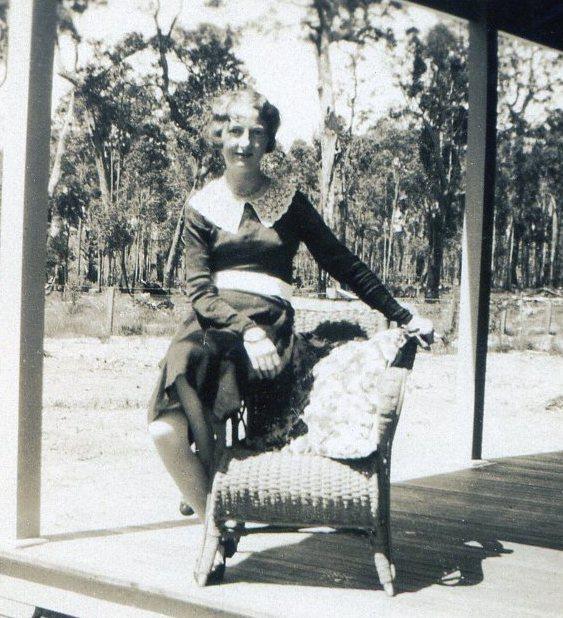
Junior’s Dad was good at sport and in his teen years played football. He didn’t excel at school although had good school reports and references. He was sent to learn a profession at the Ludlow school of Forestry, Ludlow being a small timber community about half way between Bunbury and Busselton. He played football there and appears not to have passed the rather rigorous academic side of the course and failed to fully graduate; however, the Forest Department continued to employ him principally as an office worker. He was categorised as a clerk and in the Collie office was responsible for pay and general administration but also worked on forestry maps. He seemed popular with his work colleagues, both those above him and the wages staff – the forestry workers. Junior was unaware of how his Mum and Dad met. Perhaps it was at Barton’s Mill when Mum’s family had the small shop and Dad may have been posted there after leaving Ludlow. Barton’s Mill was in the jarrah forest country of the Darling Range east of Perth and was the location of a state prison. It exists now in name only having been totally abandoned. Soon after they were married they went to live in a Forestry house at Lyells Mill, a few miles south east of Collie. At some point in his early career Junior’s Dad became involved in some sort of investigation that was always spoken of in hushed terms. It seemed to involve some very senior people and the Conservator of Forests, a Mr Kessell. Junior had no reason to believe that his Dad’s involvement in the incident, whatever that may have been, was anything but honourable, but the incident seemed to loom large in their lives.
As the War progressed Dad’s working role underwent change and he was issued with a motorbike with a large wooden box sidecar. In earlier years Dad had been a motor cyclist and old snapshots show him astride his motorbike. His work now took him into the forest country daily, visiting the fire lookout towers and with theodolite and chain, carrying out measurements for some purpose or other that remained a mystery to Junior. In fact Junior occasionally accompanied his Dad, sitting on an improvised seat in the sidecar. This was Junior’s first introduction to surveying, holding the end of the chain against a marked tree while Dad read the distance to the axis of the theodolite. On one occasion Dad took Junior to a bushfire, or at least very close to it, close enough to feel the intense heat. Dad spoke to a few of the men who were attending the fire with a big water truck (Junior was disappointed that it wasn’t painted red) and then left. That night Mum, on being told of the escapade, was less than impressed. Sometime Mum came in the sidecar with Junior to Allinson, where Dad ran a polling booth on election days.
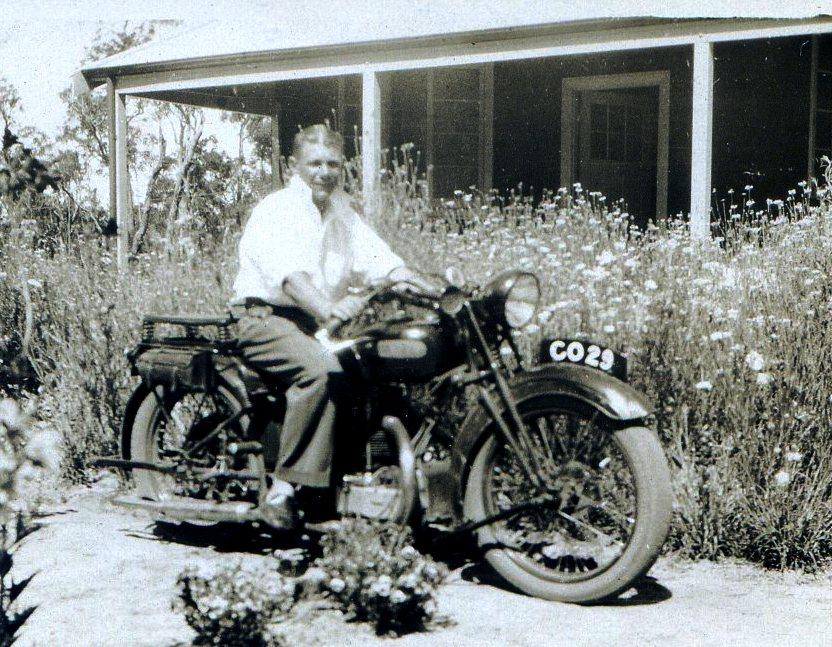
Junior loved his Dad. He was always even tempered and had a ready smile. It was Junior’s Mum who was more mercurial and often provocative in the domestic scene. Nevertheless Junior could recall very few arguments. Whether it was Mum or Dad who managed the finances was not at all clear; money was never the subject of argument. While money provoked no argument, politics did. Dad’s family were supporters of conservative government while Mum’s family and Mum herself were unashamedly socialist and voted for the Labor Party. It seems that Dad had swung to Labor himself at least by early in the War but Mum never forgave him for voting for “Pig Iron Bob” or the party he represented during the thirties. His defence was that Labor was making such a mess of things at the time. Nevertheless, the argument was resurrected each time there was an election and on one occasion Mum declared that she needed to go to Perth to discuss the issues with her family, Grandad Magowan being a committed Communist.
Dad’s sporting interest lay in tennis. He had joined the Town Club and undertook some official responsibility within the Club, perhaps secretary. He enjoyed his tennis and played a good game; may have been Club Captain at one stage. Dad tried to encourage Junior to swing a tennis racquet but Junior’s wild swings resulting in fits of laughter convinced Dad that Junior lacked any sort of ball skill.
Remember, remember the fifth of November….
For Guy Fawkes night Dad would build a huge bonfire in the middle of the paddock from the lower branches of the surrounding pine trees that were always trimmed at this time of year. It was a huge conflagration and all the neighbours would come, bringing their own crackers. The bonfire lacked the traditional effigy of Guy Fawkes tied to the stake at the top of the fire because Mum objected to that as being “horrible”. So the bonfire had no particular purpose but it was spectacular to watch. Being a “Forestry” fire it was kept under good control. One of the Forestry dads always had a firefighting water backpack at hand just in case the bonfire gotaway, but it never did. Dad also brought a supply of “crackers” – a generic expression because they included roman candles, catherine wheels, jumping jacks and one or two rockets as well as ordinary crackers and tom thumbs that you could explode holding the extreme end between finger and thumb and finally one huge “double bunger” that he would let off at the end. Junior could only watch because he was not allowed to light any of the crackers. But it was a great fun night and next morning Junior and cobbers would search the ground around the dead embers of the fire usually finding a few crackers intact that either hadn’t gone off – fizzogs – or had been lost in the dark.
And where did crackers come from during the years of the War. They were certainly in short supply – you needed to know where to go. Collie had a small Chinese population, mostly engaged in market gardening – and, it seems, providing crackers for Guy Fawkes nights. The Chinese crackers wrapped in their red paper, were much more fun than those bought at the newsagent even if a little unreliable and unpredictable.
Bikes and where they can take you…..
Despite afflictions, real or imagined and despite Junior’s lack of sporting prowess, his life at Collie was active with very few restrictions imposed on his activities. Collie and its surrounding bush was his playground – with his cobbers and with his kelpie, Pixie. At about the age of seven he was bought a bike, a new three quarter size “Runwell” with a handbrake on the rear wheel. “Runwell” was a local brand and cheaper than the “Malvern Star” but probably just as good. No doubt many were reconditioned repainted old “Malvern Stars”. The three-quarter size was somewhat too big since, with his bottom on the seat, Juniors feet would not quite reach the pedals in their lowest position. Junior learnt to ride astride the bar with Dad running behind holding the back of the seat and eventually riding his own big red Forestry bike parallel to Junior’s, still holding the back of Junior’s seat with outstretched hand. Junior soon mastered his bike but in riding astride the bar with feet occasionally slipping from the metal pedals, he had for a time a constantly bruised and sore crotch. His older cobber, Bob Hough, accompanied him on much longer rides down the Bunbury road past the cemetery, instructing Junior in basic road rules and cautioning him not to go too fast down hill. Bob’s expression that lives on in Junior’s memory was “go at an ugly speed”. Why “ugly”? Junior knew what he meant.
The bike opened up a range of play vistas much further a-field. Visiting Geoff Fogarty after school and together catching gilgies in the Co-op Mine creek, riding out to the clear water swamps to pick boronia or bunches of spider orchids and sometimes escapades with the potential for trouble but leaving a lingering excitement – all became possible.
It had been a long ride along a little used track and it was still hot in the late afternoon. Pix, running along behind was panting with his long tongue almost touching the ground. Geoff knew it led to an abandoned orchard where the fruit is waiting to be picked. They come to a clearing in the thick scrub where the grass is knee high and dry. To one side of the clearing are two indian tepee like structures, much higher than Junior’s head made from bramble and branches pulled from the surrounding scrub but now quite dry from the summer heat. The grass around them is not trampled, indicating that they had not been used for quite a while. Who could have built them? They look neater and better constructed than that which might have been built by children, at least of Junior’s and Geoff’s age. Perhaps the blacks or tramps but that seems unlikely. Geoff and Junior gingerly enter one through its triangular shaped opening. There is nothing to see inside. The grass had been pulled and the ground is bare within. Geoff produces a small box of wax matches he always has with a multitude of other things in his pocket (his dad being a miner had access to waterproof wax matches). He strike one perhaps for light in the increasing gloom. It quickly burns down, as wax matches do, and burns his finger causing him to flick it to the side. It lodges in the bramble and there is no need to strike another because in an instant the tepee was ablaze and within a few more seconds, the surrounding grass. The boys flee, Junior heading to his bike and back to Collie leaving the increasing fire to look after itself, but Geoff is pulling green branches from a sapling and furiously beating at the flames. Pix has disappeared goodness knows where. Junior abandons his bike and with a sapling branch thrust at him by his cobber, follows suit. Miraculously the flames disappear under their blows and soon all that is left is a black patch. Perhaps the grass was greener than it appeared at first glance, but thankfully it didn’t burn all that well. The boys are hot and sweating and now covered in grime, but the fire is out. One of the tepees no longer exists, being no more than a pile of smouldering black ashes on the ground. They are nervously laughing as they mount their bikes; wow – that tepee had gone up like a roman candle! Stopping at the Co-op creek on their way back they strip off and wash the grime from their bodies in the cool refreshing water. Pix catches up with them from somewhere and laps at the water. Junior, who has further to go than Geoff is late home, even after cutting across the forbidden railway marshalling yard dodging between the shunters and tightly holding Pix by the collar. Mum is annoyed but not too angry and perplexed at the black soot still clinging to Junior’s hair and in his clothes. To the inevitable question “where have you been” Junior lied “we were in some burnt out bush looking for orchids to bring home”. Junior hears Mum telling Dad about it later that evening but nothing more is said.
Matches and fire must have had a certain fascination. On another occasion, a Sunday morning, Junior was dawdling home for dinner down Atkinson Street North from Geoff’s. Sunday dinners were the traditional roast even on the hottest of days and the bike had been left home for some reason. He pulled from his pocket some of the now forbidden wax matches and began striking them casting the flaring match aside. They soon caught fire to the long dry grass between the footpath and the road (formed kerbs and gutters were yet to happen in Collie and neatly tended “nature strips” hadn’t been even thought of). The fire burnt from the preceding corner to someone’s gravel driveway five or six houses down and then extinguished to Junior’s great relief. One angry adjacent householder emerged and shouted abuse but Junior quickened his pace – “it wasn’t me Mister” – not looking back. Junior arrived home, Pix at his side, washed up and reported for dinner, incident forgotten. Forgotten until venturing onto the front veranda after dinner to his horror he could see this ugly black scar along the side of Atkinson Street North which was, in effect, the prolongation of Atkinson Street South on Junior’s side of the railway yard, the latter running down the hill to the yard and the former up the hill on the opposite side. Junior kept silent about the incident expressing surprise when Dad commented about the burn in Atkinson Street later in the day.
At about the age of about ten Junior rode his bike to Collie-Cardiff where his aunt and uncle lived. It was a distance of seven miles and he was surprised it took so little time. Hitherto a trip to Cardiff with Mum had been by train, hopping off when the train came to a standstill in the coal yard almost opposite where his uncle and aunt lived. Uncle Bert Woodward was the vet for the Cardiff coal mine, one of the largest in the coalfields, very old, very antiquated and very deep. A coal mine vet? Yes; in the forties the mine still used pit ponies to pull the skips to the main shaft where they would be linked to the cable system that pulled them to the surface. Uncle Bert was an Englishman and it took Junior many years before he came to know him at all well. Uncle Bert had a shed in the back yard that was kept under lock and key at all times, no doubt with good reason. This was where he kept all his horse medications and potions. The Magowan family seemed to have a dislike, even a hatred of “Pommies” and this seemed to extend to the Aunts that happened to marry one. Certainly it was true of Auntie Grace, the oldest of the Magowan family. She often regaled against her husband claiming that he would lock himself in his shed and get up to no good. They had three children, Edna the eldest who was only a few years younger than Junior’s Mum, Clarry and Astor, the youngest. No doubt Uncle Bert was a firm father, at least that was the impression junior was left with. He insisted that they learn all music and as it turned out they were all excellent musicians, Edna on the banjo-mandolin, Clarry on the violin and Astor, the piano. They played as a family group in Cardiff and at times in Collie although Edna went nursing and drifted away from her music, perhaps to her relief. Clarry continued with the violin in dance bands and Astor, who both played and sang became a well known performer in Perth during the war years.
Swimming
Collie had no Olympic style swimming pool in any shape or form. Such pools as a community recreational facility were hardly thought of at that time. The only swimming venue was the Collie River itself and this was confined to two location, the Town Pool at the pedestrian “swing bridge” and the Minninup Pool two or three miles south of the town. Boys taught themselves to swim at the Town Pool this being more accessible on foot and in any case the Minninup Pool was considered to be far too dangerous for the novice. On any summer weekend afternoon one might find forty or more boys at the Town Pool below the swing bridge. Girls did not frequent this location. Occasionally Junior did in the company of Geoff Fogarty (and Pix of course) on their bikes. Geoff could dog-paddle and Junior being wary of getting out of his depth could not even manage that. Furthermore there were often leeches in the Town Pool and Junior had an abhorrence of leeches.
The mark of a swimmer in Collie was to be able to swim across the Minninup Pool. It was here that the Collie River was at its widest, maybe between one and two hundred yards wide. Amongst Junior’s contemporaries it was well known that Ian Smith, the son of Doctor Smith, could swim the Minninup. Where he learnt to do that remained a mystery to all. The Minninup Pool was a favourite picnic location and Sunday school annual picnics were always at the Minninup. Junior always attended with Mum. At one end of the picnic area was the Collie Rowing Club with its shed full of rowing boats and adjacent ramp into the water. It was a popular activity even during the war when the remaining Collie young men would be out on the Minninup skulling back and forth on the marked course.
Sundays
Sundays were busy days. Dad did the weekly wash, lighting up the copper early in the morning and bundling in all the white bed linen for a good boil with copious quantities of “Persil”. Most of the clothing was washed by hand in the cement troughs next to the copper, each article scrubbed by hand with “Velvet” bar soap on the wood framed corrugated glass scrubbing board and then thrown into the adjoining trough of “Ricketts” blued water. The boiled sheets were then hooked from the copper with the designated copper stick and plunged into a trough of clean water, rinsed, wrung by hand and plunged again into the trough of clean blued water, wrung again and then pegged out on the line. It would be mid- morning before the weekly wash was over. Mum cooked the roast dinner and it was always on the table at the stroke of midday.
A family outing on bikes
Sometimes on a Sunday afternoon Mum with Junior, Mrs Hough and usually Joyce and maybe Bob bicycled out to the Minninup pool. Junior couldn’t swim and could only splash around in the shallows. These were special occasions and greatly looked forward to by Junior. Downstream from the Minninup was another favourite location where the Collie River was shallow and tumbled over smooth rocks forming many shallow pools and riffles. Junior loved those shallow pools and Bob Hough taught him to skip flat stones across the still pools of water, although he wasn’t very good at it. The trip home in the late afternoon was no less enjoyable. Sunday night was hot bath night with hot water being provided by the copper and carried across the kitchen to the bathroom by the bucket full. Dad cooked tea – “bubble and squeak” with scrambled egg and then it was time to listen to the “Lux” radio play from 8.00pm to 9.00pm on 6IX. Junior stayed up for that.
Religious endeavours
Junior’s Mum and Dad were not notably religious and in Junior’s recollection only his Mum openly expressed a belief in God. Mum’s family were probably Church of England and Dad’s Methodist. Junior was christened in the Collie Methodist Church by Mr McKeller, the Minister. It was a large wooden structure more or less diagonally across the road from the grander All Saints Church of England. The christening took place when Junior was five years old – why so late in life Junior had no idea. Perhaps it was the custom of the Methodist Church. It remained in Junior’s memory, perhaps because of a certain incident that occurred and was often joked about afterwards. Standing at the font Mum accidentally dropped some coins into the holy water. What were the coins for? Junior assumed it was part of the process. How she managed to do this remained a mystery but it seemed to be a matter of great hilarity in the retelling for some years after.
In early years Junior attended the kindergarten run by Miss McKeller daily for one or two years in the Methodist Church hall behind the Church. Somewhat improvised play ground equipment had been provided by parent’s working bees – a swing comprising a car tyre dangling from a rope being one such item. For many years Junior also attended Sunday School each Sunday morning. Whenever there was something special on, the Sunday School trooped into the Church and sat quietly on the floor to one side of the pulpit. Mr Avenell, a chemist with a shop in Throssell Street, was the Church Superintendent, apparently a very important position to hold. Mr McKeller left or retired – he seemed very old – after a few years and was replaced by Mr Fadden. Mr Fadden was stout with red hair and very serious about religion. He may have called on Junior’s mum at one time but nothing changed as a result of that visit. Once Junior asked his Mum why she didn’t attend Church (it seemed to be a given that Dads didn’t attend) and she replied that she attended in her heart.
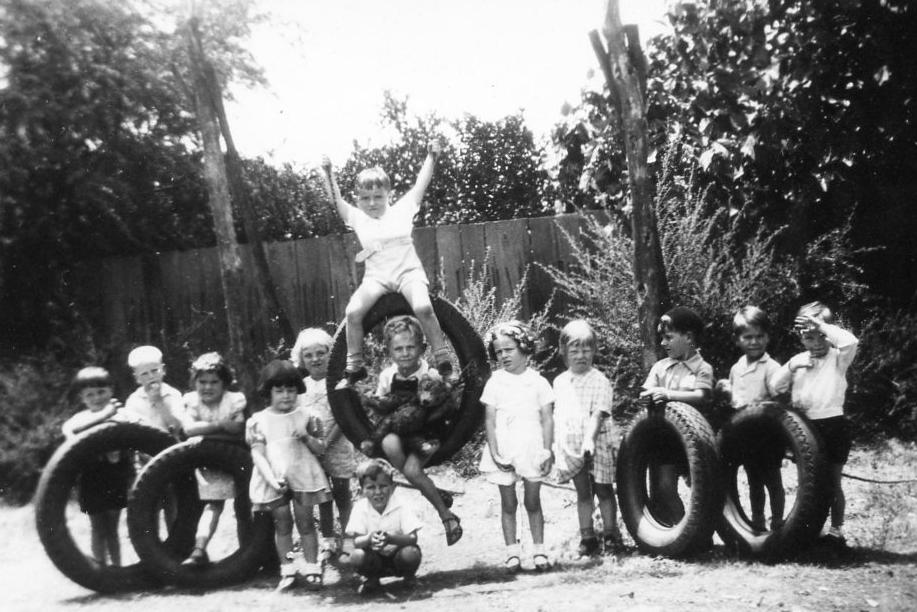
Generally the congregations of the Methodist and the Church of England didn’t mix and there seemed to be an underlying suggestion that the apparent grandeur of the latter was not in accordance with true Christian practice. In a storm during the winter of 1944 the bell tower of All Saints Church of England was struck by lightning and the wood interior at the top of the tower burned, That caused a few sage Methodist heads to nod wisely! Junior and cobbers went up the hill to examine the damage. The tiles had been struck from the top of the bell tower and the timber below was blackened. The bells didn’t peal for some time after that.
Trips to Perth and the Magowan family
Through most of Junior’s years in Collie Junior’s mum would take Junior to Perth to visit her family. The visit normally took place over the Christmas holiday period and Christmas itself was usually spent with grand parents in their home. Junior’s dad sometimes accompanied them but would return to Collie soon after Christmas. It was always the “bushfire season” and he was required in the office. Perhaps the truth was he enjoyed the break on his own and he did not get along too well with the family.
Travelling to Perth was by train. The old train, a mixture of passenger coaches and wagons, would be shunted into the platform. They would board a first class compartment – Junior’s mum would only travel first class and somehow that was afforded. The train would commence its slow journey to Brunswick Junction, some forty miles taking two hours with frequent stops. It was often said that one could leave the train and pick mushrooms in the adjacent paddocks and then rejoin the train without fear of being left behind. Junior’s mum always packed a lunch to eat in the carriage.
At Brunswick Junction on the Great Southern Line, the Perth Express from Bunbury (stopping at all stations) would be at the platform patiently waiting for the Collie connection. In wartime, waiting was part of life. The corridor coaches with their platforms at either end, dusty on the outside but clean enough inside, no doubt considered luxurious when first made, featured in each compartment polished wood panelling, water glasses and a flagon of water in a polished wood holder, luggage racks above the two opposite facing seats that provided seating for three on either side with pull-down armrests, photos of Western Australian scenes, three windows that could be open by sliding upwards on the side opposite the corridor; certainly built for comfort at least in first class. Junior liked to have the window down and lean right out looking ahead watching the big locomotive belching steam and smoke as it rounded the curves. He invariably got a speck of soot in his eye that Mum had to remove with her handkerchief, and down would come the window and he would settle back into his seat, at least for a while.
The Express would finally lurch off; next stop Pinjarra with its railway refreshment rooms selling hot pies and pasties, little cakes, hot tea from a monstrous tea-pot, some lollies but not many during the war. Mum always bought a packet of Minties. On one occasion at an early age Junior managed to drop his packet of Minties from the window of the carriage but despite pleading with his mum to stop the train and recover them, this she would not do. How Grandma subsequently knew of that regretful scene Junior failed to understand. After Pinjarra the train continued on to Perth, travelling at quite a speed Junior thought, finally arriving at the outer suburb of Armidale in the early evening and then Carlisle where Grandma and Grandad lived. Carlisle was not a regular stop for the Perth Express, it didn’t stop at the platform but for a few minutes about a hundred or so yards beyond it.
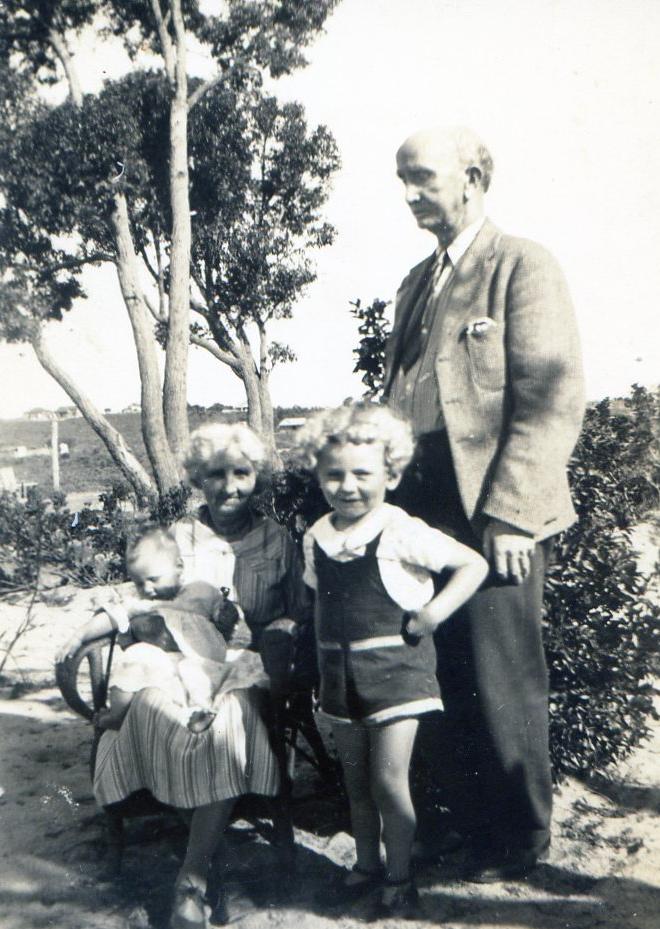
Her parents Frank and Maria Magowan were very elderly but in relatively good health. They were Junior’s Grandad and Grandma and Junior always addressed them as such. Junior and Mum always stayed with Grandma and Grandad in their rented home. The first house that Junior could recall was in Swansea Street Victoria Park, close to Mint Street and Albany Road, the second in Bishopgate Street, Carlisle. The Magowan family was quite large, even by the standards of the time, comprising six girls and two boys, so Junior had all that many aunts and uncles to get to know including the uncles by marriage who were the husbands of his aunts. The eldest of the aunts was Grace previously mentioned living at Collie Cardiff and married to Uncle Bert Woodward, the mine vet. Also previously mentioned was the next oldest, Aunty Blanche married to Uncle Willis Robinson, who in early years owned the tea shop in Forest Street. They moved to Harvey in about 1940. They had two children, girls – Rae and Sheila, considerably older than Junior. Uncle Willis suffered from consumption and died of it a few years later. Aunty Blanche was said to be “worldly”. She was always well dressed and “up with things”.
In visiting Perth Junior and his mum always called on Aunty Rhoda and Uncle Bob Dodd. Therein lays a complicated tale. Aunty Rhoda had been married to Jack Plewright and had two children to that marriage, Jack and Alex who in Junior’s experience were well and truly adults. Aunty Rhoda and Jack Plewright were never divorced but Aunty Rhoda took up a de- facto relationship with the Englishman, Robert Oodney Dodd and had a further two children, Ken and Glen. Ken was a year older than Junior and Glen about two years younger. The Dodds lived at Fremantle and somehow Bob Dodd had escaped being called up for war service. They lived in a ram-shackle sort of place that had a shop front with little in it and very rudimentary furniture in the adjoining house. Aunty Rhoda was a warm and kindly person who, the family said, let the children “run wild”. Nevertheless they survived with Aunty Rhoda taking on whatever menial work she could find and Uncle Bob being mostly at home following his varied but not very profitable pursuits, making paper flowers from crepe paper – roses with petals edged in gold – and selling them in the shop front. They were very beautiful. Perhaps he did other things as well.
Bob Dodd had a most remarkable stamp collection. He specialised in Czechoslovakian stamps. They were beautifully mounted on large format pages held loosely but in some sort of order within large folders. Reflecting back on the collection they probably covered the period from the Great War (1914-18) when the Czech and Slovak states were united following the breakup of the Austro-Hungarian Empire. Because Junior showed an interest in the beautifully designed stamps and the way they were arranged on each large format page, Uncle Bob took the trouble to show and explain them to him. Of course it was a case of look but do not touch. A point of further fascination was that many of the more recent ones showed the head of Adolf Hitler. How did Uncle Bob come by those during the Second World War? He had his sources that were probably Swiss based, Switzerland being a neutral country during the war. Of course all of this must have come at some cost and it was a mystery to the family at large how he could afford the collection. He always claimed that it was very valuable and the comment was often passed between members of the Magowan family that he should sell it and properly feed his children. However, despite their apparent poverty the Dodds lived well enough with plenty of food on the table.
To Junior Fremantle was a place of mystery and even excitement. Sometimes he and Mum stayed one or two nights with Junior tucked in with his cousins. Lingering on in his memory is an old abandoned building to which the three could gain access through a broken fence. There was something frightening about it but also fascinating, so much so that it lingered on in Junior’s dreams for many years, at times achieving a nightmare status.
Fremantle was a city of steep roads, high rock cliffs and down below all that the Swan River, accessed by a broad set of stone steps. It was a favourite bathing location, however the river, passing under the railway and road bridges a little further down before entering the harbour, flowed very strongly as the tide ran out. Junior had entered the water at that point and rapidly found himself out of his depth. Unable to swim he panicked convinced that he was about to drown. Suddenly his feet touched bottom and he was able to drag himself out on a sandy spit and back to the shore where cousins Ken and Glen were playing with some other kids, totally oblivious of Junior’s plight and disparaging of his story when he tried to win their concern. That too lingered in dreams for many years after.
Down on the wharfs of Fremantle Harbour the big black hulled ships tied up while they were unloaded; at least to Junior taken there at a young age they seemed so huge that he wondered whether they could even float. They did not look like ships at all! On the wharf or just back from it Mum showed Junior the statue of C.Y. O’Connor, the famous engineer that Junior learned about later who created the scheme to pipe water three hundred and sixty miles to the goldfields of Kalgoolie from Perth.
Uncle Bob had some connections and maybe he did things other than make and sell paper flowers. One morning he woke all three early and took them down to a beach site a little north of the harbour. It was a long walk and it was barely daylight when they left home. Mum and her sister slept on but presumably they knew what was planned. From a vantage point looking out through the coils of barbed wire that prevented access to the beach and across the sea was a huge grey ship, far larger than Junior had seen at the wharfs of Fremantle Harbour. Uncle Bob was very silent for a few minutes and then he said it was the Queen Elizabeth loading soldiers for the Middle East war zone. Little was said as they walked home for a late breakfast.
The Dodds left Fremantle not long after and rented a house in Bishopgate Street Carlisle just up the road from Grandma and Grandad’s house. Uncle Bob found a job that didn’t involve too much work at Woolworths in the city and Aunty Rhoda continued with sporadic jobs, but more about that at another time.
Junior’s Aunty Jesse was also a favourite. She lived with her English husband, Junior’s second Uncle Bert, in Ventnor Street, Subiaco, a suburb just west of the city. Uncle Bert Bell’s full name was Bartholomew Bell, a name Junior found fascinating. He was a salesman for the wholesaling firm of Goode Durante and was held in high regard. They lived a “high” life and both fell victims of alcohol going on “benders” but then having periods of sobriety when they appeared totally reformed. Aunty Jesse had a special quality and was said to be psychic. She could read palms and certainly had the appearance of a gypsy. Also she had been “east” which meant that she had visited Adelaide, Melbourne and Tasmania.
The two boys were Lennard and Alexander, Junior’s Uncle Lennie and Uncle Alec. Uncle Lennie never married and at one time Uncle Alec had been married. Both had a liking for alcohol in whatever form it came in although Uncle Lennie was mostly a beer man. Their drinking habits were different. Uncle Lennie never pretended to give it up. He rarely drank during the week but after work on Saturday he would dress in his best suit, shirt and tie, smart hat (necessary because he was very bald) and highly polished elastic sided shoes and set out for the Carlisle Hotel and having studied the racing form all week, place his bets with the SP. Thereupon he would front the bar and slowly imbibe while he listened to the racing broadcast until nine o’clock closing time. He would then meander back home (he always lived with Grandma and Grandad) with a single bottle of beer and sit at the kitchen table and eat the meal Grandma had left in the kitchen safe for him, drink his bottle of beer staring blankly at the wall, finally retiring to bed. He would religiously remove his suit and hang it up before flopping onto his bed, immediately falling asleep and snoring the night away. The bedroom had two beds and Grandad slept in the second bed. When Junior and his mum visited they occupied the double bed in the front bedroom and Grandma slept on a spare bed on the back vestibule of the little house. That was just outside the kitchen door and sometimes when Uncle Lennie lingered too long at the kitchen table Junior would hear Grandma call out “go to bed, Lennie” and Lennie would without saying anything. Uncle Lennie worked hard at the Bunnings sawmill across the railway track, not far from Bishopgate Street. He always paid his board and lodging to Grandma every payday which was more than could be said for Uncle Alec. It was said that Uncle Lennie was not the “full quid” and had been so since childhood. The only time Junior saw him cross was when Junior, looking for something to cut through a piece of rope found Uncle Lennie’s cut-throat razor in the bathroom duchess, hacked through the rope leaving a half moon in the blade resulting in a stern lecture to Junior.
Uncle Alec’s drinking habits were very different. He would go on the worst benders and finish up an alcoholic wreck, sometimes hospitalised. From time to time he lived with Grandma and Grandad and when drunk could be very abusive leading to Grandad “putting him out”. Where he went when “put out” was a mystery to Junior but when he reappeared again some days later he would be dishevelled and filthy. Grandma would see that he bathed – water would have to be heated in the outside copper and carried into the bathroom. Grandad and maybe Uncle Lennie would help and when dressed into clean clothes put to bed. Throughout this process he would be cursing and abusing. Junior found it frightening and disgusting. But then when he was off the booze he could be quite charming and always full of plans for the future, swearing to never touch alcohol again. Sometimes in an inebriated state he would require the ball of his feet to be tickled with a chook’s feather. Remarkably Grandma would do this for him and if Grandma was either not prepared or not available he would press Junior to do it. Junior might comply for a while but soon find an excuse to get away. Much of this happened at a later stage of Junior’s life after he had left Collie and came to Perth to live.
Junior’s dad had little time for his mum’s family although he probably got on well enough with some of them. Certainly he had no time for Uncle Alec. Sometime in 1942 He turned up on the doorstep at Collie having been discharged from the Army. He was grog affected and demanded to be accommodated. A Coolgardie stretcher was put up for him in the washhouse at the back and Junior’s dad accepted his presence for maybe a week or two. Uncle Alec had two middle fingers missing from above the middle joint of his right hand and his story was that this prevented him from firing a rifle in the appropriate manner on the rifle range. The instructing sergeant had set him up for discharge and Junior’s dad suspected there was more to it than that. Finally Junior’s dad ordered him to leave on the next train out and made sure he was on it. Junior’s mum was tearful, after all he was her brother, Uncle Alex was resentful and some years later ensured Junior’s mum remembered it. Perhaps the snapping point for Dad was coming home to find Junior pressed into tickling the ball of Uncle Alec’s foot with a feather.
The youngest of the Magowan girls was Aunty Thora and therein lies another story. Aunty Thora was married to Uncle Don Coverley, some eighteen years older than his wife. In early years they lived at Jarradale south of Perth where Uncle Don was a timber worker. In the mid thirties the Coverleys bought a general store at South Perth on the Canning Highway to Fremantle. Their only child Robin was born soon after. Uncle Don turned out to be a very successful businessman and in the early years of the war the business thrived. In about 1944 they moved to Arrino in the wheat belt south of Geraldton on the Midland railway line having bought a comprehensive general store that provided everything for the local farming district. The Coverley’s great interest was horse racing and they owned several race horses, one such horse, Sweet Mystery, was notably successful at country meetings. Junior and his Mum always visited Aunty Thora and Uncle Don in their South Perth shop and when Junior’s dad was undergoing military training at Swanbourne in 1940 Junior and his mum stayed with the Coverleys for a few weeks. Cousin Robin and Junior became good friends.
An accident that changed many things
The black gives way to grey. Muffled voices penetrate. Junior tastes gravel and tries to lift his head from its close contact with the road but a weight of something is holding it down. He realises that his left arm is throbbing, no, not simply throbbing but shrieking with pain. Then sunlight penetrates and there is Dad. Dad says “Junior, Junior” and Junior feels his hands holding his body. Junior says “oh Dad” and his world goes black again. He looks up and sees his bedroom and above him the gradually redefining familiar shapes of Mum and Dad and one other. Dr Smith is smiling down on him and saying something. His left arm is heavily bandaged but still throbs. He feels Mum’s hand stroking his head. He becomes aware of other patches of soreness; his knees and elbows, his side and even his face. In fact he feels sore all over. He closes his eyes again. Dr Smith’s voice continues. Mum is saying something and then Dad. The events of the past two hours start to drift into his mind. “Can we go with you Mister”? Who was that? Who was with him? They were poking around the horse stables. One of the other Forestry kids Junior sometimes played with. He was older than Junior and wasn’t really a cobber but he was all right. “Yeah – I s’pose you can help load; the chaff bags aren’t heavy; hop up on the back and hold on”. Junior climbs up and standing grasps the frame behind the doorless wooden cab. He is beaming with excitement. He thinks “Mum and Dad won’t mind”. The engine comes to life and the truck swings around into the pine tree lined driveway leading down onto Wittenoon Street. Soon the breeze is blowing his hair. It is a hot early summer Saturday in 1943. The truck turns into Atkinson Street outside the Forestry office sending a spray of gravel dust into the air. If Dad is looking out from his window he might see him. No matter, they are underway – no turning back! At the bottom of Atkinson Street outside the bakery the truck swings into the main street, Throssel Street, and down to the railway goods yard and the loading platform. A long railway wagon is at the loading platform with its side down and its dirty canvas tarp pulled back. It is piled high with big bags of chaff and already one or two truckloads have been taken from it. The Forestry truck backs in and Junior and the other boy climb down onto the platform. The driver climbs onto the railway wagon, pulls a few bags of chaff to the side of the wagon but then gets up onto the back of the truck with “ they’re not heavy, you two pass them up to me”. Junior climbs onto the railway wagon and starts pulling more bags over to the edge. The bigger boy hefts them up to the back of the truck high enough for the driver to grab them and sling them towards the back of the cab and into position. It is hot work but fun and Junior is feeling grand at doing a real job. It takes no time load the truck, the bags of chaff pile high. The driver throws a couple of ropes over the load and strains them down onto the tie-rails under the truck’s tray. Junior is already up on the top of the load holding on for grim death. The older boy has climbed into the cab next to the driver. He seemed to know the driver better than Junior, even called him by his Christian name. Junior wasn’t game to do that! The truck took off with a jolt. The driver was in a hurry; he still had another load to go after this one and wanted to knock off at 12.30. It was Saturday! They speed back up Throssel Street; Junior holding on to the tie rope. He can no longer reach the frame at the back of the cab. He starts to feel a bit anxious, the bags of chaff are moving a bit and the rope is getting looser. The truck rounds into Atkinson Street; the truck, but not its load. Junior feels it slipping from beneath him – and then – blackness. Lying in bed he shudders a bit. How did he get home? Later Mum tells him that Dad carried him home. Dr Smith is now talking to Dad and arranging for Junior to go to his surgery; the arm has to be straightened and set. Junior quietly recoils in horror. That means the mask and chloroform – he had had that before and hated it! It took him out of this world – whirling images – more blackness and afterwards uncontrolled retching – vomiting.
But that was the way it was. Mr Moore took Junior and Dad to Dr Smith’s surgery in Forrest Street later that day; the arm was set in heavy white plaster and Junior was home again that evening. The arm was no longer hurting but many other parts of his body were. Skin was missing from his hands, his left hip and the side of his face. Something had been used to bathe those areas that made them sting more and that treatment had to be repeated. Junior didn’t like that. Mum had prepared his favourite scrambled egg for tea. He still felt a little like vomiting and could only eat a couple of spoonfuls. Junior wondered about school on Monday. He was feeling a little proud of that heavy white cast on his left arm. Mum said he was to stay home in bed for a few days. His cobbers were allowed in to his bedroom to visit.
Robert Phillips was one and Geoff Fogarty and Billy Cook called in – the first and only time they had been in Junior’s house – and even Elizabeth Withell came over with her mum, bringing special jellies.
Junior did not return to school that year. School broke up two or three weeks later. Junior could not take part in the school concert to be held in the Mechanics Institute at the eastern end of Throssell Street. He was to be in the skeleton’s dance on the stage with about ten others. They had been practising at school. The mums were to make skeleton costumes, strips of white cloth representing bones sewn to black under garments. However, Junior and Dad went to the performance together and Junior thought it a great show. The skeleton dancers looked like real skeletons.
Dad also took Junior down town to see the finish of the Collie to Donneybrook bike race. It was an annual event and perhaps the biggest thing that happened in Collie each year. It started and finished outside the Colliefields Hotel and was about eighty miles in length, forty there and forty back on gravel roads. There were plenty of spills and the riders returned hot, dusty, exhausted and often bearing wounds sustained along the way.
Junior’s arm did not set properly. The break was just above the wrist and it seems that the bone was quite shattered. When the plaster came off the ends of the bone were overlapping and the hand seemed to be at a crazy angle to the arm. Dr Smith had another go at re- setting it; pulling the bones apart and more plaster. After this Junior could feel a constant ache down his arm and into his hand. Dr Smith decided that Junior should visit a specialist bone doctor in Perth and that was arranged, leaving Collie a week or two before Christmas. Junior was appalled at this. He would be in hospital over Christmas. What sort of Christmas was that? Dr Smith had said that the bones would have to be joined inside the arm with pins. What did that mean? The idea appalled! They would travel to Perth by train and stay with Grandma and Grandad in their little house in Bishopgate Street, Carlisle, at least Mum would, Junior in the Princess Margaret-Rose Children’s Hospital. Dad planned to stay only a short while – until the operation was over. Did that include Christmas? Mum packed and dressed; Dad put on his best suit – Junior took an illogical dislike to his socks, they seemed to emphasise an undue seriousness in the whole business. The socks remained. The Collie railway station was no longer a friendly place where Junior and his mates had sold boronia to arriving passengers. The slow train to Brunswick Junction was boarded. Junior usually enjoyed the trips to Perth but this time he was filled with apprehension with what was to follow. The day passed as in previous trips. Junior’s dad tried to be jokey but Junior was in no mood for jokes. They transferred to the Perth Express at Brunswick Junction and then on to Perth to leave the train at the unscheduled stop, Carlisle. How Junior’s parents knew that the train would stop at Carlisle, Junior never knew, but they did and by the time the train came to rest the three were at the end of the coach waiting to quickly alight – quite a steep climb down to the ground, Dad first, lifting Junior with his plastered arm, then helping Mum who was surprising agile. To Junior’s surprise Mum’s brother, Uncle Lennie was there to help them. Dad shook hands with Uncle Lennie and Mum gave him a quick peck on the cheek taking care not to dislodge her hat. Carrying their suitcases they walked the few blocks to Grandma and Grandad’s little house in Bishopgate Street, taking a short cut across a small paddock. Grandma and Grandad were warm and welcoming and expressed concern at Junior’s plastered arm. Junior loved his grandparent’s, Grandma with her long white hair down to her waist but normally attractively plaited and gathered into a large bun either high on her head or at the nape of her neck; Grandad, a bit gruff and a little hard to understand but kindly. The meeting and the dinner that followed took Junior’s mind off the days ahead. Christmas was only a little over a week away and Junior remained dismal at the thought of being in hospital.
The next day Junior with Mum and Dad visited Dr McKeller in his St Georges Terrace rooms. The three walked to the bus stop in Archer Street and took the Carlisle Bus Company bus into the city where it and all the other Perth bus company buses terminated in St Georges Terrace next to the Government Gardens. He proved to be a kindly elderly man who seemed to address most of his questions directly to Junior although Mum supplied most of the answers. An appointment for X Rays was made at a private hospital in St Georges Terrace, one that Junior knew only too well because it was where he had had his tonsils and adenoids removed some years before, the Westminster Hospital. The appointment was kept a day or two later and that was followed by a further visit to Dr McKeller, who this time removed the plaster from Junior’s arm with a huge pair of shears. He examined the arm very closely, gently turning it over, explaining things to Mum and Dad, showing them the X Rays and pointing out things on the large sheet of black looking film. Junior could even make out the shape of his arm on the X Ray film. Dr McKeller then drew a line on Junior’s arm with an indelible pencil just above his wrist and after further discussion Junior’s arm was re- plastered, this time with two plaster splints tightly bandaged together. The good doctor looking directly at Junior explained very simply to him what he was going to do. To Junior it sounded ghastly but Dr McKeller’s friendly, warm and re-assuring manner, making his stay in hospital over Christmas sound like fun, allowed Junior to leave somewhat mollified.
Some days later Junior, Mum and Dad were on the train this time to Subiaco with a small bag packed heading for the Princess Margaret Rose Children’s Hospital. Junior found himself in a large airy ward with wide verandas and lots of other children. Christmas decorations were everywhere and the nurses all seemed jokey good fun. Mum and Dad were able to stay awhile, but finally left, promising to be back the next day. But the next day was the day of the operation. Junior found that he wasn’t allowed any breakfast and Dr McKeller came briefly to his bedside and offered a few reassuring words. Junior had been given a needle and felt as if he was in a dream. Soon after he was put into a wheel chair and wheeled into the operating room, an enclosed part of the veranda just off the ward. The dreaded chloroform was applied to the face mask and as if it were from the end of a long tunnel down which Junior was whirling he could hear Dr McKeller’s reassuring voice.
It was over. His bed had screens around it. A nurse sat with him. He was sick and retched into a vessel the nurse held for him. He drifted into a dreamless sleep and woke feeling much better. Mum and Dad were sitting at his bedside and it was late in the afternoon. When could he come home? Not for a few days. Junior didn’t mind – he felt like going nowhere. Christmas Day arrived and so did Father Christmas in his traditional red suit and white beard. Junior more or less chose to believe that Father Christmas was real; he had even started to think of him as “Santa Claus” like they did in the movies and in Junior’s book about Saint Nicholas. Junior received a gift of some books – reading and colouring-in – a bit young for Junior who was a advanced reader, but they passed the time. Mum came nearly every day, catching the train to Subiaco and walking up the hill to the hospital. Dad had had to return to Collie; it was bush-fire season. Junior was allowed out of bed after Christmas and made friends with other children, some of whom were very very sick. He was able to help the nurses bathing some of the boys, but had to be careful with his arm, in a sling firmly pinned to his chest. Three times a week the unmistakable smell of chloroform penetrated the ward from the veranda operating room – a smell Junior hated. Dr McKeller occasionally saw him, always kindly and reassuring. One day he was taken back into the operating room and the twelve stitches in his three inch long cut above his wrist removed. The plaster splints removed were quite bloody, the blood having penetrated the plaster. The cut with the stitches removed looked to Junior like a centipede. Fresh plaster splints were made, much lighter than before, and bandaged to his arm.
It was some days before Junior was able to return to Bishopgate Street. Lots of fun things kept happening in the ward. Clowns came one day visiting each bed and handing out lollies. On another day American sailors came in and went around to each bed and talked just like they talk in the movies. They handed out little badges. Junior left with his Mum after saying goodbye to the nurses. They walked in the hot sun down to the Subiaco railway station and caught the train back to Carlisle. By the time they reached Bishopgate Street Junior was tired and upset, He couldn’t think why he was upset – surely not for leaving hospital. Grandma and Grandad were warm and attentive, asking that Junior tell them all about it. Even Uncle Lennie had a few kind words to say.
Mum and Junior stayed on at Bishopgate Street until near the end of January. Junior had a couple of visits back to Dr McKeller and a final X Ray was taken at the Westminster Hospital but once the plaster was discarded the good doctor farewelled him with a few kindly words – “no more riding on the back of trucks my boy”. During those weeks they visited Mum’s sisters, a trip by Metro Bus to Fremantle to visit Aunty Rhoda and Uncle Bob Dodd and cousins Ken and Glen; to Subiaco to visit Aunty Jessie and Uncle Bert Bell (Mum seemed always to get on well with Aunty Jessie) and to Aunty Thora and Uncle Don Coverley and little cousin Robin in the shop on the Canning Highway at South Perth. Aunty Thora was Junior’s favourite. She always seemed genuinely interested in him and talked to as if he were a grown-up. They went to the Zoo at South Perth, catching the ferry from the Barrack Street wharf and to the river beach at Como. They caught the tram to Queens Gardens where Junior liked to climb over the wonderful statue of Peter Pan with all its fairies, goblins and small animals. There they fed the ducks and black swans in the ponds.
Finally Junior and Mum returned to Collie, the Bunbury Express to Brunswick Junction and the slow old train to Collie.
Collie comes to an end
Junior’s final year in Collie was 1944. He returned to school after the Christmas holiday break in the fourth standard class of Miss Ross and his life throughout that year continued. Perhaps it was his best year. Turning ten in 1944 life was easy and a lot of fun. Away from school there were his cobbers, Geoff Fogarty, Billie Cook, Robert Phillips and some others on the fringe. Many of the incidents previously recounted occurred during that year. There were bikes, adventures, Pix the Kelpie his constant companion, music lessons with compulsory piano practice which he didn’t mind all that much. Teasing at school seemed to diminish and didn’t trouble him. He was seen as one of the brighter students in the class.
Come Christmas 1944, it was to Perth again with Mum, visits to uncles and aunts and a few outings to his favourite locations, Queen’s Gardens, Como on the Swan River, the South Perth Zoo, the Catalina flying boats at Peppermint Grove. The Dodds had moved to Bishopgate Street and he was able to see a good deal more of his cousins Ken and Glen. With them he was allowed to go to the pictures at the Savoy Theatre on Albany Road in Victoria Park and even take a tram ride into the city. Next to Grandma and Grandad’s home was a vacant block on which a house had started to be constructed. Junior became friendly with the carpenters who gave him a hammer to help nail down the veranda floor boards. However, he tended to hammer too far and make hammer head marks on the surface of the floor so the hammer was withdrawn.
Summers in Perth were invariably hot. From the porch of his grand parent’s home Junior could look across at the tall chimney of the Riverdale cement works, one or two miles away, which emitted a constant trail of grey smoke. In the mornings the smoke would trail to the left and this indicated a hot land breeze but most afternoons it would trail to the right indicating a sea breeze which had a decided cooling effect. Some people called it the “Fremantle Doctor” and the temperature could drop from the high nineties back to the low eighties (Fahrenheit). If this failed to happen one could guarantee that the following day would be very hot indeed, over 100 degrees.
Uncle Alex was well behaved – off the grog – and lived in a tent in the yard behind the house. He slept on a low Coolgardie stretcher. He had a job which sounded pretty awful, cleaning out the kilns of some kind of industrial plant in the Riverdale area. He didn’t stay there long and bought a horse and spring cart that had to be kept in the Magowan back yard. It remained a mystery as to what he would do with it but he would harness the horse into it and drive around the streets often taking Junior with him. Mum didn’t seem to mind and Grandma put up with it.
At Bishopgate Street Grandma was visited by a niece who stayed awhile, sleeping on another stretcher erected somewhere. Perhaps the daughter or granddaughter of one of her sisters she called Grandma “Aunt”. She had an American sailor boy friend whose name was Hank and Hank called Grandma “Ant”, which Junior found amusing. He thought it great that he got to know a real American sailor. Hank told them a good deal about his home and family in the States. He often visited bearing gifts, the traditional silk stockings of which American sailors seemed to have an inexhaustible supply and bars of chocolate, long off the shelves of Australian shops. He had given Grandma’s niece a small fox terrier dog with the name “Penny” and the dog remained at Bishopgate Street long after niece had returned to her home somewhere in the south west and Hank had left our shores forever.
Returning to Collie in mid January, Junior had a week or two to fill in before returning to school where he would have entered Fifth Standard, Miss Bramley’s class. And then it happened.
On the 19th January 1945, Junior returns from playing with his cobbers, Junior is greeted at the back door by Mrs Hough. He can tell something is very wrong; Mrs Hough rarely came over to his house. Mrs Hough leads him to the bedroom and there he sees Mum lying on the bed weeping uncontrollably. Her face is awash with tears. Mrs Hough had been sitting next to her, on a chair Junior has never seen in the bedroom before. Junior’s Mum can not speak; he doesn’t know what has happened. Finally Mrs Hough says “Junor – your father has had a bad accident”. Junior falters; he doesn’t know what to make of that statement. Finally she says “Junior, your father is no longer with us; he has gone to heaven”. Junior just feels cold. It had no meaning. He leaves the room –doesn’t know what to do. His cobber Bob Hough is out the back. He clearly knows what has happened. He is to sleep at the Houghs that night. Junior thinks that will be fun but where will Mum be? He can not come to terms with Dad. He knows that going to heaven means that he was dead, but how can that be?
Junior’s Mum comes over to the Hough’s house a little later. There is a lot of adult talk; talk about a truck, Dad’s motor bike, his wallet that had been picked up and the road out to the Mungelup fire lookout tower. Junior had ridden his bike out there quite a few times and the lookout lady at the top had invited him to climb up. He had done so, several times. But it all makes no sense. It is later in the evening that Mr Hough sits down with Junior and explains what has happened. The immensity of it is beyond Junior’s comprehension and it isn’t until the next day that Junior starts to realise that his world is about to change forever. Junior’s Mum has regained her composure and she is able to talk to Junior and explains to him what it all means. They will have to leave Collie. Auntie Jesse and Uncle Bert Bell are coming to Collie to be with them. They will all go together to Perth on the train. The funeral will be in Perth. Finally it is only then with the thought of leaving Collie and all his cobbers that produces tears; floods of them. It can’t be so. What about Pix – can he come too? But Pix is to be looked after by Aunty Grace at Cardiff. He will be happy there. Junior can’t be convinced and the tears keep coming. It will to be many months before Junior will come to understand that his Dad will never be with them again.
Aunty Jesse and Uncle Bert arrived a day later and Junior and Mum moved back into their home – for the last time. Cases had to be packed. Junior wondered what would happen to all the furniture. Finally they were on the train to Perth. It was back to Bishopgate Street. Uncle Bert was jokey on the train and talked to Junior. His Mum sat in a corner of the compartment lost in her thoughts. The tears had stopped coming. Aunty Jesse just sat with her. At the Carlisle stop it was Grandad that was there to meet them. They all walked together the few blocks to the home cutting across the empty paddock at the back. Aunty Rhoda was with Grandma and Uncle Lennie. They were all subdued. Conversation was in hushed tones. Junior was to spend the next few nights with the Dodds. He wasn’t sure what would happen after that. There was talk of a funeral but it was above Junior’s head. He chose to believe that his dad was somewhere else and would come soon. He tried to convince himself it was a dream and he would wake up soon.
The funeral took place at Karrakatta cemetery on the 23rd January. Junior did not attend – it was discussed and thought that it was better that way. Perhaps there was a church service somewhere – Junior never knew. Somehow the weeks passed with Junior feeling the looming presence of his dad. Junior and Mum left Bishopgate Street and travelled by train to Arrino to stay with Aunty Thora and Uncle Don where they remained until late July, then returning to Bishopgate Street. In about February Mum returned to Collie for a few weeks to wind up the home. The furniture was sold off and the house vacated. Junior started to enjoy his Arrino experience with Aunty Thora, Uncle Don and cousin Robin, but that is the start of another story.