PREFACE
National Service comes to Australia
National Service descended on Australian male youth in 1951. The federal government of the day was led by Prime Minister Robert Gordon Menzies in coalition with the Country Party representing rural interests. The Liberal Party of Robert Menzies was a relatively new political entity having risen from the ashes of past conservative political parties in 1944. For “Liberal” one should read “Conservative” because that is what it was. Menzies had succeeded in making communism the ever present national threat, attempting unsuccessfully by referendum in 1951 to ban the Communist Party of Australia. In 1950 communist North Korea invaded non-communist South Korea and Australia joined in a conglomerate United Nations force to repel the invaders in a four year long bloody campaign that finally resulted in stalemate that has persisted ever since. The font of communism at that time was the United Soviet Socialist Republic, the USSR (Russia) and communist world domination was seen to be their principal objective. It was this apparently expansionist nature of the USSR that gave rise to the “cold war”, a non-shooting war epitomised by the “arms race”. Each side, the USSR and its eastern European allies and the western nations led by the USA developed bigger, better and more sophisticated weaponry including nuclear. The Labor Party was portrayed by the Liberals as being “soft on communism”, partly because the Labor Party led the campaign against the banning of the Communist Party in the 1951 referendum. Within Australia many of the powerful trade unions that supported the Labor Party were led by card carrying Communists who seemed intent on fomenting industrial trouble not in the national interest. At least that is the way the Menzies Liberal/Country party coalition government saw it and presented it to the public, particularly at election time – kicking the “communist can” it was called. Australia was still in a state of post-war euphoria with jobs for all who sought them, housing affordable to most and for those who needed them, low rental state housing.
That was the state of the nation in the early 1950s and it is against that background that National Service was introduced in 1951. National Service was the federal government response to the “cold war threat”. Every male citizen on reaching the age of 18 was to be military trained in one of the three services, Navy, Army or Air Force. At the age of 17 ½ years males were required to register with the Department of Labour and National Service stating their vital statistics, contact details and their service preference with reasons. Remember; this was the era long before computers and the system was based largely on 17 year olds willingly presenting themselves for registration. There were of course penalties for non-registration and the long arm of the law seemed to catch up with those who failed to register. To be a conscientious objector, a conchie” was tantamount to being a communist. National Service comprised six months military training and only those accepted for the RAAF did a straight six months full time training. A limited few actually learnt to fly an aircraft. National Service in the Royal Australian Navy was for an initial four months and then two weeks a year for the succeeding four years. (It may have been four weeks in each of the following two years.) Naval National Service included sea-going training for about half the time. Both the Navy and Air Force intakes were aptitude based limited to the numbers each of those services could accommodate and adequately train. The rest were allocated to the Army where initial full time training was for three months and then three week a year in a Citizens Military Force (CMF) unit for each of four years. In each of the three services the first three months training was roughly equivalent to recruit training in the regular service. Following completion of the National Service commitment the fully trained sailor, soldier or airman was held against the inactive reserve for a period of years simply requiring that the person advise annually current address, a requirement honoured more in the breach than observance. National Servicemen were commonly called “Nashos”, in early days a term of derision applied by the “regulars” but becoming a term of affection in the public at large with the passing of years.
Navy – my preference
With that lengthy pre-amble my own story starts. My birthday falls mid year in July so my obligation to register for National Service came due in January 1953 with the possibility of being called up for an intake any time after July. I had at the time a passion for the Navy for no particular reason other than some sort of romantic notion concerning sea service. I felt that my chances of being selected for the Navy were not strong so I took up sailing having bought an old VJ sailing dinghy for ₤35.0.0, reconditioning it and then with my best mate Jim McLaughlin (I was living with his family at the time) teaching ourselves to sail on the Swan River. With that I was able to truthfully say on my NS Registration that my hobby and sporting interest was sailing. Whether it was only a requirement for naval national service or it was a more general requirement for the other two services which I doubt, I needed also to provide some sort of character reference preferably from a serving or past serving member of the Navy. Perhaps it was in order to legitimize the reasons for a stated naval preference. I approached the adult son of one of my mother’s widowed friends whom I knew as Mr Martyn and who lived close by. He had had World War Two experience and I can only imagine it was far from pleasant. He did his best to dissuade me in my choice of service and dispel my romantic notions of the sea saying on board life is exceedingly tedious and only time ashore is in any way enjoyable. Nevertheless, he did as requested and I was accepted into the Navy.
As a Perth based Western Australian I knew that the Navy NS intake was restricted to 50 in each six month period, training at the Naval Shore Establishment HMAS Leeuwin. Sea going training had in previous years been undertaken from Flinders in Victoria or Nowra in New South Wales with some National Servicemen having quite extended sea trips on the aircraft carrier HMAS Sydney. That was an exciting prospect but was not to be my lot. In 1952 the Navy had brought two corvettes to Fremantle, the HMAS Mildura and the HMAS Fremantle for the purpose of NS training. Corvettes were used mainly for minesweeping and anti-submarine warfare and in that latter capacity convoy protection.
Stepping back a little I had left school at the age of 15 years at the end of 1949 with a fairly creditable “Junior” certificate and joined the Western Australian Government Railways as a “junior draughtsman”. In that role I had commenced “night school” at the Perth Technical College studying for an engineering diploma and by 1953 had successfully completed three years and about eight or nine units. I was doing quite well and enjoying life as well as one might and had a pleasant group of friends mostly older than me from my work place – the Office of the Chief Civil Engineer in Wellington Street Perth. National Service was to disrupt what might have been a fairly undistinguished but certain career in the railways and certainly my civil engineering studies, but that is another story and I will leave that statement hanging at this point.
THE FIRST FOUR MONTHS - 1953
I front up
On the 11th January 1953 I fronted the office of the Naval Officer in Charge (NOIC) in Perth with a few basic personal items, toiletries and underwear. Instructions previously received from the office of NOIC had informed me that all items of civilian clothing would be removed from the recruit’s possession and held in store until the end of our four month period of training. We were required to wear the prescribed naval rating uniform at all times while in national service recruit training. In any case, for the first six weeks there would be no “shore leave”. Like recruits mostly anywhere we were a pretty non-descript looking lot, variously dressed and assuming attitudes ranging from mild insolence to “know it all” confidence. Some like myself saw it as the start of an adventure and I was a little dismayed at the attitude of some of the others. In batches of about twenty five (I think the intake was spread over two successive days) were went through the process of attestation – swearing allegiance to Queen and Country – following which the Petty Officer responsible for getting us all to Leeuwin, ignoring individual egos, in a brusque but not unfriendly way had us board a couple of waiting buses for the twelve mile trip to Fremantle and Her Majesty’s Shore Establishment, the HMAS Leeuwin. I had been allocated the service number of NS 2923.
HMAS Leeuwin
Leeuwin was located on the southern side of the Swan River two or three miles east of the City of Fremantle. It occupied an area of maybe five to ten acres, not huge, sloping upward from the river and surrounded by a high chain wire fence (although as I was to discover later with a number of concealed holes in it). Inside the main gate was a guard-house where a “guard” of five or six ratings slept for their overnight 24 hour tour of guard duty, an armed guard – armed with a standard .303 Lee Enfield rifle navy version. Personnel were checked off on entering or leaving the establishment. The Officer of the Day might “fall out the guard” at any hour of the night or day at his personal whim (I think) to keep them on their toes. As far as I could make out they seemed to have no duty other than to provide the gate sentry and maintain their uniform immaculate at all times. There was one large brick building comprising a drill hall – referred to as “the quarter deck” – and offices, including that of the Commanding Officer, Lieutenant Commander Hodge, a portly gentleman with a rather red face and steely blue eyes who affected, like most naval officers at the time, a somewhat British accent although I think he was as Aussie as most of us. The remainder of the Shore Establishment comprised maybe twenty or so timber and fibro huts painted mid blue and grey all rather faded in parallel rows of four huts up the side of the hill. Two were sleeping accommodation for recruits but some were set up as recreation huts with a few amenities, a dry canteen (National Servicemen being under the age of 21 years were not permitted to partake of alcohol). Larger huts on the lower slope were messes for the staff – the officer’s “ward room” and petty officer’s mess. There was of course a wet canteen for the “over 21” staff. The recruit’s dining hut was somewhere there also and the galley (kitchen). On the lower slope adjacent to the “quarter deck” complex was a parade ground, a graveled area and a number of lecture rooms and other training facilities were scattered about. One quickly learned that one didn’t walk or even march across the parade ground; one doubled.
Day 1 – the uniform
I have no clear recollection of what we did on that first day but I suspect it was largely talks on naval tradition, and there was a lot of that – the navy then was (perhaps still is)
tradition bound and it was said that Lord Nelson still lay on the quarterdeck – and naval discipline; quite frightening to us young fellows. More on that later. We were issued with our uniforms and told to make no attempt at wearing it until we were taught how. Perhaps on day one we were given a lesson on how to dress in the traditional “walking out” uniform comprising the navy blue serge bell-bottomed trousers with flap fly, matching serge jerkin, square necked shirt, square naval collar, black scarf (folded eight times and waxed) and white lanyard. We were issued also with a “Berberry”, a navy blue raincoat made of a gabardine material, very warm and quite smart, so named after the famous British equivalent and a “sea-bag”, the navy term for a kit bag. The naval rating’s uniform is quite complicated and decidedly impractical. It defies my power of expression to describe how this whole complex of items was actually put together. We were told that the black silk “scarf” was worn in mourning of the late (very late) Lord Nelson. I was a little thankful that some of our number had naval cadet experience and knew how to wear and maintain the uniform. In the passing weeks I learnt little tricks in “dickying up” the uniform; for example, the square necked shirt gave way to a “dicky front” that was simply a white square with the navy blue piping across the top edge and a tape tie in each corner that tied around the back so keeping the appearance of a shirt stretched tight across the chest under the navy blue jerkin. The square necked shirt tended to hollow out under the neck unless one had a barrel like chest and few of us did. These simple devices sold for an unconscionable cost on the “navy black market”. I bought one! Some of our more experienced number actually “shaved” their serge uniform with a razor to remove the fluff and make them look more worn – more like “old salts”. I didn’t resort to that.
And then there was the rating’s cap – near circular with white flat top kept white with tennis shoe cleaner and a blue ribbon bearing the name of one’s ship in gold letters. Ours was RANR – NS (for Royal Australian Navy Reserve – National Service). The ribbon was tied in a neat butterfly bow on the left side of the cap and for we Nashos the bow was often not much better than a knot fanned out a bit. But of course there was a “dicky” version – little ribbon bows one could purchase as for dicky fronts and pinned into place. I don’t think I ever got to buying one of those. Of course such “dicky” items were strictly illegal and certainly not to be worn on parade. Thinking back over the years one can see that they owed their presence to one’s pride in uniform and indeed we were proud to wear the uniform despite at times pretending not to be. Oh yes – caps were to be worn with the flat top totally horizontal with the front edge one inch above the eyebrows and never never on the back of one’s head. But of course, when on leave in uniform…. Should the “shore patrol” see you they quickly snapped back into correct position. Also issued was the ordinary “work” uniform of blue long-sleeve shirt, dark blue drill trousers of conventional design, dark blue shorts, dark blue hose, black boots and shoes, also a pair of cross strap sandals for off-duty wear and, as we found out later, shipboard.
The navy had an unusual and somewhat unedifying term for articles of uniform. They were known as “slops” and the clothing store was the “slops shop”.
On being issued with uniform all articles of civilian clothing other than underwear were taken from us and stowed away in boxes or one’s own suitcase if available, not to be released until the end of our initial training period. We were expected to wear uniform at all time both on rest and on leave. I believe we all did.
The hammock
On day one we must have been told how to assemble a navy hammock because that is what we were to sleep in that night and for the next four months. In two squads of twenty five we were taken by our escort, a Leading Seaman, who we were to come to know very well in the ensuing four months (whose name I have unfortunately forgotten so I will call him Leading Seaman Burstow), to the two huts at the top end of the establishment where we were confronted by a very empty space, no beds! Down one side was a row of lockers in which we were to stow our uniforms and personal gear. Across the hut at a height of about six feet were a number of steel horizontal bars about ten feet apart from one side of the hut to the other. Each bar had welded hooks spaced at about six feet along its length, probably four or five to a bar. It was from these hooks that we were to sling our hammocks.
The naval hammock comprises a rectangle of heavy canvas 6 ½ feet in length and about three feet in width with a dozen or so reinforced eyelets at either end. Two bunches of thick cords fastened together at one end with a ring, maybe twelve cords in each bunch were issued with each hammock. Laying the hammock on the deck (any floor is a “deck” in the navy) the loose end of each cord in a bunch is tied with a simple reef knot (a granny knot will do) into each of the twelve eyelets of the hammock. The ring now at each end of the hammock is hooked over two opposite hooks on two adjacent parallel bars and ‘hey presto’ there is your slung hammock. Of course, it didn’t always work out all that well. Some hammocks finished up tightly stretched between hooks and others were almost touching the ground in the middle. Others were tight on one side and loose on the opposite. Many adjustments had to be made to the ties at either end. Also issued was a narrow mattress, sheets and blanket. Getting used to sleeping in a hammock took some time; somewhat like sleeping in a cocoon. Even getting into the hammock without crashing to the deck was something of a test. Nevertheless, we all managed to do so eventually.
Pay day
The Navy had its own peculiar way of paying ratings. The pay parade was called and we Nashos formed up behind the regs standing at ease in three ranks on the quarter deck (drill hall) at one end of which the pay officer sat at a table with a petty officer standing behind him with an ominous looking pistol in a holster strapped to his web belt. On one’s name being called we snapped to attention, marched to the front of the table and with the right hand removed cap from head and held it out with top uppermost to have ones pay (notes and coins) placed on the cap by the paying officer whereupon you brought your left hand up and slapped it on top of the cash, executed a right turn and marched away. Only then did you check that you had the right amount for the fortnight.
Most Nashos maintained that they were losing money by being in National Service but if they were they were getting better pay than me. Mine seemed to be close if not a little more than I was being paid by the Western Australian Government Railway. Since many were apprentices who in those days were on little more than a subsistence level of pay I gravely doubted their claim.
The ‘voice’
At the age of 18 my voice hadn’t broken. I don’t think I saw that as a problem until National Service. I had at that point worked in the Railways for three years without anyone making comment; neither had any of my friends from school days, not even the occasional girl with whom I associated. For some fellows the “breaking” of the voice occurs overnight, their voice suddenly changes from a boy’s voice to that of a man, albeit, a bit crackly. For others it is a gradual process, almost imperceptibly the voice deepens. But mine would do neither; it was to remain a boy’s voice for another year. It was to make my introduction to the company of my Nasho cohorts quite hurtful although thankfully that was not to last more than a week or two and never directly to my face. It was their comments after lights out at night that I was to overhear. I would lie in my hammock listening to the comments wondering should I respond but suspecting that to do so would worsen the situation. I was somewhat mollified by the fact that I had one or two defenders. As it turned out it was national service that caused it to suddenly break – overnight – but not until my second National Service call-up a year later. By that time my Nasho cohorts were used to it and it attracted no further comment.
Recruit ‘Stoker’ Skitch
It wasn’t until I arrived at Leeuwin and read the instructions dished out to each of us that I learnt that I had been allocated to the trade rating of “stoker”. For National Servicemen there were two ratings; seaman and stoker. Why a stoker I asked myself envisaging shoveling coal into a fiery furnace in the bowels of the ship and picturing the seaman on the clean upper deck and bridge with the wind and the spray. I came to the conclusion that my record showed “engineering” as my intending profession and in naval logic that equated with “stoking”. Did I ask to change – I don’t think so. I stayed a stoker – Recruit Stoker Skitch and it turned out to be not all that bad.
Hodge – Lieutenant Commander RAN
On day two our training started in earnest. That day, and each day after that started with “divisions” and prayers. This took place on the quarter deck (drill hall). On day two we had not had any drill instruction so we entered the quarterdeck very informally – as a rabble – we might have been told. The “Master at Arms” took the parade. We shuffled into rows facing one end of the “quarterdeck” facing a slightly raised dais which might have been called the “bridge” – I am not sure that it was. At a certain point Lieutenant Commander Hodge appeared dressed in his white starched shorts, white short sleeved shirt with his gold braided rank insignia on his shoulders (two and a half “rings”), white knee-length stockings and white shoes, with small pink knees showing between the bottom of his shorts and the top of his white hose. He fixed us all with his truly steely gaze. Then followed a format that we came to know very well. Of course we would have all been brought to “attention” had we known how to do that and no doubt stood at ease, maybe stood easy even while Lieutenant Commander Hodge addressed us. I do not recall what he said on that first morning but I do recall that he introduced us in no uncertain terms to the Navy’s discipline code – “the Articles of War” – which he said would be read to us one by one each morning. It was frightening stuff; each article – a statement of an offence such as “disobeying a command” or “cowardice in the face of an enemy” was followed by a penalty, in the latter instance DEATH which Hodge seemed to spit out with relish. In fact quite a large number of offences seemed to carry that rather extreme penalty. Imprisonment was frequent and the only one missing was “flogging”. Following this, naval prayers were said and an appropriate hymn sung. Perhaps we were given a hymn sheet since we seemed to be able to sing with some gusto.
Piping
I became accustomed to the naval pipes, not the sort you smoke, the sort you blow. The pipe emits a shrill whistle, not like a sporting whistle, a very distinctive whistle. It is blown for all sorts of reasons. When a commanding officer boards a ship he is “piped aboard”. If a more senior officer is boarding, an admiral perhaps, there may be two of three pipes being blown, all a little off key. Of course I was familiar with the sound of the pipe having watched many British naval movies. I do not know whether the pipe has a place in the US Navy; perhaps not.1 At Leeuwin the pipe was blown at the main gate to fall out the guard and I think also at morning divisions to herald the entrance of Lieutenant Commander Hodge. Without doubt the pipe had a particularly naval sound to it and I hear it now to the accompaniment of wheeling squawking seagulls.
Training starts – drill
Morning Divisions continued each morning during our time at Leeuwin following the same format but of course with increasing smartness as we recruits learned our drill movements on Leeuwin’s small parade ground. Leading Seaman Burstow, our instructor, who was to see us through our four months of training, even spending time with us on our sea going experience, was a very pleasant fellow whom we all liked. He was a good instructor and for one such as myself who had not had any previous military experience (a surprising number of others had had school cadet, even naval cadet experience) he was quite gentle. He had had World War Two experience and at one time he told us of the ships on which he had served.
We started out with basic drill movements – standing at “attention”, at “ease” and “easy”; left turn, right turn, forming up in rows and files. Oddly, I thought, the command “attention” was not voiced but an abbreviated form such as “shun”, sort of barked. The naval salute was different from the other two services; shortest way up and down with hand positioned obliquely over the right eye as if shading the eye. I think the logic was that had the Navy adopted the Army salute (longest way up), there would be many damaged knuckles striking the many protruding metal parts of the ship. Then there was marching – double time (ie, running or at least jogging) and quick march. Slow march, a much more difficult form of locomotion was to follow at a later stage of our training. I quickly learnt that the Navy has a particular preference for “doubling”. One “doubled into position on the parade ground and then “doubled” away on the order “fall out”. It has be said that the Navy treats its un-ranked personnel as “boys” while the Army and Air Force treats them as “men” – perhaps!
Soon, as the days passed, we were marching, left and right wheeling, left and right forming (quite difficult), marking time, halting and so on. I think we kept this up for the first couple of weeks before being issued with .303 Lee Enfield service rifles and naval bayonets. I seem to recall that the rifles were an earlier version to that used by the Army, perhaps a World War 1 (1914-18) version and the naval bayonets were of greater length than the Army bayonet. It seemed to me that the rifle and bayonet was a somewhat ceremonial device in the Navy and I found it hard to envisage a situation where they might be used in anger. For parade ground purposes the issued weapons had to be maintained scrupulously clean and highly polished – woodwork with brown boot polish and bayonets burnished with a burnisher pad until they gleamed as if chrome plated. Drill with weapons became the principal occupation. We sloped arms, ordered arms, presented arms, changed arms of the march etc etc. We all finished up with very tender and bruised shoulders and then someone got the idea of purchasing a packet or two of 1 Ex naval rating Jim Cullen advises that the USN does use Pipes for piping onboard ship.
ladies’ sanitary pads. Half a pad stuck inside the left shoulder of one’s shirt greatly increased the comfort level even if it made one appear a little lop-sided.
All of this drill practice was carried out in the “work dress” previously described, long trousers or shorts with hose, naval boots ( much lighter than the Army version) web belt and gaiters. In the Navy all webbing (then) was white with highly polished brass parts. Naval gaiters were much higher than Army gaiters coming about a third way up one’s calves. At least once each week the Master at Arms would take us for drill and he was less gentle than our leading seaman instructor. I suspect that his concern lay more with the adequacy of the instruction than with our drill proficiency although the latter probably proved or disproved the former.
Ranks
We had little contact with commissioned officers during our training other than Lieutenant Commander Hodge on morning divisions. Also he took us for the occasional lesson on naval traditions and history. Around the administrative block one might see the a commissioned officer or that rather odd naval rank of “commissioned warrant officer”, usually a more elderly person who we were told had been commissioned from the rank of Chief Petty Officer. We as recruits were to call all our training seniors “Sir” although our friendly instructor, Leading Seaman Burstow told us that away from the parade ground or the class room we were to call him by his first name. He lost no respect in this regard. He was a married man with a couple of children and lived in a “married quarter” within the little naval community of married quarters a short walk from Leeuwin. After hours fraternisation between staff and trainees was not permitted although I recall being invited to his home with two or three others and meeting his attractive wife and children. We were invited to enjoy a beer and we didn’t outstay our welcome. That may have occurred at the end of our sea-going training or maybe in our second year period.
Another commissioned officer we occasionally had contact with was Lieutenant Rourke who many years later became Chief of Naval Staff with the rank of Vice Admiral. Lieutenant Rourke took us for the occasional seamanship lesson – even we stokers learnt a little about seamanship.
The medical
Quite soon after arriving at Leeuwin we were subjected to further medical and dental examination. Medical examination consisted of parading individually without clothing before a panel of (presumably) doctors one of whom examined each of us closely. For whatever reason one was required to raise arms horizontally in front and to the side, balance on one leg then the other, breathe in and out to the maximum, bend over and touch toes while the doctor inspected our anus, finishing off with being grasped around the scrotum and being ordered to cough. I passed that test and was declared medically fit. Dental examination also took place and any dental repair work then scheduled over the following weeks. Most recruits seemed to require a certain amount of work, some being ordered to have their mouth cleared – total extraction and a full set of dentures made. Looking back that seemed a bit radical but the two or three individuals so dealt with were delighted to have it done and receive a full set of dentures – all at no cost!
And sex
Then there was the sexual hygiene instruction given by a doctor supported by a quite lurid film designed to frighten we young recruits from casual sex of any sort for life. Sex with a prostitute or loose woman would almost certainly guarantee the pox. Syphilis and gonorrhoea were the most likely outcomes, held out at that time to be almost untreatable. The Technicolor movie portrayed hideous examples of untreated syphilis on penises or other less vulnerable parts of the body. Did any of this have an affect on we heavily libidoed eighteen and nineteen year old national servicemen who boasted loudly to one another from the confines of our slung hammocks of our real or imagined sexual exploits night after night? It certainly didn’t stop the boasting but may have encouraged some degree of caution if confronted with the real thing. I suspect that like me most if not all were virginal.
I became aware that in the Navy there was an undefined tolerant attitude to homosexual activity. One would hear stories second or third hand originating from the permanent Navy lower deck of homosexual parties. The appropriation of the word “gay” by the homosexual community had not occurred at that time. “Poofter” was the more usual term, not always derogatory. It became apparent that a petty officer staff member had intent on one or two of our number and had encouraged them to attend a homosexual party. Did they attend, maybe; one could never tell the truth of the lurid accounts that circulated. It was no surprise to learn during our second period on service in 1954 that the petty officer concerned had been administratively discharged from the Navy. Such accounts intensified during our sea-going period of training although again I think much of it was some form of bravado.
Our training broadens
Training progressed and after the initial fortnight drill lessons were confined to morning with lectures and practical exercises in the afternoon. Occasional lectures took place at night but these were of a general interest nature – naval traditions and experiences. Leeuwin had a couple of non-firing but otherwise operational Bofors anti aircraft guns complete with dummy ammunition. We somewhat unrealistically trained in teams of three on the Bofors under the instruction of a gunnery petty officer. It was fun and better than after lunch class room lectures.
After all these years and having undergone army recruit training a couple of years later which tends to confuse one’s memory” I cannot clearly recall whether we trained on weapons other than the .303 rifle. I think we did in which case it would have been the Bren .303 Light Machine Gun (LMG) since I am sure I had some familiarity with the Bren when I came to my army training. I wondered vaguely what earthly use such weapons would have within the confines of a naval vessel although at a later stage when at sea we practiced an “armed boarding” routine for which rifles were issued (but no ammunition). We may also have been introduced to the Owen Machine Carbine (OMC), a better weapon for shipboard use I thought. I also recall bayonet practice where one attacked with utmost vigour and with a fierce expression a chaff bag full of straw slung between two posts shouting out at the top of one’s lungs IN – OUT – ON GUARD the “on guard” position being with the bayoneted rifle clasped diagonally across the body ready to impale the next assailant before he could return the compliment. Bayonet practice was somewhat different to bayonet drill, the latter being a parade ground activity; rifle drill with bayonet attached including of course the movement of “fix” and “unfix” bayonets.
Damage control
An important element of our training was “damage control”. We learnt how a ship would be “closed down” in the event of an attack; fire-proof watertight doors slammed and bolted shut such that the ship was divided into watertight compartments. Thus damage and loss of life would be confined to any one compartment. The thought of saving lives so confined was simply not part of the teaching. Were we comfortable with our choice of Navy as a national service option? Our natural bravado carried us through. We learnt about all the various forms of fire repellants and extinguishers and how they worked. A principle that has remained in my mind is that if one lowers the flash point of the burning fuel, the fire will go out. We had practical experience of this and for me the outcome was less than comfortable. A large pan of fuel oil (somewhat like dieseline but heavier) was heated to flash point and ignited. Giving it a chance to burn into a fury of fire we each took turns at extinguishing it with a fine mist of water the object of which was to lower the temperature of the oil to below flash point and presto – the blaze would extinguish. One by one we did this. If the water pressure was too great it would cause the fire to splash out of the pan with disastrous results. Kept to a fine spray the blaze gradually diminished and after a minute or two, extinguish. Finally it was my turn. More fuel was fed into the pan and it was ignited. In my exuberance I got a little too close and although extinguishing it in record time I finished up with singed hair and burnt (not severely) knuckles.
Stoking
As a stoker I was to learn a good deal about fuel oil fired boilers (Babcock) and triple expansion reciprocating steam engines. We were provided with a book, fairly hi-tech stuff for Nashos, to study and on which we were to be examined. This was no problem for me. It gave me something to get my teeth into, a sentiment not shared by my Nasho colleagues for whom any sort of study seemed foreign. The oil fired boiler in the boiler room of a Corvette in simple terms comprised three cylindrical drums, one at the top and two at the bottom connected by a myriad of pipes, a sort of triangular configuration. The fire box was in the cavity between the drums and into this cavity a fine mist of fuel oil was sprayed and ignited. The steam leaving the boiler was super-heated, that is, heated to a high temperature above normal boiling point. Should superheated steam escape it was extremely lethal. From memory there were three fuel injectors. The bottom two cylinders were the water cylinders kept topped up from the condenser and the top cylinder the steam cylinder feeding the superheated steam to the two triple expansion steam reciprocating engines turning the propeller shafts of the ship. More on that later.
Leave at last
We continued with parade ground drill in the mornings and apart from classroom “stoker” lectures we undertook basic seamanship skills – knot tying, parts of the ship, mine sweeping, anti-submarine warfare although much of this would not really come to life until we were at sea. After four weeks we were allowed shore leave at weekends. The “liberty” bus would take us into Fremantle dropping us off at the Fremantle railway station and what we did after that was largely up to us. Of course we were in uniform and were expected to remain so for the period of our leave. Most would head home I think anxious for a home cooked meal so that meant a train or bus to Perth (12 miles). Country fellows usually found a billet with Perth based relatives or the homes of nasho mates. Nine PM was curfew time on Sunday night and failure to be “on board” by that time would generally mean a charge heard by Lieutenant Commander Hodge who would give the miscreant a thorough dressing down with denial of leave privileges for the ensuing month. Of course the misdemeanor could be seen as somewhat more serious if it meant missing the sailing time of a ship and that was the intended lesson.
And what did we do on weekend leave pass? In my case I resumed my normal life. I was living with the family of my close friend Jim McLaughlin who was serving his nasho in the Army. Sometimes he was home and sometimes not. Army Nashos seemed not to be subject to the same dress limitations as Navy Nashos, that is required to wear uniform at all times, even on leave, so when we went to a movie or some social function Jim would be in civvies and I would mostly wear my uniform. That seemed to be acceptable and in any case I was proud to wear my uniform. Of course I am sure that many Navy Nashos quickly changed into civvies also, for the ostensible reason that it was impossible to pass one’s self off as being 21 years old (then the legal drinking age) when breasting the bar. On the odd occasion when I might meet a group from my Navy Nasho intake in the city some would be in uniform and some not. Generally we would go to a movie or simply “hang out” to use the modern idiom.
Returning from weekend leave lots of conversation ensued with many lurid accounts of sexual encounters few of which had even a grain of truth. Yet we listened, half believing.
A lecture from Hodge
We saw a good deal of Lieutenant Commander Hodge apart from morning divisions. He often came into our class room periods and stood at the back of the room with his penetrating eyes fixed on the hapless lecturer giving the lesson. It must have been very off-putting for the lecturer and a bit stultifying for the class who when asked if there were any questions tended to remain in stunned silence. Hodge might well shatter the silence with a “Cmon! Someone must have a question”, said in a somewhat acerbic voice. On one occasion when the good Hodge took a lesson – very stilted delivery – one of our number (Randy I recall) fell asleep. Hodge suddenly stopped and almost roared pointing with his finger – “is that man asleep”? Indeed he was and to wake him up he was ordered outside to double around the parade ground for the rest of the lesson. Some years later Lieutenant Commander Hodge’s name came up in discussion with some of my more senior army colleagues relating to the Woomera Rocket Range project. I commented that the same gentleman had been the Officer Commanding the HMAS Leeuwin during my national service training. “Oh – that was Bunny Hodge; a really lovely fellow”. So – clearly there were two sides to Lieutenant Commander Hodge and it was only at my point of discharge from the Navy to join the Army that I personally experienced that second side.
Naval lingo
It seemed to me that the “lower deck” of the Navy had small regard for the commissioned ranks who were often referred to as “the pigs”. I never entirely understood the reason for this although it occurred to me after I had done a weekend duty as a steward in the wardroom (the name given to the officer’s mess in the Navy). At the time we had a more than usual complement of officers at Leeuwin and the state they left the wardroom in after meals and morning and afternoon tea may have earned them that epithet.
The Navy has its own language. There are of course those terms that apply to the component parts of a ship – bulkhead meaning wall, deck meaning any sort of floor, deckhead the roof or ceiling, heads meaning the latrine, galley for the kitchen, watch meaning shift, forecastle (“foc’sle”), the front end of the ship and stern, the rear end, scuttle for porthole and many others. Naval cooks were called chefs, a term that in my mind was over exalted. Such terms were transferred to any naval land establishment. Then there were others – Matelots and Pussers1 were terms I heard frequently in my navy experience. Sailors often referred to themselves at “matelots”, the French word for sailor and why it should have been adopted in the Australian navy (by the lower deck mind you) I fail to understand. Pusser (if that is how it is spelt) seemed to be navy slang for “Navy”, specifically the Royal Australian Navy. Hence if one was in the Navy one was in “Pussers”. It also seemed to apply to the correct wearing of the uniform although not necessarily correct in strict dress code. If one’s uniform, walking out uniform was declared “not pusser” it implied that it was scruff, however, I never fully understood what was meant.
Who might sail?
One or two weeks before Easter we Nashos were asked whether one of us might be interested in crewing a sailing yacht in the Easter Fremantle to Bunbury yacht race. The event had been occurring for a number of years and it attracted a large number of entries. One of the commissioned officers, a sub lieutenant I think either owned or perhaps his family owned a 30 foot sea going sloop, not a particularly large craft but could be competitive on a handicap basis. I put my name down on the list that went around stating my experience as sailing on the Swan River in a VJ. I wasn’t selected and the Nasho who was I knew a little, a very pleasant ginger haired fellow who apparently had blue water sailing experience. The race commenced on Easter Saturday late afternoon and the lead yachts would be expected to sail into Bunbury harbour sometime the following morning. It was an overnight race and wasn’t without its hazards either. Our selected Nasho was given a little time to familiarise with the crew and the boat on the Swan River and passed muster. He disappeared from our ranks a couple of days before Easter and we didn’t see him again until a day or two after Easter. We knew of course that the Sub Lieutenant’s craft did not win since there had been some newspaper and radio coverage of the event and even some mention of a yacht coming to grief on Point Perrin about a third of the way south of Fremantle. You guessed it! It was the unofficial Navy entrant with our Nasho sailor. He told the story on his return to his group of friends and it spread rapidly. It seems that they were running into a sou-wester requiring them to tack down the coast. I imagine that the option was either large tacks out into the open sea or a series of small tacks keeping close to the coast and the latter was chosen. The wind had whipped up a choppy sea and our Sub Lieutenant at the helm was suffering some sea-sickness and as night fell he was following the red beam light of a larger yacht ahead of him. No he wasn’t, he only thought he was. The red light was apparently a warning light at the western most end of Point Perrin, a rocky protuberance from the mainland south of Garden Island. And that is where they ignominiously finished their race. It might have been tragic but it wasn’t. They were able to beach their craft and make their way on foot to the nearby town of Rockingham. The yacht was subsequently recovered.
A sporting life
The Navy was not all that keen on sport and I do not recall being thrust into any ad-hoc footy teams, but after all, our period of Nashos was mostly in summer and it is hard to play footy or any other form of sport on a Corvette. I am not a sporting sort of person and have a total lack of ball coordination – so I have been told. My sporting background had been confined to social tennis and a bit of badminton where I failed to excel and as a "pusser's grip", the name given to a canvas bag that sailors may use instead of a suitcase (it folds flat and is thus easy to stow on board ship).
depended on the generosity of my partners and others to even allow me onto the court. Any sort of body contact sport was not my bag. However, we did have sports afternoons while at Leeuwin; athletics tryouts for the inter-service competition (I failed to make the grade) and cricket where yet again I failed to excel. At least one didn’t get hurt at cricket; at least not the way it was played at Leeuwin. Usually I was able to make a run or two but my bowling was so abysmal that the ball was lucky to even make the length of the pitch. Fielding – not good. I seemed to suffer from very slippery hands. Finally on my second or third cricket afternoon it was thought best that I become an umpire. On the first occasion that my judgment was sought when the cry “Howzat” sounded from an over-eager bowler on an LBW decision and I ceremoniously raised my finger to send the batsman off the wicket, there arose a considerable disputation. Instead of the batsman leaving the crease I, the umpire, was recalled to the sideline. It appears that everyone thought my judgment had left me and I would be better employed as a scorer. Well – that was the end of my naval cricketing career. Rest in peace!
SEA GOING AT LAST
Corvettes
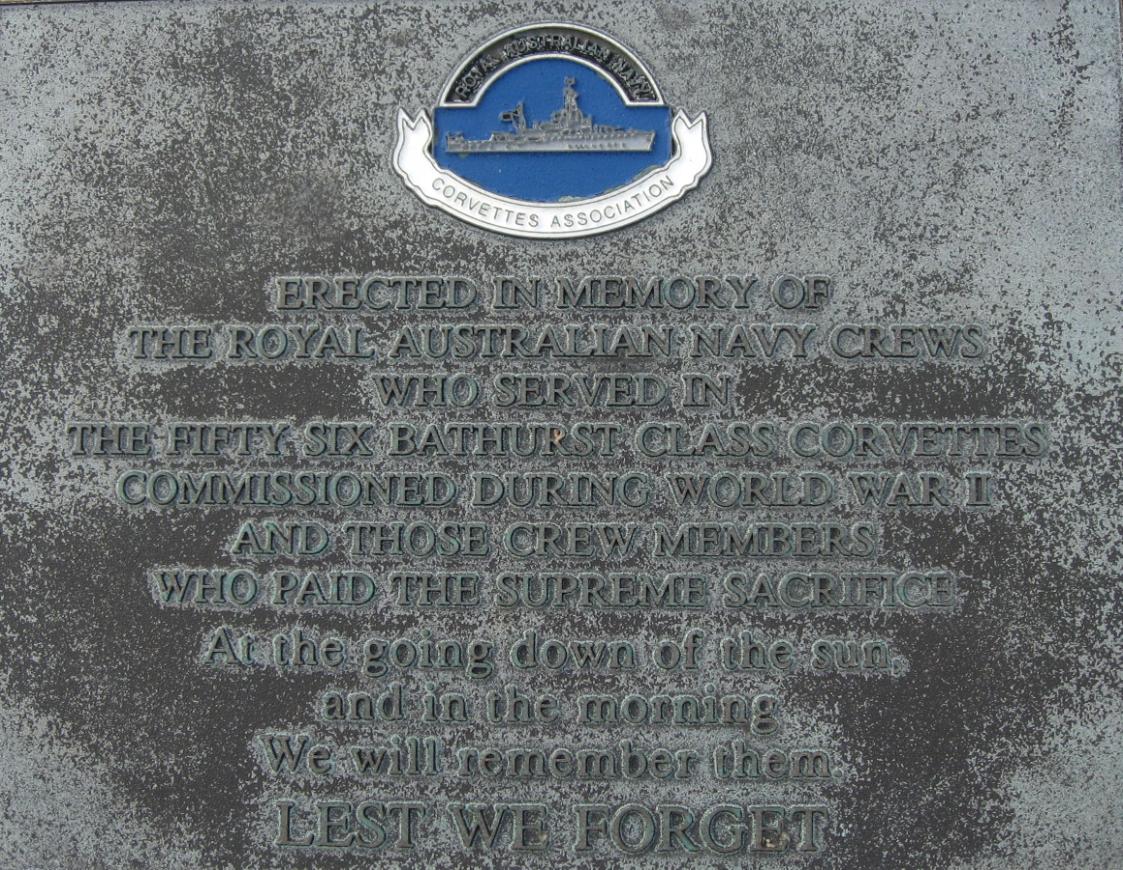
And so our land-based training continued for the first ten weeks and then it was time to go to sea. Our training ships were the HMAS Mildura and the HMAS Fremantle. I was allocated to the Fremantle which had recently been re-fitted for training purposes. That meant it was clean and free of cockroaches. Not so the Mildura which was about to be paid off. Both were Bathurst Class ships built in Australia, two of sixty built during WW1 for the principal purpose of mine sweeping and convoy escort. Their top speed was 15 knots but usually cruised at 12 knots. Their armament comprised one four inch gun mounted on the foc’sle and two Oerlikon 20mm anti-aircraft cannons. Their length was 186 feet (57 metres) with a 31 foot (9.5 metres) beam and a displacement of 650 tons. With a crew of 85 reduced I believe to about 70 to make some space for the 25 Nashos, they were to say the least very crowded. Lieutenant Commander Rance was the captain of the Fremantle, a very proper Englishman. In Naval tradition as captain of the ship he was referred to as Captain Rance. His “number one”, 1st Lieutenant (also called the “Jimmy) was an Australian lieutenant and there was a navigation officer, a sub lieutenant, a rather nice young fellow. It was the Jimmy who ran most shipboard operations. He was not an approachable fellow and the crew was wary of him. Then there were the seamen, “ordinary” and “able bodied” (known as ABs), some leading seamen, stokers and leading stokers, engine room artificers (petty officers) and chiefs (chief petty officers). There were others, radio operators referred to as “sparks” and carpenter called a “chippie”.
For me it was a whole new world. We ratings slept in hammocks on the quarterdeck mid- ship, the seamen on the port side and us stokers on the starboard side. On the quarterdeck hooks for hammocks were welded into the deckhead, quite close together fore and aft. There were not enough so we had to sling some hammocks diagonally across two parallel sling hooks. Hammocks were laced into a sausage and stowed in bins at the forward end of the quarterdeck at 0600h. Those off-watch during the day could “kip” on the longitudinal lounge running down either side of the midship quarterdeck. Some slept there at night also. The centre of the midship quarterdeck that is the port side of the starboard deck and the starboard side of the port deck had seaman’s lockers from deck to deckhead, three rows I think in which to stow our personal kit – uniforms, underwear, shoes, and personal items. From memory a locker measured about15 inches wide, 20 inches high and 30 inches deep. They were kept locked with the individual carrying the key around his neck at all times. Theft from a shipmate was a heinous crime; so was leaving one’s locker unlocked.
The two corvettes were often tied up along side each other so that on boarding one marched up the gang plank of the ship at the wharf (smartly saluting the quarterdeck on stepping on to it – that’s where Nelson’s body lay – proceeding smartly across the ship and onto a short gang plank joining the two ships, not forgetting to salute the quarterdeck of the second. The Mildura outranked the Fremantle both by virtue of it being longer in the service and the seniority of its Captain. The Mildura therefore preceded the Fremantle in steaming in and out of the harbour and was first to tie up alongside the wharf or another ship.
Day one aboard
We boarded and it was probably a day or two before we went to sea. Our land based training started to have an an application. Leading Seaman Burstow shipped with us and gradually we came to terms with this complex piece of floating machinery from the uppermost bridge to the bilges. Our ship-board dress was blue shirt, shorts and sandals, simple cross-strapped leather sandals with leather sole and of course caps which by now were developing character and beginning to look very “pusser”. Captain Rance was less than impressed by our pusser looking caps on his first inspection of our dress before going on leave and threatened to have steel plates inserted in the crown of each cap. We knew he wasn’t fair dinkum. Our first night aboard sleeping or at least attempting to in the confined space of the mid-ship quarterdeck (stoker’s side of course) was a trial. Even at dock corvettes seem to roll and ships are incredibly noisy places, at least corvettes are. Made of steel and without any form of sound proofing, someone only has to drop a spanner on the deck and it seems to reverberate through the whole ship. But it was more than that. The noise of machinery was continuous even when not under sail (or steam). All sorts of ancillary equipment hissed and groaned throughout the night and there was a certain smell to get used to.
Bells and Watches
Routine on board a naval ship is governed by bells and watches – or at least it was. Traditionally, a 24-hour day is divided into six watches of 4 hours with the 4 to 8 pm watch, the Dog Watch being split into two half watches. These are: midnight to 4 am [0000h-0400h], the Mid Watch; 4 to 8 am [0400h-0800h], Morning Watch; 8 am to noon [0800h-1200], Forenoon Watch; noon to 4 pm [1200h-1600h], Afternoon Watch; 4 to 6 pm [1600h-1800h] First Dog Watch; 6 to 8 pm [1800h-2000h], Second Dog Watch; and, 8 pm to midnight [2000h-2400h], Evening Watch. The half hours of the watch are marked by the striking the bell each half hour. Thus on a normal four hour watch of eight half hours, eight bells signifies the end of the watch. Only the Dog Watch is split into two 2 hour watches which conveniently allows everyone to have their evening meal. Why is it called a “Dog Watch”? – I never knew.3
The boiler room
On day two our shore based instructor, Leading Seaman Burstow, handed we stokers over to a leading stoker, a pleasant fellow who treated us like sons. We were told not to call him “sir” but by his first name, Bill or whatever it was. The Chief Boiler Room Artificer was of course called Chief as were all Chief Petty Officers. This was to be my introduction to the “boiler room” and the two Babcock boilers previous described and about which we learned a good deal in our class room lectures. We donned our issue navy blue boiler suits – neck to ankle to wrist overalls – beneath which one wore nothing more than a pair of jocks if that; bottoms tucked into socks into boots, with a navy blue cloth cap to cover our hair and entered the twin door air lock chamber; external door slammed shut before opening the inner door (it was not possible to open the inner door before the external door was closed). Perhaps in groups of about six we passed through to the steel near vertical steps leading down into the bowels of the corvette where the two huge (they seemed so) boilers were located. It was like a descent into hell or at least for me it became so. Why the airlock doors? The boiler room operates under an air pressure of one and a quarter atmospheres, that is, normal atmospheric pressure at the earth’s surface is 15 pounds per square inch – in the boiler room it is 19 pounds per square inch. Why? To keep the flame from the burners blowing inwards and not outward – called “blow-back” – should the air pressure be allowed to drop back to normal air pressure – so we were told. I thought that was pretty dramatic and I hesitantly asked the obvious question “what if that were to happen” and the response was “you would be cooked to a cinder”! But of course the boilers were not fired on the day of our “cold” inspection. Nevertheless, it was a sobering thought.
The boiler room was also a clutter of taps and cocks, some with the opening/closing wheel on top, others with it at the bottom, that is, upside down, or at the side, levers that directed steam or water from one pipe to another and still more serving all sorts of critical functions including air pressure within the boiler room. This latter was very important – too much air and the boiler would give off white smoke or not enough air and the smoke would be black. Either was unacceptable; either could be spotted by the enemy. The object was no visible smoke at all. A system of mirrors up a long tube to the funnel allowed the chief stoker to monitor the smoke condition. If he failed to observe the smoke condition an angry call from the bridge would draw his attention to it. We were assured that for all wheels turning clockwise was on and anti-clockwise was off but with some wheels upside down I found it hard enough to tell what was clockwise and what was anti-clockwise.
There was a certain smell in the boiler room that I only really came to identify when the ship was under way, that is “going” and my appreciation of the boiler room wasn’t to develop until then. However, that wasn’t to happen for a day or two and we were still familiarizing with the ship at dock.
shorted to 'dog watch'. An alternative etymology is that those sleeping get only 'dog sleep' in this watch. It may also be called the dog watch because it is "cur-tailed"
The reason behind this watch's existence is that in order for the crew to rotate through all the watches it was necessary to split one of the watches in half. This allowed the sailors to stand different watches instead of one team being forced to stand the mid-watch every night.
The engine room
It was the engine room with its two triple expansion reciprocating engines that fascinated me. Each comprised three cylinders, the first about 15 inches in diameter, the second 24 inches and the third 30 inches (more or less). Superheated steam from the boiler room entered the smaller cylinder giving the piston a downward thrust onto the huge exposed crank shaft then the same steam travelled from the smaller cylinder to the middle sized cylinder then after doing its job on that piston, still with plenty of oomph entered the biggest cylinder expanding and thrusting its huge piston down on the crankshaft. The massive crankshaft fully exposed sloshed around in a trough of “admiralty mix” oil. We were told that admiralty mix lubricant was a combination of vegetable and mineral oil with water (I think) which produced a thick yellow creamy brew that sloshed around the crankshaft and piston ends. Steam engines are relatively quiet. They hiss and slosh a lot but do not roar. Each triple expansion steam engine turned a screw (the Corvette has twin screws). I rapidly became a fan of these magnificent pieces of machinery and have remained so all my life.
There were other things that roared when turned on, for example the auxiliary generator. Then there was the “hunting gear” in a separate compartment aft of the engine room which you entered through a separate hatch on the after-quarter deck. The hunting gear controlled the ship’s rudder. One on either side of the ship they were driven from the two crankshafts coming off the main drive shafts somehow and did a lot of hissing and whining. The engine room was open to the sky through glass windows – a blessed relief after the claustrophobic boiler room. But I wasn’t to learn all this until we were under way.
Underway
Finally we were underway. The boilers had been fired up quite early and we steamed out of Fremantle Harbour at 8 am, HMAS Mildura in the lead, with all off-duty ratings lined up on either side of the quarter deck to be stood down once the ship cleared the harbour and North and South Moles at the harbour entrance. Once underway the system of watches became four hours on and eight or twelve hours off. Of course for we national servicemen the eight hours off was not time to settle down to a good book and a kip. We had lectures to attend and various demonstrations many of which involved the whole ship’s complement.
For the first week the two corvettes exercised off Fremantle in the stretch of water known as Gage Roads between the mainland and Rottnest Island. My first watch in the boiler room came up soon enough and with one of my fellow Nashos we passed through the air lock and descended the steps to the base level of the boiler room. I was hit first of all by the heat. The temperature was intense; probably 120degrees Fahrenheit (48 degrees Celsius), maybe hotter. My neck to ankle boiler suit was sweat soaked within half an hour. The leading stoker on duty was a pleasant fellow and told us what we were to do – in fact not a great deal. We each took up a position in front of our allocated boiler. From time to time we were required to change and clean a burner (there were three burners firing into each furnace). First the oil supply to the burner was turned off, then on its swivel mount the burner would be turned out from its firing position so that it was clear of the furnace and allowed to cool – a minute or two. A clean replacement burner could then be mounted on the swivel, connected to the fuel supply and swung back into the furnace and turned on. It would immediately fire up. At least that is how I remember it. The stoker’s job was then to scrub the burner clean in a bucket of diesel fuel or similar – altogether a rather smelly and unpleasant task where everything was almost too hot to handle.
As mentioned before, the boiler room had its own uniquely overpowering smell. Perhaps it was just the burning fuel or the deposits of oily tar that seemed to accumulate on the metal deck plates (below which were the bilges) but to me it seemed to be accentuated by the pusser coffee that was brewed in the boiler room in a not too clean metal jug with boiling or extremely hot water pulled from some part of the system and condensed milk and salt – why salt, I don’t believe I ever knew. In front of each furnace was a vertical metal tube half full of water – hot water – into which various pokers and tongs were dropped to cool them down. These were used to extract the burner from its swivel arm in the cleaning process. It seemed to be practice to tip the residual coffee into the cooling tube which must have accumulated over time to form quite a witch’s brew of tar, coffee and condensed milk. Each time a hot poker was dropped in the steamy fumes emitted added to the pungency of the boiler room’s unique smell.
So, that was the boiler room for me. To escape it and emerge on the quarterdeck and the fresh sea air was an indescribable delight. Once at sea with the rolling and pitching of the Corvette I found I could tolerate little more than an hour or two – sometimes much less – in that oppressive environment before sea sickness set in and mercifully the leading stoker would send me up onto the open deck to recover.
Inspections
The Fremantle was a very clean ship and our Jimmy intended it to stay that way. He personally inspected every nook and cranny of the ship (but not the boiler room or the engine room) every morning with the officer of the day and the Master at Arms. Special attention was given to the mess deck, seamen’s and stoker’s – we believed that he was especially picky with the stokers. The Heads (that is the latrines in land-lubber’s language) were a problem in that the white tiled deck easily marked and in the stoker’s grubby outfit and boots black marks on the white tiles could not be avoided and were hard to clean off, especially with everyone wanting to “go” after breakfast. Then someone came up with a good idea. “Brasso” was held in ample quantities on board for the intensive on-going job of polishing all the brass parts that tarnished very quickly. A wipe over of the floor tiles with Brasso made them look and smell clean. It was purely a cover- up but oddly enough we got away with it. Our Heads passed inspection but of course the first person to use them would leave dirty marks yet again.
Sea Sickness
In opting for the navy why did I ever believe that I would not be prone to sea sickness. Even as a child on the very few occasions I rode in a car I would be succumb to travel sickness. Buses also were not so good but I could manage train travel. Perhaps during my sea going period I learnt to control it to a considerable degree, at least to enable me to carry out my duties. Greasy food which the galley mostly turned out was poison to me. At sea I existed on a diet of apples and salads. Chundering over the ship’s side is great way to lose weight and I recall I dropped back to about seven stone (45 kilos). Of course I wasn’t the only nasho on board to be affected by sea sickness. Some of the seaman nashos with their open deck duties were sea sick and I even observed the occasional regular sailor heave his breakfast to the ocean which was in a sense, comforting. I didn’t enjoy being sea sick; I found it embarrassing and disappointing and I became determined to control it. But the boiler room was beyond me. I simply could not handle it. Thankfully I was to spend most of my shipboard time on engine room duties. There one could move around doing the multitude of small tasks required of an engine room attendant. The smells were cleaner. Steam, sea water, fresh air – even the coffee was agreeable. I still had to watch my diet and when under way, particularly in lumpy seas I had to find somewhere to sleep other than the hammock midships. I would take my narrow mattress and blanket to a secluded corner of the open deck and kip away. There were others who did the same and the ship’s regular company seemed to accept it.
A Ship of War
Yes – our Corvette was a “war ship”; only a small one perhaps but a war ship nevertheless. And of course, what was the purpose of National Service if it wasn’t for training young men to go to war? Our armament was light but in many respects deadly. As stated before, the principal roles of the Corvette was convoy protection and mine sweeping. At “action stations” all crew not on watch, that is driving the ship, had that second role to perform whether they were seamen, stokers or anything else (other than “chefs” in the galley). So we were all trained in mine sweeping and anti-submarine warfare for which the principal weapon was the “depth charge”. These resembled 44 gallon drums, bit smaller perhaps, that were rolled off the stern of the Corvette as the ship passed over the top of the enemy submarine. They were detonated, maybe electronically (I am not sure of that) or by water pressure when the depth charge reached a predetermined depth, hopefully in close proximity to the submarine, with one helluva bang!
We did this drill a number of times at sea off Rottnest ( I think we were operating in a proclaimed training area) and the first time I was aware of it I was in the boiler room, (it must have been a relatively calm day). It was as if the stern of the ship was lifted feet out of the water and the Chief Stoker muttered to the effect “shit – that was a bit close”! It was and there followed the clanging of bells and apparently a good deal of mayhem on the quarter deck so I was told. The 4 inch gun was manned (not by Nashos – we were but spectators to this sort of drill) for the purpose of pounding a few rounds into the submarine should it surface and while it was not Navy tradition to machine gun survivors in the water, they remained enemy until physically captured and the submarine totally disabled and on its way to the bottom of the ocean.
The mine sweeping procedure was somewhat less dramatic but more interesting. On either side of the quarter deck were two cigar shaped devices with fins sitting in cradles. I recall they were called ora-pisas after the Swedish fellow who invented the technique. At a glance one could tell they were clearly hydrodynamic. At the forward end of the quarterdeck was a large power operated spool wound with a very heavy steel hawser that appeared exceedingly rough. This was because it was “lang laid”, that is, instead of all strands being wound in the same direction like an ordinary steel rope, one strand was wound into the rope in the opposite direction. There was a reason for this. The end of the steel hawser is attached to a strong steel bracket beneath the ora-pisa which is then launched into the water with the ship traveling forward at a fair rate of knots. The hydrodynamic shape of the ora-pisa with steel rope attached then drives it away from the ship restrained only by the steel hawser – somewhat like flying a kite. Now; sea mines are large spherical objects, two to three feet in diameter bristling with detonators such that a ship hitting a mine would inevitably hit a detonator and explode the mine with dire consequences to the ship. Although the mine floats it is anchored to the sea bed by a cable with the mine a few feet below the surface. All mines (land or sea) must be capable of being disarmed because eventually at the cessation of hostilities the sea lane or passage must be re-opened to shipping. The disarming of the mine is achieved by cutting the rope that anchors it to the sea bed. As the ship travels forward with the ora-pisa ranging out to the side (either starboard or port) the connecting lang-laid steel hawser contacts the mine anchoring rope and severs it. The mine then floats harmlessly to the surface. What happens after that I really never knew. I often wondered also what would stop the mine sweeping ship from hitting a mine itself. I suspect it was a matter of good luck. Apparently one particular type of German mine could be detonated by the inherent magnetic field of a ship. This problem had been overcome by something like a power cable that was laid around the entire circumference of the ship which neutralized the ship's magnetic field.
Of course we had no mines to sweep, not even dummies if such ever existed. At one time during a minesweeping exercise we swept up a number of crab pot markers. These were large glass balls enclosed in a rope net attached by a long rope to the pot. The pots should not have been placed within the naval training zone, however, Lieutenant Commander Rance directed that they be collected and they were subsequently delivered to the appropriate authority in Fremantle – to the disappointment of some of the crew who would liked to have souvenired them.
Ship-board activities
Life at sea is not necessarily all activity. It seemed to me that most crew had considerably free time on their hands and there is a limit to the amount of time one could spend sitting around yarning. Of course we Nashos were kept occupied to some extent with training sessions and that involved at least some of the crew, but not all the time. The crew members themselves often played cards, Crown and Anchor, and Five Hundred. Another game that I saw them playing was Mah Jong, the Chinese game of chance. It was a mystery to me at the time and many of the naval terms for the various pieces and hands were somewhat ribald. I was to become a Mah Jong player myself in a later year and learned the correct terminology. Of course any sort of gambling for money was strictly forbidden and I was never sure whether there was a settling up on match sticks or notebook entries. Many simply read (my main free time activity) and one or two were involved in courses of study.
Neither do I recall crew members inviting Nashos to join in their games. We generally had a fairly easy relationship with the crew members – we had to, living together in such close confines as we were. I recall a conversation on the quarterdeck on one occasion between a couple of crew and a small group of Nashos (it was a warm sunny day given to relaxed activity). The crew members claimed that we Nashos looked down on the regular sailors because of our generally superior education. Some of our national service members were university undergraduates. In my estimation the ordinary sailors and other crew were all good blokes; many were married with wives and children in various locations around Australia – not necessarily Fremantle since most had only just arrived with the HMAS Fremantle. Nevertheless there was one of two whom I avoided. I found them rough in their manner and excessively crude in their speech and humour – given to taking a rise out of Nashos. Another discussion I recall concerned the various State newspapers, not so much the principal broadsheets but the weekly tabloids. The Perth based “Mirror” newspaper was voted the smuttiest – it specialized in divorce news, back in the days when “private eyes” with flash light camera at the ready snooped on the offending husband (always the husband) indulging his passion with a wayward lady, the photo to be used in a subsequent divorce action. Such photos often finished up in the Mirror newspaper accompanied by a salacious story. One sensational photo was of a well known and highly respected golfer taking off from a golf course hidey-hole sans trousers leaving the poor damsel to fend for herself.
Our voyages
Unlike Navy National Servicemen in the eastern states who trained at Flinders in Victoria and Nowra in NSW and whose sea going training was on the old aircraft carrier HMAS Sydney our voyages were relatively short. One of the Sydney trips took them to Japan and back – nothing like that for us West Aussies. The most memorable trip we took during that first four months training was to Shark Bay, some 700 kilometres north of Perth. Carnarvon is slightly north of Shark Bay and we all thought we might get shore leave there but this was not to be the case. We had had a pretty rough voyage up the coast running into a head sea and our little Corvette had pounded its way through. I was of course sea sick and I had plenty of company. I recall spending the night huddled up under the big gun on a lump of canvas, wet and cold. The quarter deck was awash including the midship sailor’s sleeping deck. Some of the lockers had burst open and the contents left sloshing around on the deck. We entered the calm waters of Shark Bay mid morning having been at sea all the previous day and overnight and recovery from sea sickness was rapid. We dropped anchor and spent the day cleaning ship, even the wooden planked fore-deck was holystoned by the seamen Nashos (good practice) and we stoker Nashos were involved in appropriate cleaning in both the boiler room and engine room. By mid afternoon there was a general stand-down and to our surprise out came the fishing tackle. Our sister ship the HMAS Mildura was anchored about a mile away (distances seem short at sea) and apparently they too were straight into the fishing. Was that the whole purpose of our voyage to Shark Bay?
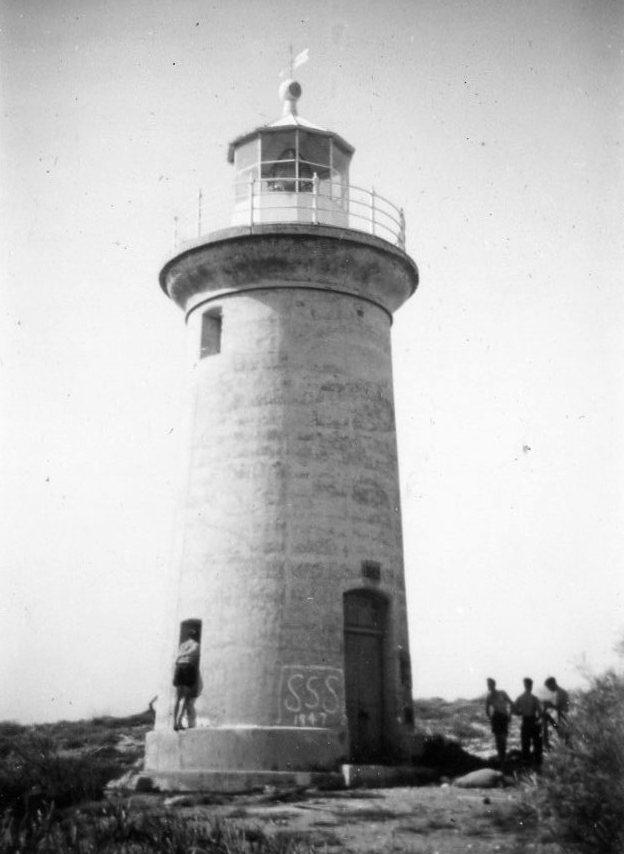
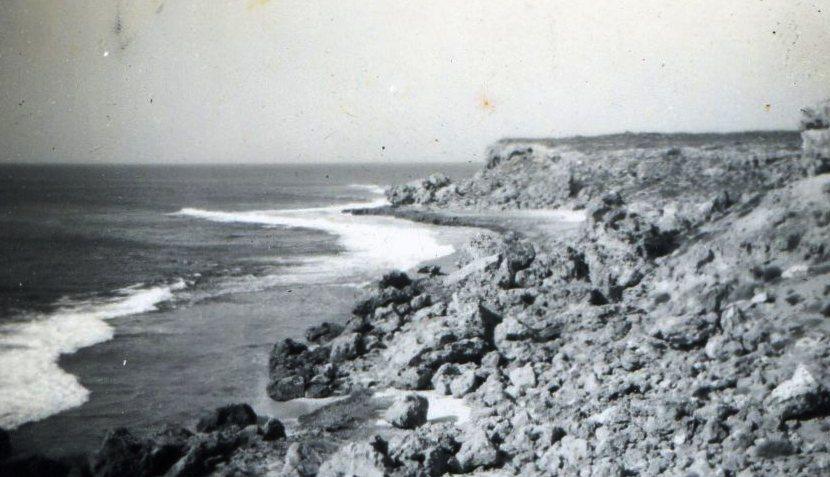
The following day we Nashos were given shore leave – not in Carnarvon – but on Dirk Hartog’s Island to stretch our legs. The crew remained on board fishing. The galley provided us with lunch packs and we went ashore in the ship’s motorised cutter. A similar procedure was followed on the Mildura and we met up on the beach on the eastern side of the Island a little south of Cape Inscription.
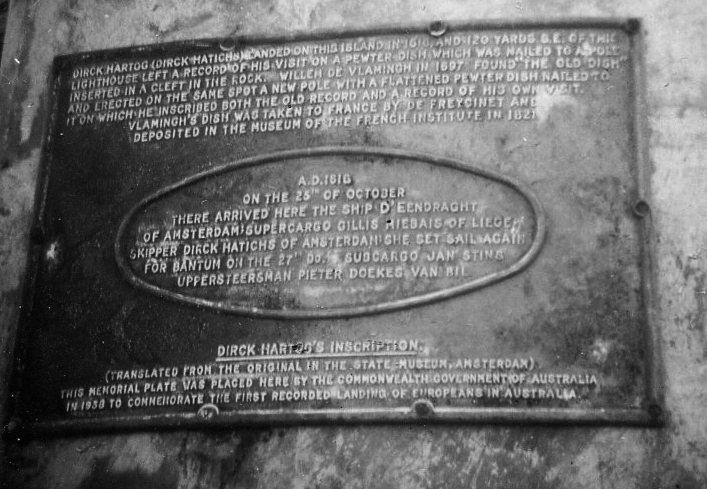
It was at Cape Inscription in the year 1616 that Captain Dirk Hartog of the Dutch trading ship ‘Eendracht’ landed and after exploring the island planted a post on which he affixed a pewter plate bearing an inscription of his voyage. The plate and post were replaced in 1697 by William de Vlamingh who re-inscribed Hartog’s previous inscription adding further detail of his own voyage. Vlamingh’s plate unfortunately resides in Holland although I think I saw a replica of it in the Fremantle Maritime Museum.
In 1953 Dirk Hartog Island was pretty nearly uninhabited, certainly the northern end, apart from the lighthouse keeper near Cape Inscription. Most of us spent the day exploring around, taking a few photos and having a plunge in the cooling waters of Shark Bay – mindful that the bay no doubt owed its name to the physical presence of sharks. Some of the blokes from the Mildura came up with the story that a group of them found a shark stranded in a large tidal pool lying on its side apparently dead. One of their number waded in and grabbed it by the tail with a view to pulling it up onto the beach. The shark was not dead and gave an almighty flick sending its attacker flat into the water. He literally flew from the pool in gigantic bounds to escape. Perhaps the shark was only a metre in length but it grew by an extra metre with each retelling of the story.
At some point of the day we ate our lunches and finally drifted back to the embarking point to return to our respective Corvettes in the late afternoon. I think we all enjoyed our sojourn on the island and were not too disappointed at not having shore leave in Carnarvon. The crew had made good use of their fishing time, some from the ship’s side and others taking the cutter out some distance from the Fremantle. The fish caught were pink snapper – by the dozens; the quarterdeck was alive with snapper. They were being gutted, washed and stowed in the ship’s freezer, not for onboard consumption but bound (I think) for the Fremantle fish market. We may have had a fish dinner that night.
The ‘Batavia’ incident. It was on the voyage back to Fremantle that our sister ship the Mildura undertook an interesting mission. We hove to in a calm water area near the Abrolhos Islands some forty miles off-shore from Geraldton. From the Fremantle we could see a good deal of activity on the quarterdeck of the Mildura and finally the cutter was lowered into the water with one of the whalers in tow. They were engaged for a few hours on the western side of one of the low lying islands out of sight of the Fremantle returning to the Mildura just before sunset. Again there was a lot of activity on the Mildura’s quarterdeck. The cutter and the whaler were hoisted back into their davits but there was more to it than that and it wasn’t until we reached Fremantle the next day that we learned what it was all about. The Mildura had set out with a special mission, that being to raise the ship’s cannon of the Dutch trading ship Batavia that was wrecked on the outer reef in the year 1629. Thereon rests a most gruesome tale of murder, rape and mayhem that is not part of this account. The Mildura was successful in the venture and the cannon now resides in the Fremantle Maritime Museum. Just how the cannon was brought to the surface and into the whaler I have no idea but I was told that the operation stoved in the thwarts of the whaler which no doubt was not appreciated by the Navy.
We weighed anchor and departed for Fremantle again. I suspect that I was not looking forward to the voyage back but the sea had calmed and the previous head sea was now a much flatter tail sea. We Nashos were not required to observe watches until the following morning.
While most of our sea going training took place in the proclaimed area off Garden Island we undertook another voyage to Busselton 300 kilometres south of Fremantle in the company of our sister ship the Mildura. This time the seas were kind to us and it was a pleasant journey in day light hours. Our Corvette anchored in the harbour some distance from the end of Busselton’s very long jetty. We did very little that I can recall. Captain Vance may have gone ashore with the Jimmy in the motorized cutter for some official reason and in the afternoon the whaler was lowered and with one or two crew and a few of the Nasho seamen rigged the sail and sailed around the harbour. The whaler is sharp at both ends and only the presence of a rudder identifies the stern. The sails were of heavy grey canvas and the mainsail is not reefed to a boom and is controlled by a sheet (rope) only through a double block. It is designed for rowing with three rowlocks down each gunwale. I was disappointed at not having the opportunity to sail – we stoker were not “seamen” enough to be invited.
Word had got around that we would round Cape Leeuwin and head for Albany but finally the next day we set sail north again to Bunbury. This time our Corvette tied up near the end of the long Bunbury jetty in the late evening. We Nashos were allowed ashore the following day and headed for the surf on the back beach – in our uniforms I recall. Nevertheless, some of us changed and ventured into the surf. I had not been to Bunbury since my very young years in Collie and found some pleasure in exploring the town with a couple of my Nasho friends. In the late afternoon we were back on board and the following morning steamed out of the harbour and headed north again to Fremantle. I seemed to be assigned to engine room duties throughout that voyage and I think it was only on the odd occasion that I served a watch in the boiler room.
Our Sister Ship HMAS Mildura
It is appropriate to say a few words about our sister ship HMAS Mildura. Throughout our sea going training on this first period of National Service Mildura and Fremantle operated in tandem. When steaming together it was somehow exhilarating to look out abeam and slightly aft to see our sister ship three or four hundred metres away on either port or starboard side. The only times I boarded the Mildura was on those occasions when we were tied up along side and I needed to cross over the Mildura to board the Fremantle. Even a casual inspection showed that the old vessel was due either for refit or decommissioning and of course, it was the latter that was to happen in September of that same year. Its current commitment to our national service intake was the last it would have. The Captain of the Mildura was Lieutenant Commander Bromell, a fairly robust officer and very different to Lieutenant Commander Rance.
Other ships
From time to time other ships of the Royal Australian Navy, and in one instance, the Royal Navy visited Fremantle, generally en-route to the eastern states. The opportunity would be taken to have the current crop of Nashos board and inspect the visiting ship. The aircraft carrier HMAS (previously HMS) Vengeance came into Fremantle harbour in about May 1953. The Vengeance had been acquired from the Royal Navy and this may have been its maiden voyage to Australia. With a displacement of 18,000 tons it was at the time one of the largest war ships to dock in Fremantle harbour. For us stokers the point of interest was of course its massive (to us) steam turbine engines and we were given access to the engine room with its complexity of platforms, catwalks and ladders. We may have ventured into the boiler room but I have no particular recollection of that.
In considerable contrast was the Royal Navy submarine HMS Thorough. In small groups we were taken into the submarine and poked our way through its narrow companion ways and compartments. I am not sure of the submarine’s intended fate or what its purpose was in Australian waters. It was restricted to surface travel, that is, it could not dive. My lasting impression of it was its incredibly cramped space and the pervasive smell of sweat, oil and fuel. The submarine in surface travel is powered by twin diesel engines which not only drive the submarine’s screws but also charge the batteries that drive the twin electric motors when submerged.
The HMS Thorough had an impressive war record, responsible for the sinking of a large number of enemy (German) ships in the Mediterranean and later Japanese in the Pacific. I suspected life on such a small craft, the hull of which is near completely submerged even when under way on the surface, would be unpleasant indeed. Nevertheless, sub-mariners are a proud lot and are accorded a deal of veneration in navies the world over.
We exercised with Thorough off Garden Island and since it was restricted to surface travel the best that could be devised for training was an armed boarding. I suppose there may have been an element of realism in that a submarine brought to the surface by a depth charge could fly the flag of surrender and would then have to be boarded and the crew captured. It all seemed a little unlikely to me. However, a boarding party was organized on both the Fremantle and the Mildura and they each proceeded by cutter to the Thorough. What happened after that I never knew but after half an hour or so the cutters left the Thorough and returned to their respective Corvettes. End of exercise!
Stokers allowed being Seamen
At some point of our sea going training we Nasho stokers were permitted to enter the realms of seamanship. Of course those mundane tasks of chipping rust patches with chipping hammers and coating the affected areas with yellow chromate paint (red-lead had gone out with the ark so I was told), or holystoning the wooden planked forward deck were always available for idle stokers to perform but the holy grail of seamanship tasks was to be on the bridge. I don’t recall the Nasho seaman being required to reciprocate in the boiler room hell hole nor the engine room – they would not have known what to do! It was entirely different up on the bridge. The officers were pleasant and especially Captain Rance, even the Jimmy seemed quite approachable. So what did we do on the Bridge? There was the excessively arduous task of port and starboard look-outs – that involved nothing at all. A little more active task was to be assigned to the telegraphs, port and starboard that gave direction from the Bridge to the engine room “full ahead”, half ahead”, “full astern” etcetera – on command of the Captain. On one occasion I was assigned to “The Wheel”, that is, steer the ship. That was awesome! The Corvettes had a rather old fashioned looking wheel, quite large diameter, maybe three feet with spokes sticking out radially about a foot apart on its circumference. It was of varnished timber rich brown in colour with highly polished brass bits. Polishing the brass on the bridge was a seaman’s job. Of course while I was on the wheel a leading seaman stood behind me coaxing me through the movements when changing course a few degrees. In front of the wheel was the binnacle, also in highly polished brass containing the gyroscopic compass. The trick was not to watch the compass needle too much but to watch the forward mast against the horizon to maintain a steady direction. If one’s mind wandered a bit so did the course of the ship. If one was relaxing on the quarterdeck gazing aft at the wake, one could tell if a nasho was on the wheel because the wake would tend to zig-zag a bit. Relaxing stokers (assigned crew, not nashos) could well come out with a ribald comment or two. In the engine room one would hear the “hunting gear” constantly wheezing and groaning as the course corrections were applied to the wheel and the big rudder adjusted slightly port or starboard.
All in all, those last few weeks of sea going training were very pleasant. I had by then gained my “sea legs” to some extent, watched my diet – I seemed to exist well enough on apples that were always plentiful, lettuce and tomatoes; some bread maybe. I loved my sailor’s uniform and in going ashore in full rig I felt quite proud. I think the other nashos did also even if they would not admit it.
On returning to Fremantle harbour at the end of a day’s activity off Rottnest Island or in Gage Roads we were rarely if ever able to tie up in a wharf berth. Fremantle was a busy port, I was to learn how busy and why during my second stint of Nasho in 1954. So we more often than not tied up alongside a merchant ship and I especially recall the “Blue Funnel Line” always crewed by Lasars from some part of India with British Mates (officers in merchant navy terminology).
Our sea going training came to an end in about June and we had a week or two to fill in at Leeuwin before returning to civvy street again until our next call-up. In that final fortnight we had written examinations that were taken lightly by most. I did a little study, it was my nature to do so and in any case I found the content interesting. Sitting on two consecutive mornings the papers were easy enough although some did not think so. I think everyone passed and I had the distinction of topping the results with well over 80%. I was mildly embarrassed thinking that I would get a ribbing but that was not the case; I was soundly congratulated by all my ship-mates and instructors – heady stuff! From that moment I was no longer Recruit Stoker Skitch but Stoker Skitch.
Coral Sea Week
I am not completely clear whether the event I describe below took place during my first period of National Service in 1953 or the second period in 1954, however, the details of the event remain firmly in my mind.
It was during Coral Sea week that our fifty National Servicemen with regular sailors from Leeuwin and our two Corvettes marched through Perth, for all of us a very proud occasion. We were taken by bus from Leeuwin to our forming up area in Mount Street and then to the music of the Western Command Band we marched down St Georges Terrace to Adelaide Terrace. Of course in the days preceding we practiced the march quite thoroughly along a winding road a little east of Leeuwin. Having not long before been at sea and not having regained our “land legs” our legs wouldn’t always behave as we would have wished and keeping in step was a little difficult. Our march commander was Lieutenant Rourke who pulled us into line and on the morning of the march inspected our uniform in detail. Of course we were in our best kit with caps freshly whitened, white web belt and white naval gaiters (almost leggings), our “bell bottomed” trouser legs neatly bloused over the top of the gaiter, white slings on our .303 rifles, bayonets fixed and all brass highly polished. We were an impressive lot. The Western Command Band (Army) was well versed in naval music and gave a splendid naval rendition of “Anchors Aweigh” and “Hearts of Oak” (steady boys, steady) and one or two other traditional naval marches. Our hearts swelled – at least mine did! We passed the saluting dais and gave a smart eyes left (I think Lieutenant Commander Hodge was on the dais with other ranking officers from the Royal Australian Navy and the United States Navy. Some of us slipped step at that instant but quickly regained it. Our march commander Lieutenant Rourke leading us with his naval sword (the first I had ever seen) extended in front of him. In Adelaide Terrace just past Government Gardens we were halted and fell out, back into the bus and return to Leeuwin.
The following description of the Battle of the Coral Sea is by Robert Lewis and is accessible on internet.
The Battle of the Coral Sea was a series of naval engagements off the north-east coast of Australia between 4 and 8 May 1942. It was fought by Allied (United States and Australian) and Japanese aircraft against four different major groups of warships. Some of the aircraft involved were land-based, but most were from the opposing aircraft carriers.
It was the first aircraft carrier battle ever fought, and the first naval battle in which the opposing forces of surface ships at no stage sighted or fired at each other. All attacks were carried out by aeroplanes. It is also the largest naval battle that has ever been fought off Australia’s shores. The battle was significant for two main reasons:
it was the first time in World War 2 that the Japanese experienced failure in a major operation; and the battle stopped the Japanese sea-borne invasion of Port Moresby.
And we come to an end
The next few days were very relaxed. We had completed the prescribed 124 days of training and on the 15th May we were issued with our civvies once again and the buses took us to Perth from where we returned to “normal” life. And that brought to an end our first four month period of recruit naval training.
THE SECOND PERIOD - 1954
This took place in 1954 and I must confess to some difficulty in separating the events of 1953 from those of 1954. During the intervening period the Government had reduced the second national service commitment from two months to six weeks and a year later I think it was reduced even further. At the time of my first call-up we were to have completed the prescribed six months in two of three week bites per year for the following three years and consolidating that into a single six week period seemed to be good sense. Of course we continued a commitment in the Naval Reserve for at least three years during which time we could be called into full time service at short notice.
As I recall it the second period of full time training was mainly ship based, on the HMAS Fremantle. I think we probably spent a week at Leeuwin initially doing some refresher training but I recall it being a fairly relaxed time. Lieutenant Commander Hodge was still the Commanding Officer and our morning divisions were a more relaxed event. Our instructor was this time a petty officer whom we knew in a very different role on the initial recruit training. Then he had a more disciplinary role and this time he seemed much more human. I have long forgotten his name so I will give him one – Smith will do, Petty Officer Smith! He was a seaman and from him I learnt some more seamanship skills. We had the occasional lecture on stoker matters from a very aged petty officer stoker. All went very comfortably – we were no longer recruits. Of course with only one minesweeper now available, the HMAS Mildura had long left for decommissioning in the eastern states there could be only twenty five of us this time and I was pleased to find that they seemed to be all the fellows I got on with quite well on the previous time.
In the second week we boarded the Fremantle and even the “Jimmy” seemed to have lost his acerbity and welcomed us aboard in a friendly manner with the skipper, Captain Rance looking down in a fatherly fashion. It all looked very promising and that was the way it turned out to be.
In the short time we had on board the Fremantle we exercised in Gage Roads and beyond Rottnest Island and did two trips, the first south to Bunbury and the second north to Geraldton. In both instances the weather was kind, little more than low swells that the Corvette handled easily. Again I watched my diet and my watch schedule was largely confined to the engine room, but also some seaman duties, on the bridge occasionally; on one occasion coming into Fremantle Harbour – as a lookout probably. Nevertheless it was fascinating to see the procedure for berthing. I recall a comment from an officer of the cargo ship along side of which we were tying up, to the effect “grab a look of the mob they have on the bridge” and a response “ah they are just trainees”.
South to Bunbury
Our first trip to Bunbury was overnight and we berthed at the end of Bunbury’s long jetty (not as long as Busselton jetty). Whether by pre-arrangement or coincidence my mother and stepfather were on the jetty to welcome me when I finally stepped ashore. The afternoon had been declared open to the public and no doubt they had become aware of that. I recall my mother being astonished at how small the Fremantle was and indeed it did seem so with the quarterdeck several feet below the level of the quite high jetty. More than likely there would have been a small freighter tied up on the opposite side of the jetty since Bunbury was an exporting port. My recollection is a little vague as to what took place following this. I think I may have taken them aboard for an inspection that was limited to the open deck space and following this we may have picnicked on the foreshore. In the afternoon I caught up with my mates and we finished up on the Bunbury “back beach”, not for a surf – we were all in our number one uniform and I notice in the photo of this occasion (taken with my “Brownie” box camera) some were wearing their berets. Bunbury was a pretty quiet town at night and only the pubs and the occasional greasy restaurant were open. As Nashos under twenty one and conspicuously in uniform we had no access to the pubs and I suspect after a feed of fish and chips we probably returned to the Fremantle and lounged around the quarter deck for an hour or two before slinging our hammocks.
We steamed out of Bunbury Harbour the following day and returned to Fremantle and resumed exercises off Rottnest Island. On some days we would take on a group of Navy reservists, not ex-Nashos, for a day of exercises, usually dropping a depth charge or two and minesweeping with the Ora-Pisas out. Of course we Nashos in our second training period and no longer “recruits” were “old salts” by comparison. We went about our normal duties, boiler room and engine room with small groups of two or three reservists venturing down the ladders to experience simply being there. Thankfully calm weather prevailed and I remained unaffected by sea sickness – it would have been ignominious to be seen throwing up in front of these reservists. I recall that amongst one bunch was a fellow from my place of civilian employment, a clerk I think, older than me who fell victim to sea sickness even in the prevailing calm waters of the day. Perhaps a chop had arisen from the afternoon sea-breeze (the “Fremantle Doctor”) but “chops” were of little concern to us “old salts” and I was able to benignly sympathise with my erstwhile work colleague.
Each night in Fremantle we remained on board. I think one could request liberty for a good reason but few did. We generally filled in time yarning on the quarterdeck. If the boilers were not shut down completely then there remained a need for a watch in the boiler room but I do not recall being so detailed. It was towards the end of our sea-going that we set out on our second voyage up the coast to Geraldton. I had not been to Geraldton before and was looking forward to the experience.
North to Geraldton – and a broken voice
The voyage was easy and I do not recall problems with sea sickness – I had it under control. We left Fremantle in the very early morning and arrived at Geraldton in the evening and anchored in the outer harbour. The following morning with anchor’s aweigh we steamed into a harbour tying up at the wharf. We were surrounded by fishing boats off-loading their catch of Dongara Crays. Dongara is a small community south of Geraldton and the crays (small lobsters) are a major industry. Geraldton was (and is) also a wheat exporting port. Soon after docking we Nashos were granted shore leave, an occasion that proved to be a significant one for me. I do not recall very much of the day other than we wandered about the very interesting old town, more or less filling in time. At some point of the late afternoon we found ourselves breasting the bar of a pub that didn’t seem to mind that we were Nashos and of course we assured them that we were all twenty one. I had a lot to learn on holding one’s liquor. I think the only time I had had a single glass of beer might have been when with a small group of Nashos I was invited to the married quarter of Leading Seaman Burstow at the end of our first training period. So…. I breasted the bar and socked back more than a few schooners and I seem to recall taking bottles to a park with fish and chips and continuing on and then suddenly being hit with the urgent need to chunder. And I chundered and chundered and I even recall a couple of my mates holding me up – and out and still I chundered to the point where my voice became a croak. Somehow we got back to the ship and into my hammock, or maybe some concealed corner of the foredeck. The next day was a “make and mend day” and we stayed on board doing small chores and during that time I recovered. My voice continued to croak and by the time we got back to Fremantle my voice had broken.
I think it might have been on that occasion that we “weighed anchor” manually. The Jimmy undertook this little operation and with a few of the crew rigged up a block and tackle hooked in to the massive anchor chain at water level leaving a long lead rope down one side of the deck below the bridge. Twenty or so off duty Nashos (I was one) were then arrayed along the lead rope (as for a tug of war) and on the order ‘pick up rope’ we did and then on the order ‘pull’ we pulled – and pulled and pulled. Eventually we could feel the anchor free from the bottom and lift. Of course it could only lift the distance from water level to the edge of the deck, then it had to be locked and the tackle played out to water level again and the process repeated – and repeated – several times until the Jimmy, peering over the ships side called our ‘Anchor’s aweigh’ at which point the call was repeated by Captain Rance observing the procedure from the side of the bridge and the ship started moving forward slowly. Soon we were under way, back to Fremantle.
Mates
And who were my mates? I can picture them all well enough and only my old photo album allows me to recall their names. There was Keith Potter, Doug Leicester, Johnny Warburton, Ron Witcombe, Nev Parker, Bob Rand, Vic Kelly, Barry Oldham, Ray Young, Brian Haigh, Mike Foster, Greg Caldwell, Chas Hannaby, and Bryce Hanley – all stokers. My close mates were Keith Potter, (a big bloke from the country somewhere); Johnny Warburton (who had had naval cadet service and was very “pusser”); Vic Kelly (who always watched out for me); Nev Parker (who had his mouth “cleared”) and one other whose name eludes me but he came from Collie and knew me at school and who earned in Nasho the nickname of “Freddo”. It may have been after Nasho that a few of us met in Perth at a pub and Freddo told me that back in school days he thought I was a bit of a wimp but now that he knew me in Nasho he thought I was a pretty good bloke! Such praise!
Back to Leeuwin
We left the HMAS Fremantle finally and at least on my part feeling something of a loss – perhaps others too! There were only a few days left to see out our commitment to National Service. No more lectures or lessons we were all assigned to jobs around the base. I think some may even have found themselves with pots of white paint giving the white painted stones bordering gardens and the roads and paths another coat. The Navy had a penchant for white painted stones! I landed what must have looked like the plum job in the office chart room where I learnt something I had not previously known. The Port of Fremantle is (or was) a major “bunkering” port; that is, a port where vessels after their long voyage across the Indian Ocean bunker up and take on fuel oil. Beneath the ground in Fremantle there are (or were) huge tanks that contain ship’s fuel oil. Why beneath the ground? I can only assume that it was a WW1 measure – less obvious in the event of enemy attack. Furthermore it was the Navy, the Royal Australian Navy, that controlled the supply of oil to ships. On a particularly broad intersection in an out-of-the-way place on high ground overlooking the harbour, in fact an intersection that carried little traffic, there were a number of steel manhole covers, maybe six, maybe ten. Quite what the manholes covered I never really knew but they certainly had something to do with bunkering and fuel pipelines. I was given the task of carrying out a small survey and thence produce a scale diagram of where each “manhole” was in relation to each other and the road kerbs. What a job! I was doing it under the gaze of chief petty officers and even Lieutenant Commander Hodge cast his sharp eye over what I was doing. I was assigned a petty officer (who drove one of the few motor vehicles at Leeuwin) to assist in measuring up the manholes, identifying each one by whatever was inscribed on the cover, measuring each of the kerbs etcetera; I recall taking many taped measurements because I had no theodolite with which to turn angles. Taking all this back to Leeuwin I was provided with a draughting board and a few draughting instruments and a sheet of cartridge paper. Over the next day or two I draughted it up into a credible looking plan with street names and symbols such as I had become familiar with on railway plans, finally inking it in with black Indian ink. Job done, it was well received.
Through the fence
The previously mentioned high chain wire fence had a number of escape holes in it which even if the higher command of the base knew about the holes they remained open. Most were concealed from view by assorted low shrubs, however, we nashos knew where they were and occasionally one or two would use them at night for a few hours unofficial leave (“adrift” in naval lingo) making sure that they were well and truly back and snuggled up in their hammock before the “wakey wakey hit the deck” call soon after first light. To my knowledge no one was ever caught out. With that in mind I made my own escape on a Saturday night to attend the wedding reception of Peter Tournay, a work colleague with whom I usually traveled to work each day. Although not a formal invitation he had suggested I might attend the reception if I could get a leave pass from Leeuwin. For some reason Leeuwin was a closed camp that weekend perhaps because we had only a couple of weeks to go to complete our national service obligation.
In an act of bravado (for me) I decided to use the hole in the fence to attend the wedding reception (the service was not possible because my escape would have been in broad daylight – far too risky) and in my best number one uniform just after dark I made my escape. It probably took me an hour or two to reach the reception in Victoria Park, having to walk briskly from the street at the back of Leeuwin to the nearest bus stop and then a bus into Fremantle, another to Perth and another to Victoria Park and the reception location. I made it, to the surprise of many at the reception who were mostly work colleagues and of course in naval uniform I was fairly obvious. Arriving just after dinner I was welcomed by Peter and his new wife and stayed during the dancing that followed dinner, the throwing of the garter and the line up of guests farewelling the married couple on their honeymoon departure. I left soon after and made my way back to Leeuwin and the hole in the fence. Although I was able to get the bus from Perth to Fremantle the shorter bus run from Fremantle to the vicinity of Leeuwin ceased at midnight and I had a longish walk from the traffic bridge back to the street behind the base (a street full of navy married quarters) and finally the hole in the fence. I quickly folded my number one uniform and poked it back into my locker. My hammock had been slung for me by my mates and stuffed with pillows and an extra mattress to make it look occupied. I removed these, stowed them away in the hammock bin and climbed into my hammock and slept fitfully till dawn and the call to hit the deck. I had got away with my one and only escape escapade.
Naval justice
Our final few days were quite idle but then an incident occurred that caused me some alarm. A friend from my Collie childhood appeared in uniform having arrived by air from Sydney. It was Geoff Fogarty with whom I had shared many a childhood adventure. It seems that Geoff had been in the National Service intake in the six months after my own. He had returned from weekend leave somewhat inebriated and he had fallen asleep on top of the lockers. A spot inspection by the duty officer (no doubt looking for something to do), a Sub-lieutenant, had occurred and Geoff was ordered to stand up. He slid himself off the lockers and whether as a result of his inebriation or simply standing up from having been horizontal in a drunken sleep he stumbled and fell against the duty officer (dressed in his evening wardroom kit of black trousers, white shirt with rank insignia on his shoulder epaulettes and black cummerbund). He was immediately charged with striking an officer and found guilty (presumably in a court martial) and awarded detention for forty days followed by a dishonorable discharge. As was the practice at that time the maximum period of detention could only be served at the Military Detention Centre at Holsworthy, New South Wales. He was taken there by air with an escort of two leading seamen and served his time.
The story I have recounted was given to me by Geoff and corroborated by others who had arrived at Leeuwin for their second period of training. I was confounded by the story. It was after all only seven or eight years since Geoff and I had ridden our bikes together, caught gilgies in the local creeks together, swam in pools together and picked boronia in the swamps around Collie. We were look-alikes, same build, fair hair to the extent that we were sometimes mistaken for brothers. It seemed impossible that he would in any circumstance have assaulted an officer or anyone else for that matter. The resulting punishment was (and remains) in my mind grossly inappropriate. I can easily picture the situation, an up-jumped sub-lieutenant in his fancy wardroom dinner dress deciding to do an unannounced inspection of the Nasho sleeping deck at 9.00pm as the liberty men were arriving back from a weekend leave. Perhaps Geoff was administratively discharged without the ignominy of a dishonorable discharge. The latter remains as a stain on one’s career for the rest of life. I believe that offences and punishments incurred during national service training were expunged from the record but I am not certain of that. Against that one would wonder at the sheer cost of the resulting action; the cost of three return air fares at the time when air travel was a very expensive undertaking and Geoff’s detention (imprisonment) in a military prison that had a reputation for harshness. I was left wondering at what constituted justice in the Navy.
During the few days Geoff spent at Leeuwin he was required to report to the duty room several times each day but finally he was released to return to Collie. I believe he was given a rail pass but beyond that he was stony broke. I offered him a pound and after some persuasion he took it. A week or two later I received a letter from him with a one pound postal note enclosed. I may have replied but it was the last contact I had with my friend Geoff Fogarty.
It comes to an end
Our last day finally arrived. We paraded on the drill ground and Lieutenant Commander Hodge wished us all farewell and good fortune in our respective careers. We were not actually discharged from the Navy but transferred to the inactive Naval Reserve without any attendance obligation but simply the requirement to advise changes of address. We were required to keep our uniforms in the event of being called up. More informally afterwards many of our instructors mingled with us shaking hands and wishing us good luck. The liberty bus took us into Fremantle and I trained back to Perth thence bus to my new home at Belmont.
Where does the story end; not quite at this point. I had been through an experience that was to last in my memory through to this present day; even through twentysix years in the Australian Army. On leaving HMAS Leeuwin in about July 1954 I felt a certain hollowness. I missed the camaraderie and somehow the disciplined structure of the Navy although I had come to realise that the Navy did not offer a career prospect for me. My railway career was showing some promise in that as a junior I found myself in the sole role of construction surveyor on the new railway track from Fremantle to the new Kwinana oil refinery and the BHP steel rolling mill, a situation brought about by a dire shortage of more qualified personnel. The Railways had granted me the status of a final year cadet engineer with a pay increase, a somewhat more exalted position from that of “junior draughtsman”. Nevertheless, I could not see much job interest beyond the completion of that task. Towards the end of 1954 I spotted a “position” in the Commonwealth Vacancies of the West Australian newspaper for topographical surveyors with the Australian Army, offering a ten month full time intensive course in the skill. That sounded sufficiently adventurous to be of interest and I applied. If joining the Army was an obstacle it wasn’t to be for long. But before I could do so and on the understanding that I was joining the Army I had to seek discharge from the Naval Reserve and return my uniforms. This entailed a return to HMAS Leeuwin where in the administrative building I was greeted with surprising friendliness. I was taken into the office of the great man himself, Lieutenant Commander Hodge, who invited me to be seated in a comfortable chair and we chatted. I told him of my interest in surveying and that I was being Corps enlisted into the Royal Australian Survey Corps whereupon he said ‘You should have been a seaman not a stoker’ and I should have applied for a change of mustering at the commencement of my training. He went on to express his regard for the Survey Corps, members of which he had come to know some years before at Woomera on the Long Range Weapons project. I thanked him and we shook hands – not a bad bloke after all. But I was on my way. Another life was in the offing; the Navy was to fade into a distant memory – well, distant perhaps but not entirely forgotten.
PHOTO PLATES
PLATE 1
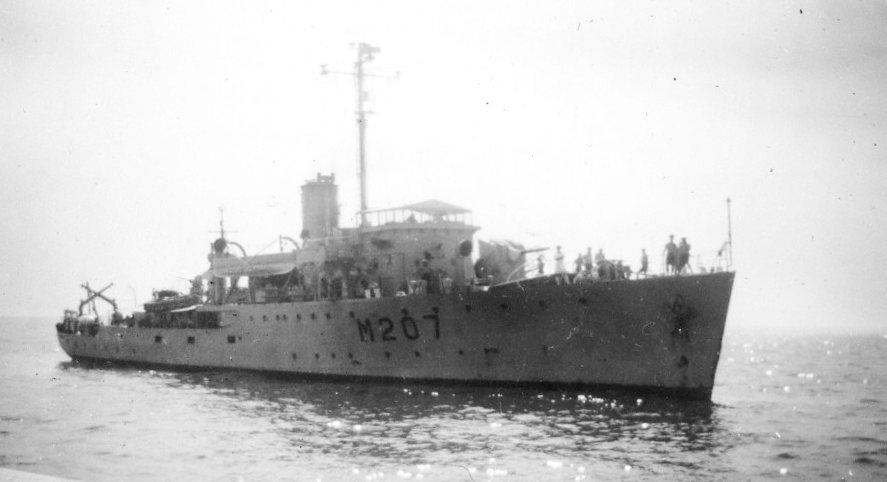
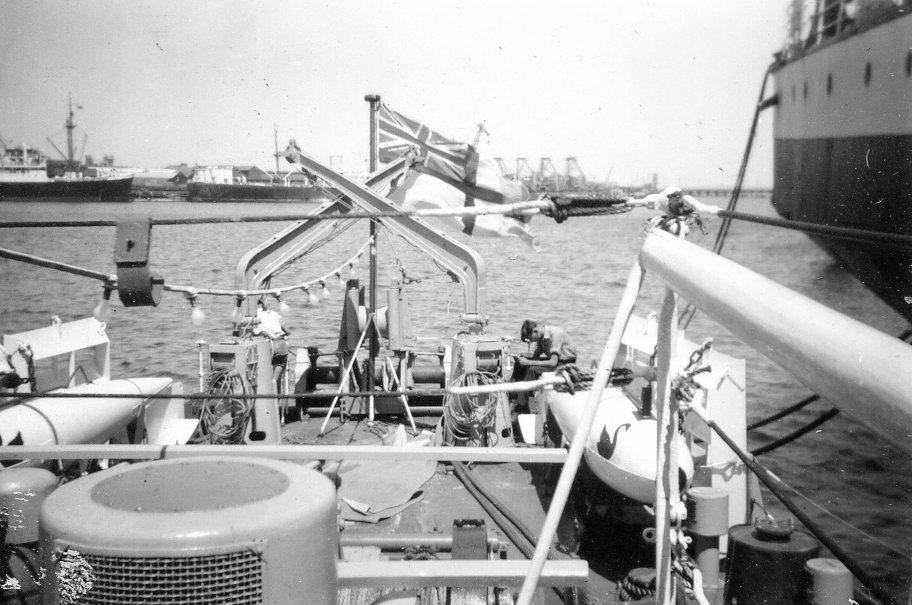
PLATE 2
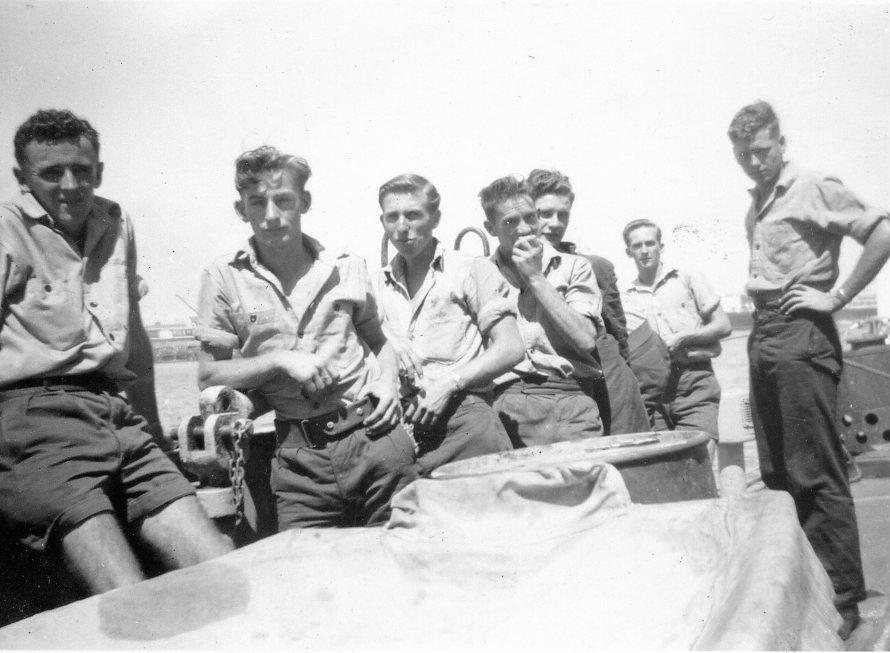
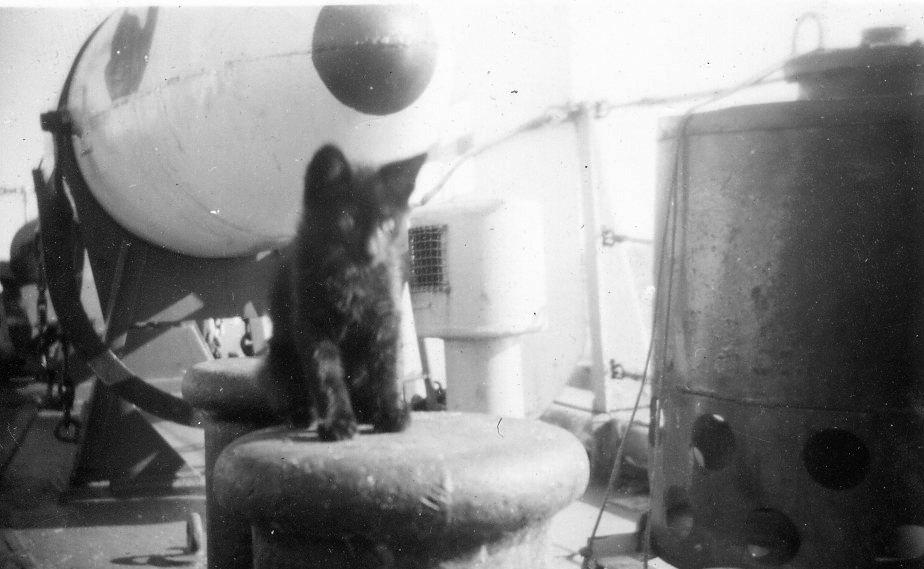
PLATE 3
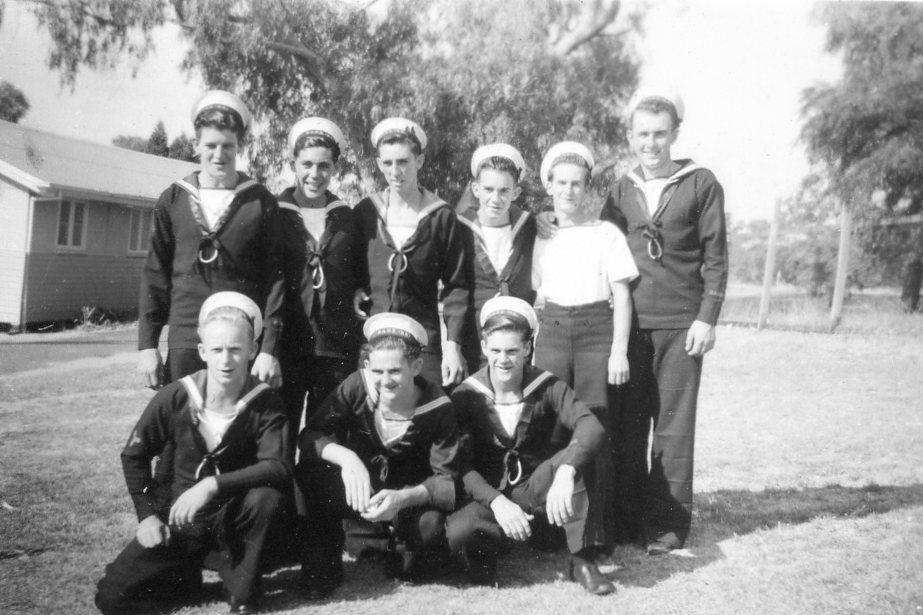
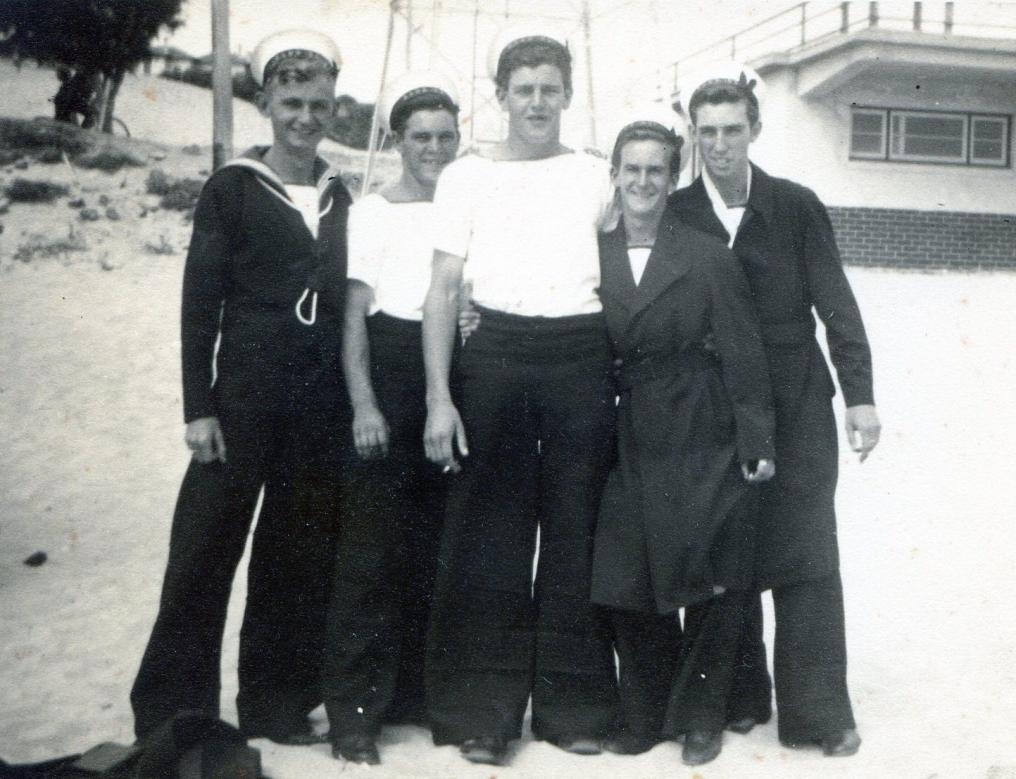
PLATE 4
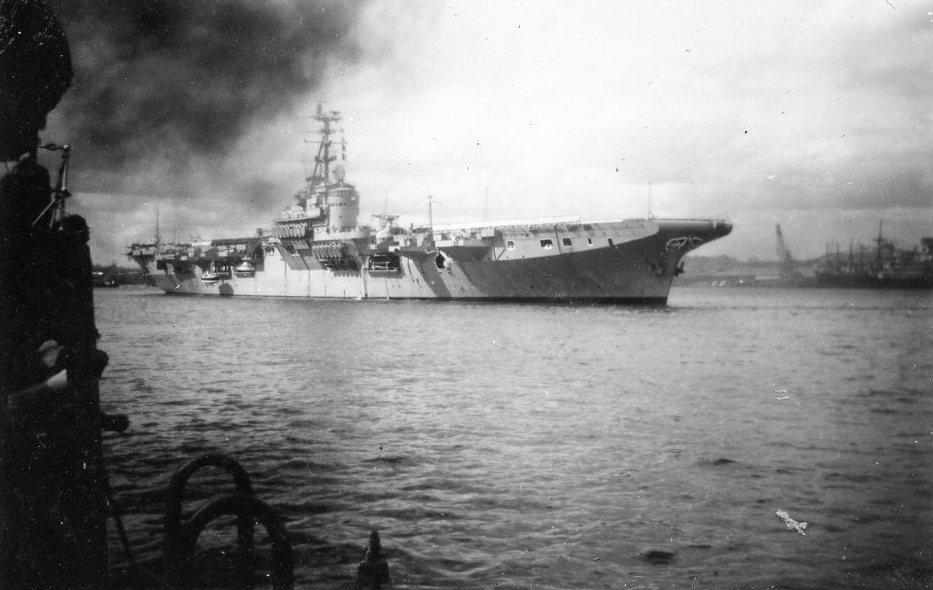
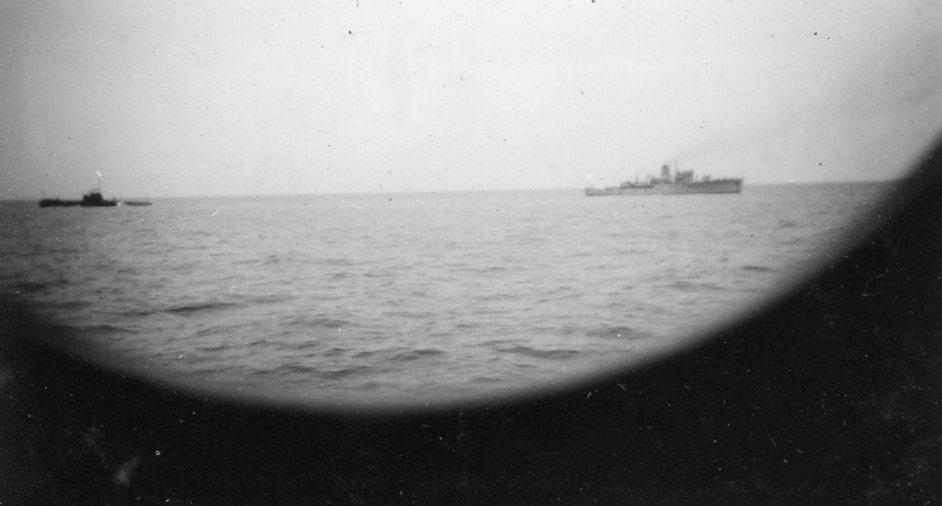
PLATE 5
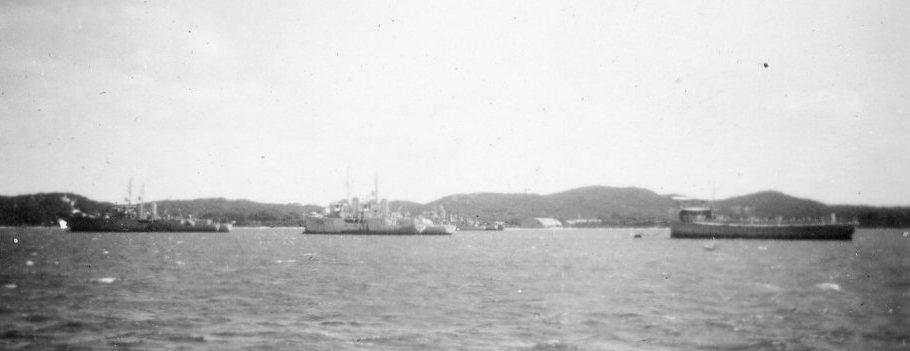
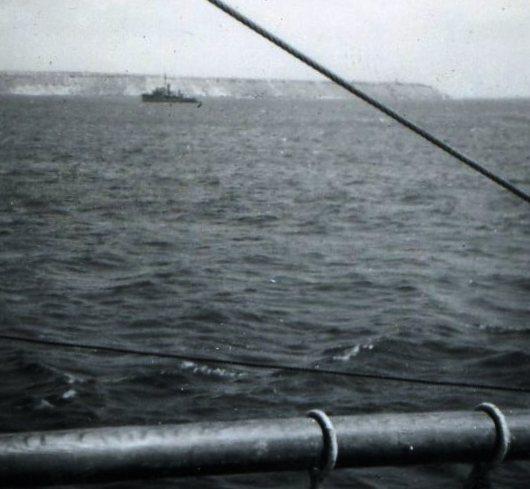
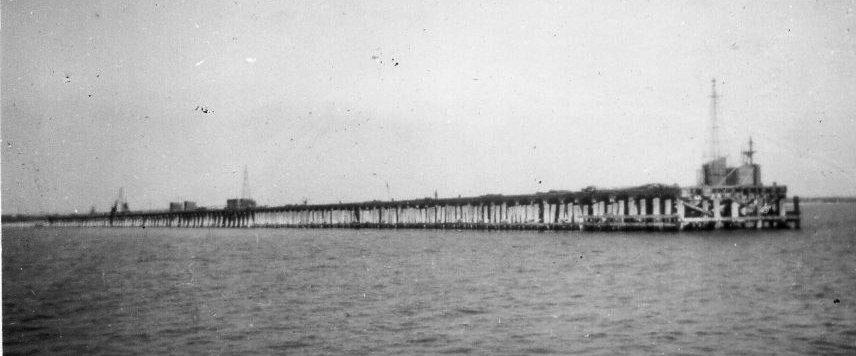
PLATE 6